Section 3.6 Application of Derivative

In this section we will discuss about the applications of derivative in various fields. We will discuss about the following topics -
  1. Rate measurement.
  2. Approximatation and error analysis.
  3. Tangent and Normal to the curve at a point.
  4. Rolle’s Theorem
  5. Mean Value Theorem.
  6. Maxima and Minima on curve.
Why Do We Use Derivatives Derivatives measure the instantaneous rate of change of one quantity with respect to another. Instead of asking "how much did something change overall?", a derivative asks "how fast is it changing right now?" This makes it indispensable in physics, engineering, and any field where things change continuously.
Use in Non-Constant Acceleration Motion In uniform motion, simple formulas like \(v = d/t\) work fine. But when acceleration varies with time, those formulas break down and this is where derivatives become essential. Given position as a function of time, \(x(t)\text{:}\)
  • First derivative gives instantaneous velocity: \(v(t) = dx/dt\)
  • Second derivative gives instantaneous acceleration: \(a(t) = dv/dt = dΒ²x/dtΒ²\)
Example: Suppose a particle’s position is: \(x(t) = 3t^3 - 5t^2 + 2t\) Then:
  • \(v(t) = 9t^2 - 10t + 2\, \rightarrow \,\) velocity changes at every instant
  • \(a(t) = 18t - 10 \, \rightarrow \, \) acceleration itself is changing with time
No single constant formula could describe this motion only derivatives can capture the behavior at each specific moment.
In Short: Derivatives allow us to analyze motion precisely at any instant, making them the fundamental mathematical tool for describing real-world motion where forces and therefore accelerations are rarely constant.
Derivatives in Mathematics & Finance Mathematical Examples of Derivatives
 1 
sklkarn.github.io/Lab_anim/derivatives_animation.html
  1. Power Functions: \(f(x) = x^4 - 3x^2 + 7\)
    • \(f'(x) = 4x^3 - 6x \, \rightarrow \) slope of the curve at any point
    • \(f''(x) = 12x^2 - 6 \, \rightarrow \) rate of change of slope (concavity).
  2. Trigonometric Functions: \(f(t) = sin(t)\)
    • \(f'(t) = cos(t) \, \rightarrow \) used in wave motion, oscillations, AC circuits
    • At \(t = 0\text{,}\) the rate of change is 1 (maximum rate).
  3. Exponential Growth/Decay: \(f(t) = e^{kt}\)
    • \(f'(t) = k e^{kt} \, \rightarrow \) the function grows proportionally to itself
    • Used in population growth, radioactive decay, and compound interest.
  4. Finding Maxima & Minima: \(f(x) = -x^2 + 8x - 5\)
    • Setting \(f'(x) = 0\text{:}\) \(-2x + 8 = 0 \Rightarrow x = 4\) is the maximum point
    • Used in optimization problems: maximizing profit, minimizing cost.
Derivatives in Finance In finance, derivatives serve two roles β€” as a mathematical tool to analyze financial quantities, and as financial instruments (contracts whose value depends on an underlying asset).
  1. Marginal Cost & Revenue: If total cost is \(C(q) = q^3 - 6q^2 + 20q\text{,}\) then:
    • \(C'(q) = 3q^2 - 12q + 20 \, \rightarrow \, \) marginal cost at any production level
    • Profit is maximized where Marginal Revenue = Marginal Cost, so derivatives help find optimal production levels.
    • Without derivatives, businesses couldn’t pinpoint the optimal output to maximize profit or minimize costs.

Subsection 3.6.1 Measurement of Rate

Example 3.6.1.

If the sides of a square decreasing at the rate of \(1.5 \, cm/s\text{.}\) Find the rate of decrease of its perimeter.
Solution.
Given: \(\frac{dx}{dt} = -1.5\, cm/s\) \(\frac{dp}{dt} = ?\text{.}\)
\begin{equation*} p=4x \end{equation*}
\begin{equation*} \therefore \, \frac{dp}{dt} = 4\frac{dx}{dt} = - 6 \, cm/s. \end{equation*}

Example 3.6.2.

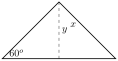
The median of an equilateral triangle is increasing at the rate of \(2\sqrt{3} \, cm/s.\) Find the rate at which its side is increasing.
Solution.
Given: \(\frac{dy}{dt} = 2\sqrt{3} \, cm/s\) \(\frac{dx}{dt} = ?\text{.}\)
\begin{align*} \sin 60^0 \amp = \frac{y}{x}\\ y \amp =x\sin 60^o = \frac{\sqrt{3}}{2} x\\ or, \, \frac{dy}{dt} \amp = \frac{\sqrt{3}}{2} \frac{dx}{dt} \\ or, \,2\sqrt{3} \amp = \frac{\sqrt{3}}{2} \frac{dx}{dt} \\ or, \frac{dx}{dt} \amp = 4\, cm/s \end{align*}

Example 3.6.3.

A spherical baloon is expanding. If the radius is increasing at the rate of \(5\) inch per minute. Find the rate at which the volume increases (in cubic inches per minute) when the radius is 10 inch.
Solution.
\begin{equation*} V= \frac{4}{3}\pi r^3 \end{equation*}
Differentiate w.r.t. "x", we get -
\begin{equation*} \frac{dV}{dt} = \frac{4}{3}\pi (3r^2)\frac{dr}{dt} = 4\pi r^2\times 5 = 20 \pi r^2 \end{equation*}
\begin{equation*} \therefore \, \frac{dr}{dt}\bigg|_{r=10} = 20 \pi \times 10^2 = 2000\pi. \end{equation*}

Example 3.6.4.

If the radius of a circle is decreasing at uniform rate of \(2 \, cm/s\text{,}\) then find the rate of change of area the circle when \(r=20 \, cm\)
Solution.
Given \(\frac{dr}{dt}=-2 \, cm/s\text{.}\) For a circle
\begin{equation*} A= \pi r^2 \end{equation*}
Differentiate w.r.t. "x", we get -
\begin{equation*} \frac{dA}{dt} = 2\pi r \frac{dr}{dt} = 2\pi r (-2) = -4\pi r \end{equation*}
\begin{equation*} \therefore \, \frac{dA}{dt}\bigg|_{r=20} = -4 \pi \times 20 = -80\pi \, cm^2/s. \end{equation*}
i.e., the rate of area of the circle is decreasing by \(80 \pi\text{.}\)

Example 3.6.5.

The tangent of an angle increases four times as the angle itself. At what rate the sine of the angle increaseses w.r.t. the angle?
Solution.
Given
\begin{equation*} \frac{d}{dt}\tan\theta =4\frac{d\theta}{dt} \end{equation*}
\begin{equation*} or, \, \frac{d}{d\theta}\tan\theta =4 \end{equation*}
\begin{equation*} or, \, \sec^2 \theta =4 \end{equation*}
\begin{equation*} or, \, \cos^2 \theta =\frac{1}{4} \end{equation*}
\begin{equation*} i.e., \, \cos \theta =\pm \frac{1}{2} \end{equation*}
Hence,
\begin{equation*} \frac{d}{d\theta}\sin\theta = \cos \theta = + \frac{1}{2} \end{equation*}

Example 3.6.6.

A \(13\, m \) ladder initially leaning against the vertical wall starts slidding on the floor at the rate of \(2\, cm/s.\) How fast is the height of ladder on the wall is decreasing when the foot of the ladder is \(5\, m\) away form the wall? Ladder Sliding
 2 
sklkarn.github.io/Lab_anim/ladder_sliding.html
Solution.
Given: \(\frac{dx}{dt}=2\, cm/s\text{,}\) \(l=13\, m\text{,}\) \(\frac{dy}{dt}\bigg|_x=5\, m\)
\begin{equation} y^2 = 13^2-x^2\tag{3.6.1} \end{equation}
\begin{equation*} or, \, 2y\frac{dy}{dt} = 0-2x\frac{dx}{dt} \end{equation*}
\begin{equation*} or, \, \frac{dy}{dt} = -\frac{x}{y}\frac{dx}{dt} \end{equation*}
Now from (3.6.1), when \(x=5\, m\text{,}\) we get - \(y=\sqrt{13^2-5^2} = 12 \, m\)
\begin{equation*} \therefore \,\frac{dy}{dt} = -\frac{5}{12}\times 2 = -\frac{5}{6} \, cm/s. \end{equation*}

Example 3.6.7.

A particle moves along a curve \(6y=x^3+2,\) find the points on the curve at which \(y\) coordinate is changing 8 times as fast as \(x\) coordinate.
Solution.
Given:
\begin{equation} \frac{dy}{dx} =8\tag{3.6.2} \end{equation}
\begin{equation*} 6y=x^3+2 \end{equation*}
\begin{equation*} 6\frac{dy}{dx} = 3x^2 \end{equation*}
\begin{equation} or, \, \frac{dy}{dx} = \frac{x^2}{2}\tag{3.6.3} \end{equation}
Therefore,
\begin{equation*} \frac{x^2}{2} = 8 \end{equation*}
\begin{equation*} or, x^2 = 16 \, \Rightarrow \, x = \pm 4 \end{equation*}
Now,
\begin{equation*} 6y_1=4^3+2 \, \Rightarrow \, y_1 = 11 \end{equation*}
\begin{equation*} 6y_2=(-4)^3+2 \, \Rightarrow \, y_2 = -\frac{31}{3} \end{equation*}
Hence the points are \((4,11),(-4,--\frac{31}{3})\text{.}\)

Example 3.6.8.

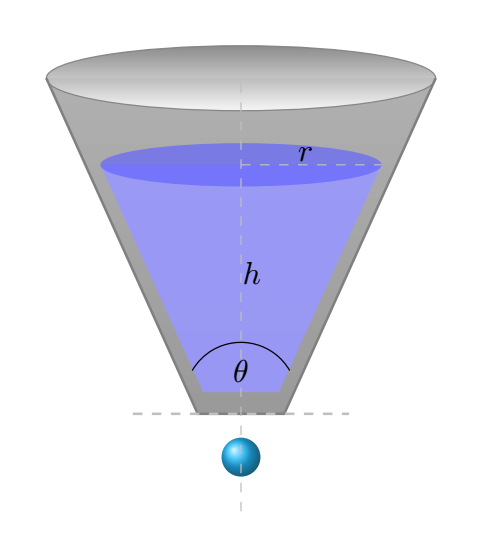
Water is dripping out of a conical funnel at a uniform rate of \(4 \, cc/s\) through a tiny hole at the vertex in bottom, when the slant height of water is \(3 \, cm\text{,}\) find rate of decrease of slant height, it is given that the vertical angle is \(120^o\text{.}\) Funnel Dripping
 3 
sklkarn.github.io/Lab_anim/inverted_cone_drain.html
Solution.
Given:
\begin{equation*} \frac{dV}{dt} = -4 cc/s. \end{equation*}
\begin{equation*} \frac{dl}{dt}\bigg|_{l=3cm} = ? \end{equation*}
\begin{equation*} V = \frac{1}{3}\pi r^2h \end{equation*}
From figure,
\begin{equation*} \cos \frac{\theta}{2} = \frac{h}{l} \end{equation*}
here \(l\) is slant height of water.
\begin{equation*} \therefore \, \cos (60) =\frac{h}{l} \, \Rightarrow h = l\cos (60) = \frac{l}{2} \end{equation*}
\begin{equation*} and \, \sin (60) =\frac{r}{l} \, \Rightarrow r = l\sin (60) = l\frac{\sqrt{3}}{2} \end{equation*}
\begin{equation*} hence, \, V = \frac{1}{3}\pi (l\frac{\sqrt{3}}{2})^2(frac{l}{2}) = \frac{1}{8}\pi l^3 \end{equation*}
\begin{equation*} now, \, \frac{dV}{dt} = \frac{1}{8}3\pi l^2\frac{dl}{dt} = \frac{3}{8}\pi l^2\frac{dl}{dt} \end{equation*}
\begin{equation*} \therefore \, \frac{dV}{dt}\bigg|_{l=3} = \frac{3}{8}\pi 3^2\frac{dl}{dt}\bigg|_{l=3} \end{equation*}
\begin{equation*} o, \, -4 = \frac{3}{8}\pi 3^2\frac{dl}{dt}\bigg|_{l=3} \end{equation*}
\begin{equation*} \therefore \, \frac{dl}{dt}\bigg|_{l=3} = \frac{-4\times 8}{3\times 3^2\times \pi} = -\frac{32}{27 \pi}. \end{equation*}

Example 3.6.9.

A conical tank \((h=10 \, m, r=5 \, m)\) is being filled with water at the rate of \(10 \, cc/s\text{.}\) The tank is inverted and the vertex is at the bottom. Find the rate at which the water level is rising when the water is \(4 \, m\) deep. Conical Tank Filling
 4 
sklkarn.github.io/Lab_anim/inverted_cone_fill.html

Example 3.6.10.

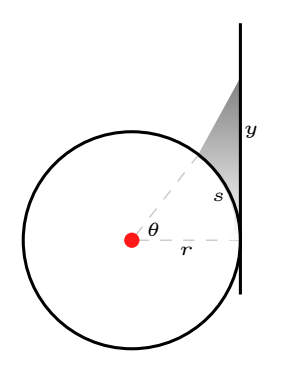
A light source is at center of circle, the circumference of which a horse is runing with speed of \(20 \, km/h\text{.}\) A fence is along the tangent to the circle at the point from where horse starts running. Find the speed with which the shadow of horse move along the fence at the moment when it covers \(\frac{1}{8}^{th} \) of the circle.
Solution.
Given:
\begin{equation*} \frac{ds}{dt} =20 km/h, \, \frac{dy}{dt}\bigg|_{s=\frac{1}{8}c} =? \end{equation*}
\begin{equation*} \tan\theta =\frac{y}{r} \, \Rightarrow \, y =r \tan\theta \end{equation*}
\begin{equation*} \frac{dy}{dt} = r\sec^2\theta \frac{d\theta}{dt}+\tan\theta \cancelto{0}{\frac{dr}{dt}} \end{equation*}
\begin{equation*} s= r\theta \end{equation*}
\begin{equation*} \frac{ds}{dt} = r\frac{d\theta}{dt} +\theta\cancelto{0}{\frac{dr}{dt} } \end{equation*}
do your self.

Example 3.6.11.

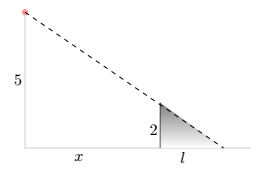
A man \(2 \,m\) high walks at a uniform speed of \(6 /, m/min,\) away from lamppost, \(5 \,m\) high. Find rate at which length of its shadow increases. Growing Shadow
 5 
sklkarn.github.io/Lab_anim/growing_shadow.html
Solution.
Given:
\begin{equation*} \frac{dx}{dt} = 6 \, m/min, \, \frac{dl}{dt} = ? \end{equation*}
From similar triangles
\begin{equation*} \frac{5}{2}= \frac{x+l}{l} \end{equation*}
\begin{equation*} \frac{x}{l} = \frac{5}{2}-1 = \frac{3}{2} \end{equation*}
\begin{equation*} x= \frac{3}{2} l \end{equation*}
\begin{equation*} \frac{dx}{dt} = \frac{3}{2} \frac{dl}{dt} \end{equation*}
\begin{equation*} \cancelto{2}{6} = \frac{\cancel{3}}{2} \frac{dl}{dt} \end{equation*}
\begin{equation*} \frac{dl}{dt} = 4 \, m/min. \end{equation*}

Example 3.6.12.

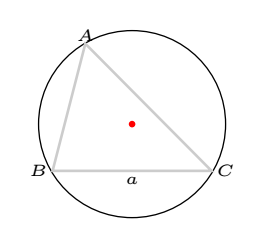
A variable triangle is inscribed in a circle of radius \(r\) when rate of change of particular side is \(r\) times the rate of change of opposite angle, then find that angle at that instant.
Hint.
Given:
\begin{equation*} \frac{da}{dt} =r\frac{dA}{dt}, \, A=? \end{equation*}
From sine formula
\begin{equation*} \frac{\sin A}{a} = \frac{\sin B}{b} = \frac{\sin C}{c} = \frac{1}{2r} \end{equation*}
\begin{equation*} a=2r\sin A \end{equation*}
\begin{equation*} \frac{da}{dt} = 2r\cos A\frac{dA}{dt} \end{equation*}
\begin{equation*} \cancel{r\frac{dA}{dt}} = 2\cancel{r}\cos A\cancel{\frac{dA}{dt}} \end{equation*}
\begin{equation*} 2\cos A =1 \, \Rightarrow \, A = 60^o. \end{equation*}
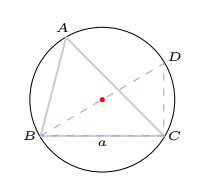
Note:
The inscribed angles subtended by the same arc are equal. That is, \(\angle BAC = \angle BDC.\) Now area of \(\triangle ABC = \frac{1}{2} \,(base) \,(height) = \frac{1}{2} \,a \,b\sin C \) but from right angled \(\triangle BCD \) we have \(\sin D = \frac{BC}{BD} = \frac{a}{2r}\)
\begin{equation*} \therefore \sin D = \sin A = \frac{a}{2r} \end{equation*}
\begin{equation*} or, \, \frac{\sin A}{a} = \frac{1}{2r}. \end{equation*}

Subsection 3.6.2 Approximatation and error analysis

Remember
\begin{equation*} \lim_{h\to 0} f(a)= \frac{f(a+h)-f(a)}{h} =f'(a) \end{equation*}
\begin{equation*} or, \, f(a+h)= f(a)+ hf'(a) \end{equation*}
Errors
\begin{equation*} \frac{\nabla y}{\nabla x} \approx. \frac{dy}{dx} \, \Rightarrow \, \nabla y = \nabla x \frac{dy}{dx} \end{equation*}
The term \(\frac{dy}{dx}\) is derivative at certain point. Also,
\begin{equation*} \text{ Relative Error } = \frac{\nabla y}{y} \end{equation*}
and \(\text{ Change } = \nabla = y_2-y_1\)

Example 3.6.13.

Find the approximate value of \(\sqrt{36.6}.\)
Solution.
\begin{align*} Let, \, f(x) \amp =\sqrt{x} \\ or, f'(x) \amp =\frac{1}{2\sqrt{x} } \end{align*}
\begin{align*} again, \, a+h \amp = 36.6 = 36 + 0.6 \\ \therefore \, a \amp =36 \, \text{ and } \, h=0.6 \end{align*}
here \(a=36\) is the closest value of 36.6 whose square root is known. hence,
\begin{align*} f'(a) \amp = \frac{1}{2\sqrt{36} } =\frac{1}{12}\\ but, \, f(a+h) \amp = f(a)+hf'(a)\\ \therefore \sqrt{36.6} \amp = 6 + 0.6\times \frac{1}{12} = 6.05. \end{align*}

Example 3.6.14.

Find approximate value of \(f(x) = x^2-2x-3\) at \(x=1.999.\)
Solution.
\begin{equation*} f(x) = x^2-2x-3 \end{equation*}
\begin{equation*} f'(x) = 2x-2 \end{equation*}
\begin{equation*} also, \, a+h = 1.999 \end{equation*}
where \(a=2\) closest point and \(h=-0.001,\) and
\begin{equation*} f'(a) = 2\times 2-2=2 \end{equation*}
\begin{equation*} but, \, f(a+h) = f(a) +hf'(a) \end{equation*}
\begin{equation*} but, \, 1.999 = (4-4-3) -0.001\times 2 = -3-0.002 =-3.002 \end{equation*}

Example 3.6.15.

Find approximate value of \((33)^{\frac{1}{5}}.\)
Solution.
\begin{equation*} f(x) = x^{\frac{1}{5}} \end{equation*}
\begin{equation*} f'(x) = \frac{1}{5}x^{\frac{-4}{5}} = \frac{1}{5x^{\frac{-4}{5}}} \end{equation*}
\begin{equation*} now, \, f(a+h) = f(a) +hf'(a) \end{equation*}
also \(33=32+1 = 2^5 +1 = a+h\)
\begin{equation*} f'(x)\vert_{x=a} = \frac{1}{5\cdot 2^{5\frac{-4}{5}}} = \frac{1}{5\times 2^4}=\frac{1}{80} \end{equation*}
\begin{equation*} 33^{1/5} = 32^{1/5} + 1\times \frac{1}{80} = 2+\frac{1}{80}= \frac{161}{80} =2.0125. \end{equation*}

Example 3.6.16.

Approximate value of \(\cos 31^o\) is ....
Solution.
\begin{equation*} Let \, f(x) = \cos x \end{equation*}
\begin{equation*} or, \, f'(x) = -\sin x \end{equation*}
Now convert \(31^o \) into real number, i.e., \(31^o = 30^o+1^o = \frac{\pi}{6}+ \frac{\pi}{180}=a+h\) hence, \(a=\frac{\pi}{6} \) and \(h= \frac{\pi}{180}.\)
\begin{equation*} Now, \, f'(a) = -\sin (\frac{\pi}{6}) = -\frac{1}{2}. \end{equation*}
\begin{equation*} or, \, f(a+h) = f(a) +hf'(a) \end{equation*}
\begin{equation*} \therefore \, \cos 31^o = \cos \frac{\pi}{6} +\frac{\pi}{180}\times -\frac{1}{2} = \frac{\sqrt{3}}{2} - \frac{\pi}{360} =0.857. \end{equation*}

Example 3.6.17.

If radius of sphere is measured \(7\, m\) with an error of \(0.02 \, m\text{,}\) then find approximate error in its volume.
Solution.
\(r= 7m, \, \nabla r = 0.02 \, m,\) \(\nabla V = ?\) we have
\begin{equation*} V= \frac{4}{3}\pi r^3 \end{equation*}
\begin{equation*} or, \, \frac{dV}{dr} = 4\pi r^2 \end{equation*}
\begin{equation*} But, \, \nabla V = \nabla r \frac{dV}{dr} = 0.02\times 4\pi 7^2 = 12.31 \, m^3. \end{equation*}

Example 3.6.18.

Find the approximate change in the volume \(V\) of a cube of side \(x\) meters caused by increaseing the side by 2%.
Solution.
For a cube
\begin{align*} V \amp =x^3\\ or, \, \frac{dV}{dx} \amp =3x^2\\ also, \, \frac{\nabla x}{x} \amp = 2\%\\ or, \, \frac{\nabla x}{x} \amp = \frac{2}{100} = 0.02\\ or, \, \nabla x \amp = 0.02x \end{align*}
\begin{equation*} Now, \, \nabla V = \nabla x \frac{dV}{dx} = 0.02x \times 3x^2 = 0.06x^3. \end{equation*}
\begin{equation*} \therefore \, \frac{\nabla V}{V} =\frac{0.06x^3}{x^3} =0.06 \end{equation*}
\begin{equation*} Hence, \, \%\frac{\nabla V}{V} =\frac{0.06x^3}{x^3} =6\%. \end{equation*}
alternately, from physics if \(V=x^3\)
\begin{equation*} \nabla V=3\nabla x = 3\times 2\% = 6\%. \end{equation*}

Example 3.6.19.

Find approximate valume of metal in a hollow spherical shell whose internal and external radii are 3 and 3.0005 cm respectively.
Solution.
\begin{equation*} V=\frac{4}{3}\pi r^3 \end{equation*}
\begin{equation*} \frac{dV}{dr} =4\pi r^2 \end{equation*}
\begin{equation*} \therefore \, \nabla V = \nabla r \frac{dV}{dr} = 0.0005\times (4\pi\times 3^2) = 0.018\pi \, cm^3. \end{equation*}

Example 3.6.20.

In \(\triangle ABC\) if side length \(a, \, b, \) remain constant such that \(\alpha \) is the eroor in \(\angle C\) then find relative error in its area.
Solution.
Given: \(\nabla C = \alpha \) then \(\nabla S =?\text{.}\) From sine formula of a triangle
\begin{equation*} Area \, S = \frac{1}{2}ab\sin C \end{equation*}
\begin{equation*} or, \, \frac{dS}{dC} = \frac{1}{2}ab\cos C \end{equation*}
\begin{equation*} Now, \,\nabla S = \nabla C \frac{dS}{dC} = \alpha\frac{dS}{dC} = \alpha\frac{1}{2}ab\cos C \end{equation*}
\begin{equation*} \therefore \, \frac{\nabla S}{S} =\frac{\alpha\frac{1}{2}ab\cos C}{\frac{1}{2}ab\sin C} =\alpha \cot C. \end{equation*}

Example 3.6.21.

Find the approximate value of \(\sqrt{50}.\)
Solution.
Let, \(f(x) = \sqrt{x}\) then \(f'(x) = \frac{1}{2\sqrt{x}}.\) Now, \(50 = 49 + 1 = a+h\) where \(a=49\) and \(h=1.\) Hence,
\begin{equation*} f(a+h) = f(a) + hf'(a) = 7 + 1\times \frac{1}{2\times 7} = \frac{99}{14} = 7.07. \end{equation*}

Example 3.6.22.

Find the approximate value of \(e^{0.01}.\)
Solution.
Let, \(f(x) = e^x\) then \(f'(x) = e^x.\) Now, \(0.01 = 0 + 0.01 = a+h\) where \(a=0\) and \(h=0.01.\) Hence,
\begin{equation*} f(a+h) = f(a) + hf'(a) = 1 + 0.01\times 1 = 1.01. \end{equation*}

Example 3.6.23.

Find the approximate value of \(\sin 1^o.\)
Solution.
Let, \(f(x) = \sin x\) then \(f'(x) = \cos x.\) Now, \(1^o = 0 + 1^o = a+h\) where \(a=0\) and \(h=1^o.\) Hence,
\begin{equation*} f(a+h) = f(a) + hf'(a) = 0 + 1^o\times 1 = \frac{\pi}{180} = 0.017. \end{equation*}

Example 3.6.24.

Find the approximate value of \(\log_e 1.01.\)
Solution.
Let, \(f(x) = \log_e x\) then \(f'(x) = \frac{1}{x}.\) Now, \(1.01 = 1 + 0.01 = a+h\) where \(a=1\) and \(h=0.01.\) Hence,
\begin{equation*} f(a+h) = f(a) + hf'(a) = 0 + 0.01\times 1 = 0.01. \end{equation*}

Example 3.6.25.

A searchlight is focused on a person walking with a speed of 4 m/s in a straight line. Find the rate at which the searchlight is rotating when the person is 60 m away from the point on the ground nearest to the searchlight. Searchlight Rotating
 6 
sklkarn.github.io/Lab_anim/searchlight_anim.html
Solution.
Given: \(\frac{dx}{dt} = 4 m/s, \, \frac{d\theta}{dt}\bigg|_{x=60} = ?\) From figure,
\begin{equation*} \tan \theta = \frac{x}{60} \end{equation*}
\begin{equation*} \sec^2 \theta \frac{d\theta}{dt} = \frac{1}{60}\frac{dx}{dt} \end{equation*}
\begin{equation*} \therefore \, \frac{d\theta}{dt} = \frac{\cos^2\theta}{60}\times 4 \end{equation*}
\begin{equation*} when x=60, \, \tan\theta =1 \, \Rightarrow \, \theta = 45^o \end{equation*}
\begin{equation*} hence, \, \frac{d\theta}{dt}\bigg|_{x=60} = 0.033 rad/s. \end{equation*}

Subsection 3.6.3 Tangent and Normal at a Point

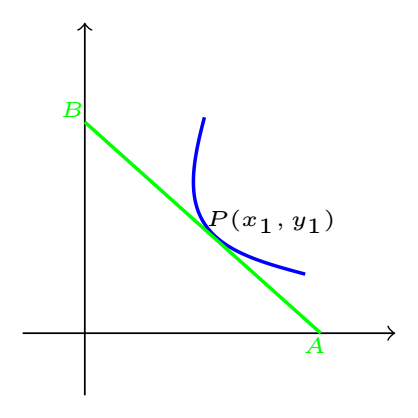
Equation of tangent at a point (x_1,y_1) with slope of \(m\) is given as
\begin{equation*} y-y_1 = m(x-x_1) \end{equation*}
and an equation of normal at tangent at the given point is given as
\begin{equation*} y-y_1 =-\frac{1}{m}(x-x_1) \end{equation*}

Proof.

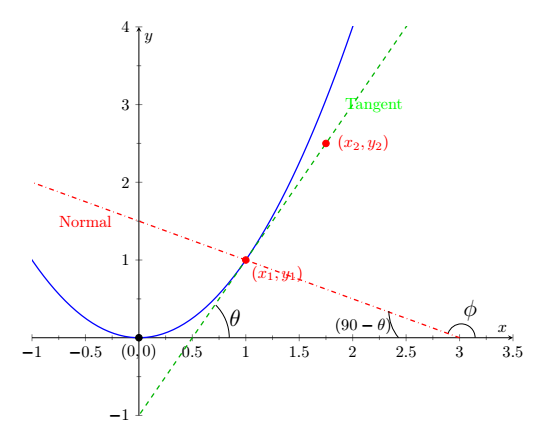
The slope of a tangent line through a given point \(P(x_1,y_1)\) is given by
\begin{equation*} slope=m_t=\tan \theta = \frac{rise}{run} =\frac{y_2-y_1}{x_2-x_1} \end{equation*}
\begin{equation} or, \, y-y_1 = m_t(x-x_1)\tag{3.6.4} \end{equation}
by taking \(x_2\) as \(x\) and \(y_2\) as \(y.\)
Now from figure, we have
\begin{equation*} m_1 =\tan\theta \end{equation*}
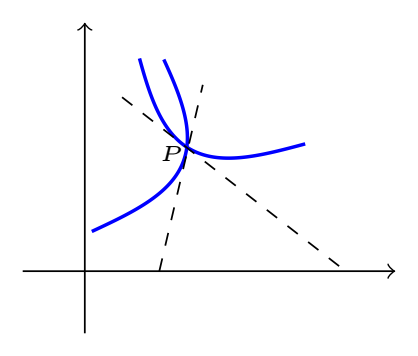
and the slope for normal line
\begin{align*} m_n=\tan\phi \amp = \tan(180^o-(90^o-\theta)) \\ \amp = \tan(90^o+\theta) = -\cot \theta\\ \therefore \, m_n \amp = - \frac{1}{\tan\theta} = - \frac{1}{m_t} \end{align*}
Hence, the equation of normal line through \(P(x_1, y_1)\) is given as
\begin{equation} y-y_1 = m_n(x-x_1) = - \frac{1}{m_t}(x-x_1)\tag{3.6.5} \end{equation}

Example 3.6.26.

Find equation of tangent and normal to \(y=\frac{4}{x^2+2}\) at \(x=0.\)
Solution.
stepI: Find the point on the curve \(y\text{.}\) at \(x=0,\) \(y= \frac{4}{2}=2.\)
\begin{equation*} now, \, \frac{dy}{dx} = 4\left[-\frac{1}{(x^2+2)^2}\times 2x\right] = -\frac{8x}{(x^2+2)^2} \end{equation*}
\begin{equation*} \therefore \,\frac{dy}{dx}\bigg|_{x=0} = -\frac{8x}{(x^2+2)^2} = 0 \end{equation*}
\begin{equation*} y-y_1=m(x-x_1) \end{equation*}
\begin{equation*} y-2=0 \, \Rightarrow \, y = 2 \, \text{ horizontal line}. \end{equation*}
Also, normal line
\begin{equation*} y-y_1=-\frac{1}{m}(x-x_1) \end{equation*}
\begin{equation*} or, \, x-x_1= -m(y-y_1) \end{equation*}
\begin{equation*} or, x =0 \, \text{ vertical line} \end{equation*}

Example 3.6.27.

Find a cubic funciton \(y=ax^3+bx^2+cx+d\) whose graph has horizontal tangents at the points (-2,6) and (2,0).
Solution.
Here
\begin{equation*} y=ax^3+bx^2+cx+d \end{equation*}
\begin{equation*} \therefore \, \frac{dy}{dx} = 3ax^2+2bx+c \end{equation*}
\begin{equation*} or, \, m_1 = \frac{dy}{dx}\bigg|_{x=-2} = 3a(-2)^2 +2b(-2)+c = 12a-4b+c \end{equation*}
But, slope, \(m_1=0\) for a horizontal tangent line.
\begin{equation*} \therefore \, m_1= 12a-4b+c=0 \end{equation*}
Also,
\begin{equation*} or, \, m_2 = \frac{dy}{dx}\vert_{x=2} = 3a(2)^2 +2b(2)+c = 12a+4b+c =0 \end{equation*}
Hence, the equation of tangent line
\begin{align*} y-y_1 \amp =m_1(x-x_1)\\ y-6 \amp = (12a-4b+c)(x+2) \end{align*}
\begin{equation*} y-6 = (12a-4b+c)(x+2) \end{equation*}
and
\begin{equation*} y-0 = (12a+4b+c)(x-2) \end{equation*}
Now, collecting all equations from above,
\begin{align} y(-2) \amp = -8a+4b-2c+d = 6 \tag{✢}\\ y(2) \amp = 8a+4b+2c+d = 0 \tag{✢✢}\\ y'(-2) \amp = m_1= 12a-4b+c = 0 \tag{✢✢✢}\\ y(2) \amp = m_2 = 12a+4b+c = 0\tag{##} \end{align}
Solving last third and fourth equations, we have
\begin{align*} 12a-4b+c \amp =0 \\ 12a+4b+c \amp = 0 \end{align*}
\begin{equation} -8b=0 \Rightarrow \, b=0\tag{3.6.6} \end{equation}
From third equation
\begin{equation} 12a+c = 0 \, \Rightarrow \, c=-12a\tag{3.6.7} \end{equation}
From first equation
\begin{equation} -8a+0-2(-12a)+d = 6 \, \Rightarrow \, 16a+d=6\tag{3.6.8} \end{equation}
From second equation
\begin{equation} 8a+0+2(-12a)+d = 0 \, \Rightarrow \, -16a +d =0\tag{3.6.9} \end{equation}
Solving last these two equations
\begin{align*} 16a+d=6 \amp=0 \\ -16a +d \amp =0 \end{align*}
\begin{equation} d=3.\tag{3.6.10} \end{equation}
from equation \(-16a +d =0\)
\begin{equation} a= \frac{3}{16}.\tag{3.6.11} \end{equation}
Again, from \(8a+4b+2c+d = 0\text{,}\) we get -
\begin{equation*} 8(\frac{3}{16})+4(0) +2c +3 = 0 \, \Rightarrow \, c= -\frac{9}{4} \end{equation*}
Therefore \(a=\frac{3}{16},\) \(b=0,\) \(c=-\frac{9}{4}\text{,}\) and \(d=3.\)
Hence, the curve can be written as
\begin{equation*} y= \frac{3}{16}x^3-\frac{9}{4}x+3. \end{equation*}
Example 3.6.28.

Find equation of tangent and normal to
\begin{equation*} y=|x^2-|x|| \end{equation*}
at \(x=-2.\)
Solution.
Here,
\begin{equation*} y = |x^2-|x|| = |x^2-(-x)|= |x^2+x| = (x^2+x) \end{equation*}
now at \(x=-2, \)
\begin{equation*} y\bigg|_{x=-2} = 4-2=2 \end{equation*}
\begin{equation*} and \, \frac{dy}{dx} = 2x+1 \end{equation*}
\begin{equation*} \Rightarrow \, \frac{dy}{dx}\bigg|_{x=-2} = (2x+1)\bigg|_{x=-2} =-3. \end{equation*}
The tangent line is
\begin{align*} \therefore \, y-y_1 \amp =m(x-x_1)\\ y-2 \amp =-3(x+2)\\ y \amp = -3x-4 \end{align*}
and normal line is
\begin{align*} \, y-y_1 \amp =-\frac{1}{m}(x-x_1)\\ y-2 \amp =+\frac{1}{3}(x+2)\\ y \amp = \frac{1}{3}x+\frac{8}{3} \end{align*}

Example 3.6.29.

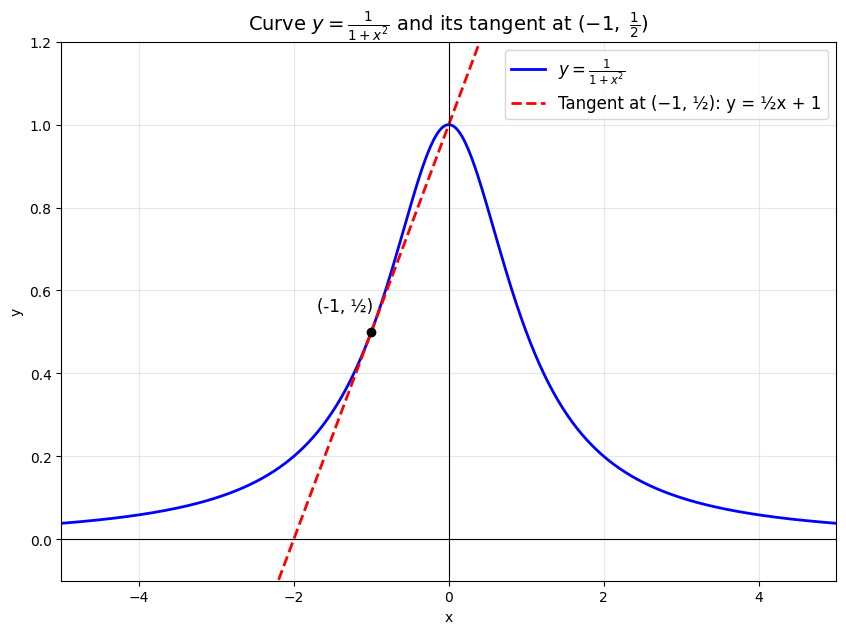
Find an equation of tangent line to the curve \(y=\frac{1}{(1+x^2)}\) at the point \((-1,\frac{1}{2}).\)
Solution.
Let
\begin{equation*} y=\frac{1}{(1+x^2)} \end{equation*}
Step I: Verify if the point is on the curve.
\begin{equation*} y(-1) = \frac{1}{1+(-1)^2} = \frac{1}{2}. \end{equation*}
i.e. yes, point lies on the given curve.
Step II: Find derivative.
\begin{align*} \frac{\,dy}{\, dx} \amp = \frac{\,d}{\, dx} \left(\frac{1}{(1+x^2)}\right) \\ \amp = \frac{\left(1+x^2\right)\cdot 0-1(0+2x)}{\left(1+x^2\right)^2} \\ \therefore \, \frac{\,dy}{\, dx} \amp = \frac{-2x}{\left(1+x^2\right)^2} \end{align*}
Step III: Find the slope of tangent line at \(x=-1.\)
\begin{equation*} m=\frac{\,dy}{\, dx}\bigg|_{x=-1} = \frac{-2\cdot (-1)}{\left(1+(-1)^2\right)^2} = \frac{+2}{\left(1+1\right)^2} = \frac{1}{2}. \end{equation*}
Step IV: Find equation of the tangent line.
\begin{align*} y-y_1 \amp =m(x-x_1)\\ or, \, y-\frac{1}{2} \amp =\frac{1}{2}(x-(-1)) = \frac{1}{2}(x+1)\\ or, \, y \amp = \frac{1}{2}x+ \frac{1}{2}+ \frac{1}{2} =\frac{1}{2}x+ 1 \\ \therefore \, y \amp = \frac{1}{2}x + 1 \end{align*}

Example 3.6.30.

Find an equation of tangent line and normal line to the curve \(y=x+\sqrt{x}\) at the point \((1,2).\)
Solution.
We have,
\begin{equation*} y=x+\sqrt{x} \end{equation*}

Step I: Verify if the point is on the curve.
\begin{equation*} y(1) = 1+\sqrt{1} =2. \end{equation*}

i.e. yes, point lies on the given curve.
Step II: Find derivative.
\begin{align*} \frac{\,dy}{\, dx} \amp = \frac{\,d}{\, dx} \left(x+\sqrt{x}\right) \\ \amp = 1+\frac{1}{2} x^{\frac{1}{2}-1} =1+\frac{1}{2} x^{-\frac{1}{2}} \\ \therefore \, \frac{\,dy}{\, dx} \amp = 1+\frac{1}{2\sqrt{x}} \end{align*}
Step III: Find the slope of tangent line at \(x=1.\)
\begin{equation*} m=\frac{\,dy}{\, dx}\bigg|_{x=1} = 1+\frac{1}{2\sqrt{1}} = \frac{3}{2}. \end{equation*}
Step IV: Find equation of the tangent line.
\begin{align*} y-y_1 \amp =m(x-x_1)\\ or, \, y-2 \amp =\frac{3}{2}(x-1) = \frac{3}{2}x-\frac{3}{2} \\ or, \, y \amp = \frac{3}{2}x-\frac{3}{2}+2 \\ \therefore \, y \amp = \frac{3}{2}x + \frac{1}{2} \end{align*}
Step V: Find equation of the normal line.
\begin{align*} y-y_1 \amp =-\frac{1}{m}(x-x_1)\\ or, \, y-2 \amp =-\frac{2}{3}(x-1) \\ or, \, y \amp = -\frac{2}{3}x+\frac{2}{3}+2 \\ \therefore \, y \amp = -\frac{2}{3}x + \frac{8}{3} \end{align*}

Example 3.6.31.

If
\begin{equation*} y^2=5x^4-x^2, \end{equation*}
find equation of tangent line at \((1,2)\)
Solution.
\begin{equation*} 2y\frac{dy}{dx} = 20x^3-2x \end{equation*}
\begin{equation*} \frac{dy}{dx} = \frac{20x^3-2x}{2y} = \frac{10x^3-x}{y} \end{equation*}
\begin{equation*} \therefore \, \frac{dy}{dx}\bigg|_{(1,2)} = \frac{10\times 1^3-1}{2} = 4.5. \end{equation*}
Hence, the equation of tangent line,
\begin{align*} y-y_1 \amp =m(x-x_1) \\ y-2 \amp =4.5(x-1)\\ y \amp =4.5x-2.5 \end{align*}

Example 3.6.32.

Find the point on \(x^2+2y^2= 6\) which is nearest to \(x+y=7.\)
Solution.
\begin{align*} x^2+2y^2 \amp =6 \\ \frac{x^2}{6}+ \frac{y^2}{3}\amp = 1 \end{align*}
which is equation of eclipse. The shortest distance from a point to a line is measured along the common normal (perpendicular). Therefore, the point of minimum distance on the ellipse must have its tangent parallel to the line \(x + y = 7\) (i.e., same normal direction). The line \(x + y - 7 = 0\) has normal vector \(\langle 1, 1 \rangle\text{,}\) so the tangent to the ellipse at the closest point must also have normal vector parallel to \(\langle 1, 1 \rangle\text{.}\)

Example 3.6.33.

For the curve \(xy=c^2,\) prove that the position of the tangent at any point on the curve intercepted between the coordinate axes is bisected by the point of contact.
Solution.
Let \(P(x_1,y_1)\) be any point on the curve
\begin{equation*} xy=c^2 \end{equation*}
\begin{equation*} or, \, x \frac{dy}{dx}+y = 0 \end{equation*}
\begin{equation*} or, \, \frac{dy}{dx} = -\frac{y}{x} \end{equation*}
\begin{equation*} or, \, \frac{dy}{dx}\bigg|_{x_1} = -\frac{y_1}{x_1} =m \end{equation*}
Equation of tangent at \(P(x_1,y_1)\) is
\begin{equation*} y-y_1=m(x-x_1) \end{equation*}
\begin{equation*} or, \, y-y_1=-\frac{y_1}{x_1} (x-x_1) \end{equation*}
\begin{equation*} or, \,x_1(y-y_1) = -y_1 (x-x_1) \end{equation*}
\begin{equation*} or, \,x_1y-x_1y_1 = -y_1 x+y_1x_1 \end{equation*}
\begin{equation} or, \,x_1y + y_1 x = y_1x_1+x_1y_1 = 2x_1y_1 =2c^2\tag{3.6.12} \end{equation}
For x-intercept, put \(y=0\) in eqn. (3.6.12)
\begin{equation*} \,x_1\times 0 + y_1 x = 2c^2 \end{equation*}
\begin{equation*} \therefore \, x = \frac{2c^2}{y_1} \end{equation*}
Hence the point at intercept \(A\left(\frac{2c^2}{y_1},0\right) \)
For y-intercept, put \(x=0\) in eqn. (3.6.12)
\begin{equation*} \,x_1y + y_1 \times 0 = 2c^2 \end{equation*}
\begin{equation*} \therefore \, y = \frac{2c^2}{x_1} \end{equation*}
Hence the point at intercept \(B\left(0,\frac{2c^2}{x_1}\right) \)
Therefore the mid-point of AB is
\begin{equation*} \left(\frac{\frac{2c^2}{y_1}+0}{2},\frac{0+\frac{2c^2}{x_1}}{2}\right) = \left(\frac{c^2}{y_1}, \frac{c^2}{x_1}\right)= (x_1,y_1) \end{equation*}
Which is the coordinate of point P.

Example 3.6.34.

Find the angle between the curves \(2y^2 = x^3\) and \(y^2=32 x\) in the first quadrant.
Solution.
\begin{equation*} 2y^2 = x^3 \end{equation*}
\begin{equation*} y^2=32 x \end{equation*}
\begin{align*} y^2 \amp =32 x \\ or, \, \frac{x^3}{2} \amp =32 x\\ or, \, x^3-64x \amp =0\\ or, \, x=0; \, \amp \, x=\pm 8 \end{align*}
hence, \(y=0\) at \(x=0;\) and \(y=\sqrt{32 \times 8} = 16.\) The value of \(x =-8\) can be discarded as \(\sqrt{y}\) never be negative. So the coordinate of point P is \(P(8,16)\text{,}\) the point at origin is not taken here for finding slope of tangents.
Now from
\begin{equation*} 2y^2=x^3 \end{equation*}
we have
\begin{equation*} 4y\frac{dy}{dx}=3x^2 \end{equation*}
\begin{equation*} or, \, \frac{dy}{dx}\bigg|_{P}=\frac{3x^2}{4y} = \frac{3\times 8^2}{4\times 16} = 3 =m_1 \end{equation*}
Also from
\begin{equation*} y^2=32 x \end{equation*}
we have
\begin{equation*} 2y\frac{dy}{dx}=32 \end{equation*}
\begin{equation*} or, \, \frac{dy}{dx}\bigg|_{P}=\frac{32}{2y} = \frac{32}{2\times 16} = 1=m_2 \end{equation*}
Hence,
\begin{equation*} \tan\theta =\bigg| \frac{m_2-m_1}{1+m_1m_2}\bigg| = \bigg| \frac{1-3}{1+3}\bigg|= |-\frac{1}{2}| =\frac{1}{2} \end{equation*}
\begin{equation*} \therefore \, \theta = \tan^{-1} {\frac{1}{2}} \approx 26^o \end{equation*}

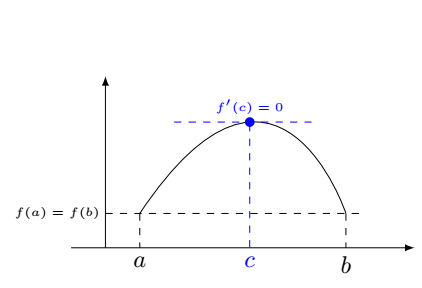
Subsection 3.6.4 Rolle’s Theorem

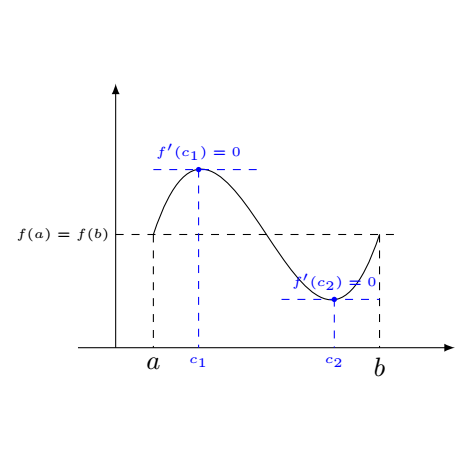
If a function \(f(x)\) is defined in an interval \([a,b]\) such that:
  1. \(f(x) \) is continuous in \([a,b]\)
  2. \(f(x) \) is also differentiable in \((a,b)\)
  3. and \(f(a) =f(b)\)
then there must exist at least one point \(c\) such that \(c \in (a,b)\) where
\begin{equation*} f'(c) =0 \text{.} \end{equation*}
Or, in other words \(f(x)\) has a critical point in \((a,b)\text{.}\) Here, slope of function at point/s \(c\) is parallel to the slope of horizontal secant line through \(AB.\)

Subsection 3.6.5 Mean Value Theorem

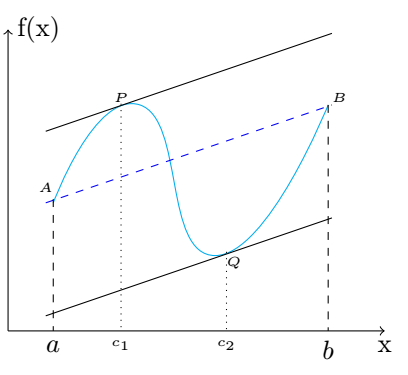
If a function \(f(x)\) is defined in an interval \([a,b]\) such that:
  1. \(f(x) \) is continuous in \([a,b]\)
  2. \(f(x) \) is also differentiable in \((a,b)\)
then there must exist at least one point \(c\) such that \(c \in (a,b)\) where
\begin{equation*} f'(c) = \frac{f(b) -f(a)}{b-a} \text{.} \end{equation*}
Or, in other words \(f(x)\) has a critical point in \((a,b)\text{.}\) Here, slope of tangent at points \(P\) and \(Q\) are parallel to the slope of secant line through \(AB.\)

Subsection 3.6.6 Maxima and Minima

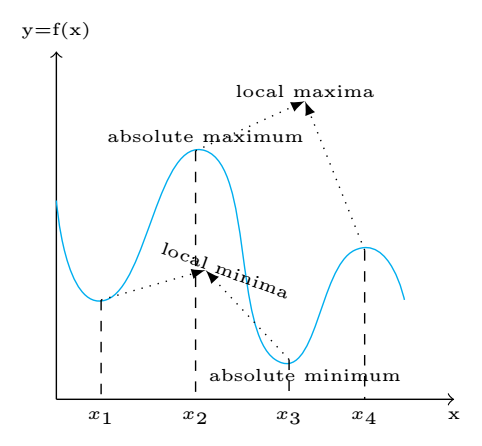
Important points on plot
  1. Local maxima points are \(x_2, x_4\)
  2. Local maxima values are \(f(x_2), f(x_4)\)
  3. Absolute maximum point is \(x_2\)
  4. Absolute maximum value is \(f(x_2)\)
  5. Local minima points are \(x_1, x_3\)
  6. Local minima values are \(f(x_1), f(x_3)\)
  7. Absolute minimum point is \(x_3\)
  8. Absolute minimum value is \(f(x_3)\)

Definition 3.6.35.

  • A function \(y=f(x)\) is said to have local maxima (or, local extrema) at \(x=a\) if value of function at that point is greater than or equal to values of function in some neighbourhood of \(x=a.\)
  • A function \(y=f(x)\) is said to have local minima (or, local extrema) at \(x=a\) if value of function at that point is less than or equal to values of function in some neighbourhood of \(x=a.\)
  • A function \(y=f(x)\) is said to have global maxima (or, absolute maxima) at \(x=a\) if \(f(a) \geq f(x) \, \forall_x\) in domain of \(f(x).\)
  • A function \(y=f(x)\) is said to have global minima (or, absolute minima) at \(x=a\) if \(f(a) \leq f(x) \, \forall_x\) in domain of \(f(x).\)
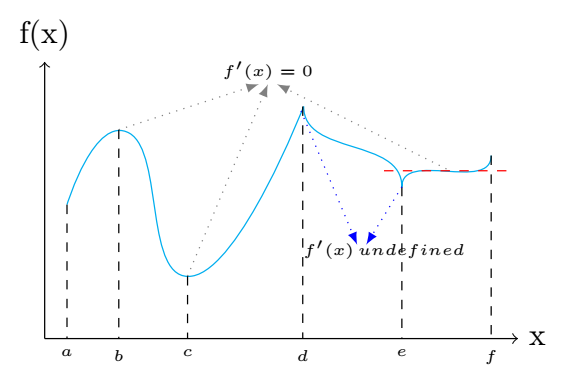
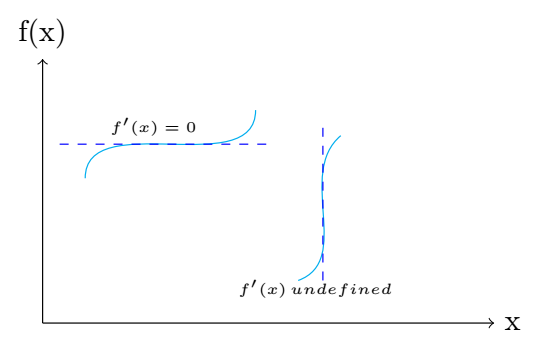
Critical Points: It is a collection of points for which \(f'(x) \) is either zero or undefined. Critical points are interior points within the given inetrval \([a,f].\) Critical points are contenders for giving maxima and minima.
Figure 3.6.36.
Inflection Point: It is the point at which a smooth graph has tangent about which concavity changes.

Remark 3.6.37.

Points at which \(f"(x) \) is either zero or undefined are contenders for inflection point. The \(f"(x)\) always changes its sign at inflection point.

Subsubsection 3.6.6.1 Local Maxima

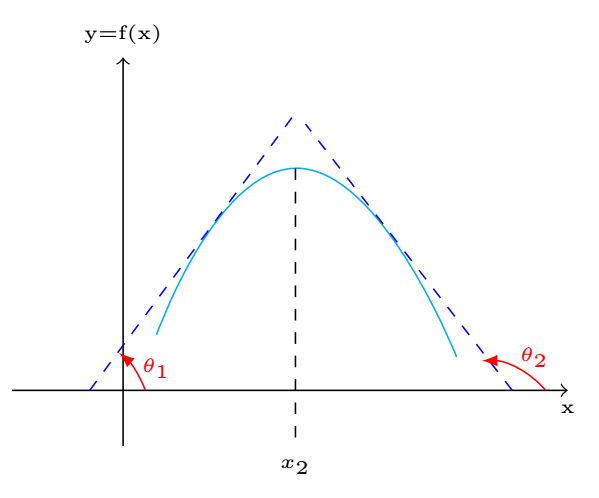
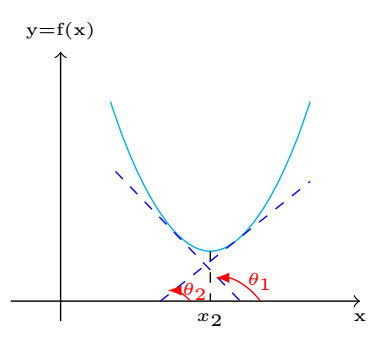
If tangent is drawn at left of local maxima, \(x_2\text{,}\) then it’s angle (\(\theta\)) with x-axis falls in first quadrant i.e.,
\begin{align*} \theta \amp \lt 90^o \\ or, \, \tan\theta \amp \gt 0\\ or, \, f'(x) \amp \gt 0 \end{align*}
\(or, f'(x)\) is \(+ve.\)
On the other hand, if tangent is drawn at right to the local maxima, then it’s angle (\(\theta\)) with x-axis falls in second quadrant i.e.,
\begin{align*} \theta \amp \gt 90^o \\ or,\, \tan\theta \amp \lt 0\\ or, \, f'(x) \amp \lt 0 \end{align*}
\(\, f'(x)\) is \(-ve.\)
So, around local maxima slope of tangent lines rotates from \(+ve \) to \(-ve\) as can be seen in the figure above.

Subsubsection 3.6.6.2 Local Minima

If tangent is drawn at left of local minima \(x_3\text{,}\) then it’s angle (\(\theta\)) with x-axis falls in second quadrant i.e.,
\begin{align*} \theta \amp \gt 90^o \\ or, \, \tan\theta \amp \lt 0\\ or, \, f'(x) \amp \lt 0 \end{align*}
\(or, f'(x)\) is \(-ve.\)
On the other hand, if tangent is drawn at right of the local minima, then it’s angle (\(\theta\)) with x-axis falls in the first quadrant i.e.,
\begin{align*} \theta \amp \lt 90^o \\ or,\, \tan\theta \amp \gt 0\\ or, \, f'(x) \amp \gt 0 \end{align*}
\(\, f'(x)\) is \(+ve.\)
So, around local maxima slope of tangent lines rotates from \(+ve \) to \(-ve\) as can be seen in the figure above.
In summary,
  1. If sign of \(f'(x)\) changes from \(-ve\) to \(+ve\) then the point is minima.
  2. If sign of \(f'(x)\) changes from \(+ve\) to \(-ve\) then the point is maxima.
  3. Tangent line at any maxima or minima points is always parallel to the \(x-axis,\) i.e., \(f'(x) =0\) at all maxima or minima points.
Maxima or minima points (or points of any extrema) can also be determined by using second derivative as: if \(f'(x) = 0,\) then we get extremum points as \(x_1, x_2, \cdots \text{.}\) Now if
\begin{equation*} f"(x)\bigg|_{x=x_1} \gt 0 \end{equation*}
or \(+ve\) then point gives place of minima (curve opens up) and
\begin{equation*} f"(x)\bigg|_{x=x_1} \lt 0 \end{equation*}
or \(-ve\) then point gives place of maxima (curve opens down).
Example 3.6.38.
Examine the nature of the function, \(f(x) = x^3-3x+2\) at points \(x=0,\, 1, \, 2.\)
Solution.
Differentiate \(f(x)\) w.r.t ’x’ we get -
\begin{equation*} f(x) = x^3-3x+2 \end{equation*}
\begin{equation*} f'(x) = 3x^2-3 \end{equation*}
Now at \(x=0,\) \(f(0) = +2,\) and \(f'(0) = -3\) so the function is decreasing.
At \(x=1,\) \(f(1) = 1-3+2 = 0,\) and \(f'(1) = 3-3 =0\text{.}\) Since both become zero we need to test \(f'(x)\) at \(1^-\) and \(1^+\text{.}\)
\begin{equation*} f'(1^-)= 3(0.99)^2-3 = -ve \end{equation*}
also,
\begin{equation*} f'(1^+)= 3(1.01)^2-3 = +ve \end{equation*}
That is \(f'(x)\) is changing its value from -ve to +ve around \(1.\) Hence the function is neither increasing nor decreasing. Note: If \(f(x) \) and \(f'(x)\) are both zero at any point, and if \(f'(x)\) is +ve around the point then it is increasing and -ve around that point then it is decreasing.
At \(x=2,\) \(f(2) = 8-6+2=4,\) and \(f'(2) = 12-3=9\) so the function is increasing.
Example 3.6.39.
Find critical points of
  1. \begin{equation*} y=\frac{x^3}{3}-\frac{5x^2}{2}+6x+1 \forall_x \in [2,4] \end{equation*}
  2. \begin{equation*} y=(x-2)^{\frac{2}{3}}(2x+1) \end{equation*}
Solution.
  1. \begin{equation*} y=\frac{x^3}{3}-\frac{5x^2}{2}+6x+1; \, \quad \forall_x \in [2,4] \end{equation*}
    \begin{equation*} \frac{dy}{dx} =f'(x)= x^2-5x+6 \end{equation*}
    For critical points, set \(f'(x)=0\)
    \begin{equation*} \therefore \, f'(x)= 0= (x-3)(x-2) \end{equation*}
    \begin{equation*} or, \, x=2,3 \end{equation*}
    But, \(x=2\) should not be a critical point because it is one of the interval points \([2,4]\) of the function [Critical Point].
    Hence, \(x=3\) is a critical point.
  2. \begin{equation*} y=(x-2)^{\frac{2}{3}}(2x+1) \end{equation*}
    If the interval is not given then it is taken as \(x\in (-\infty, \infty)\)
    \begin{equation*} f'(x) = \frac{2}{3}(x-2)^{-\frac{1}{3}}(2x+1)\cdot 1+(x-2)^{\frac{2}{3}}\cdot 2 \end{equation*}
    set \(f'(x) =0\) for critical points.
    \begin{equation*} 0 = \frac{\frac{2}{3}(2x+1)+2(x-2)}{(x-2)^{\frac{1}{3}}} \end{equation*}
    \begin{equation*} \frac{4x+2+6x-12}{3(x-2)^{\frac{1}{3}}} =0 \end{equation*}
    \begin{equation*} \frac{10x-10}{3(x-2)^{\frac{1}{3}}} =0 \end{equation*}
    here, \(10x-10 =0\) gives \(f'(x) =0\) but \(x-2 =0 \, \Rightarrow \, x=2\) makes \(f'(x) \) undefined.
    \begin{equation*} hence, \, 10x-10 =0 \, \Rightarrow \, x=1 \end{equation*}
    Thus the critical points are \(1,2.\)
Example 3.6.40.
Find the inflection point of the funciton
\begin{equation*} f(x) = x^4-4x^3+x-10 \end{equation*}
Solution.
\begin{align*} f(x) \amp = x^4-4x^3+x-10\\ f'(x) \amp =4x^3-12x^2+1\\ f''(x) \amp =12x^2-24x = 12x(x-2) \end{align*}
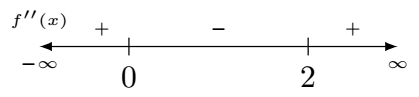
set \(f''(x) = 0, \) we get - \(x=0\) and \(x=2\text{.}\) Now draw sign of \(f''(x) \) on interval line as shown below:
At points \(0\) and \(2\) the \(f''(x) \) is changings its sign from \(+ve \) to \(-ve \) to \(+ve. \) We get points of maxima and minima where \(f'(x) \) changes sign and we get inflection point where \(f''(x)\) changes sign.
Example 3.6.41.
Find the points of maxima and minima of \(f(x) = -x^3+12x+5\)
Solution.
\begin{equation*} f(x) = -x^3+12x+5 \end{equation*}
\begin{equation*} f'(x) = -3x^2+12 = 0 \end{equation*}
\begin{equation*} \therefore \, x = \pm 2 \end{equation*}
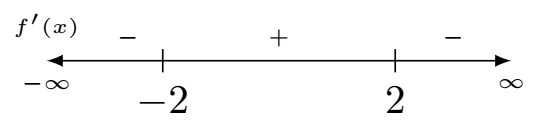
draw a number line and see how \(f'(x)\) is changing sign.
If sign has changes alternatively around -2 to +2 then they must be extremum points. Around maximum point \(f'(x)\) changes sign from +ve to -ve, and around minimum point it changes sign from -ve to +ve.