
Section 3.2 Derivative (short cut rule)

It is the process of finding the derivative of a function, which tells us the instantaneous rate of change of that function at any point. Geometrically, the derivative is the slope of the tangent line to the curve at that point.
Imagine you are driving a car. Your position as a function of time is \(s(t)\text{.}\) The average speed over an interval is \(\frac{\Delta s}{\Delta t} \text{.}\) The instantaneous speed at exactly \(t = 3\) seconds is the derivative \(\lim_{\Delta t \to 0} \frac{\Delta s}{\Delta t}\) \(= \frac{\,ds}{\,dt} \text{.}\)
In real life, we care about instantaneous rates: how fast a population is growing right now, how sensitive profit is to a price change, the acceleration of a rocket at lift-off, etc.
Once a function is known to be differentiable, we can compute its derivative using established rules rather than the limit definition every time.

Basic Rules of Differentiation.

  1. Constant Rule: If \(f(x) = c\) (constant), then \(f'(x) = 0.\)

    Proof.

    \begin{equation*} f'(c) = \lim_{h\to 0} \frac{f(c+h) - f(c)}{h} = \lim_{h\to 0} \frac{c-c}{h} = 0. \end{equation*}
    \(\because\, f(c+h) = c.\)
  2. Power Rule: If \(f(x) = x^n\) where \(n\) is a real number and \(x^n\) is defined, then
    \begin{equation*} f'(x) = \frac{\,d}{\,dx}(x^n) = nx^{n-1} \end{equation*}
    provided \(x \neq 0\) if \(n \leq 0\text{.}\)
  3. Constant Multiple Rule: If \(f(x) = c \cdot g(x)\) and \(g\) is differentiable, then
    \begin{equation*} f'(x)=cβ‹…g'(x). \end{equation*}
  4. Sum Rule: If \(f(x) = g(x) + h(x)\) and both are differentiable, then
    \begin{equation*} f'(x)=g'(x)+h'(x). \end{equation*}
  5. Product Rule: If \(f(x) = g(x) \cdot h(x)\) and both are differentiable, then
    \begin{equation*} f'(x)=g'(x)h(x)+g(x)h'(x). \end{equation*}
    or,
    \begin{equation*} (uv)' = u'v + uv' \end{equation*}
    or,
    \begin{equation*} \frac{d}{dx}(uvw) = uv\frac{dw}{dx} + uw\frac{dv}{dx}+ vw\frac{du}{dx} \end{equation*}
  6. Quotient Rule: If \(f(x) = \frac{g(x)}{h(x)} =\frac{u}{v}\) with \(h(x) \neq 0\) and both differentiable, then
    \begin{equation*} f'(x)=g'(x)h(x)-g(x)h'(x)[h(x)]^2 = \frac{u'v-uv'}{v^2}. \end{equation*}
  7. Chain Rule: The chain rule allows differentiation of composite functions. If \(y = f(u)\) and \(u = g(x)\text{,}\) with \(f\) differentiable at \(u = g(x)\) and \(g\) differentiable at \(x\text{,}\) then
    \begin{equation*} \frac{dy}{dx}=\frac{df}{du}β‹…\frac{du}{dx}. \end{equation*}
    or,
    \begin{equation*} \frac{\,d}{\,dx}f(g(x)) = f'(g(x))β‹…g'(x) \end{equation*}
  8. Exponent Rule
    \begin{equation*} \frac{d}{dx}(a^x) = a^x\log a \end{equation*}
    \begin{equation*} \frac{d}{dx}(e^x) = e^x \end{equation*}
    \begin{equation*} \frac{d}{dx}\left(\log_a |x|\right) = \frac{1}{x}\log_a (e) = \frac{1}{x\log_e (a)} \end{equation*}

Subsection 3.2.1 Standard Derivatives

\begin{align*} \frac{d}{dx}(x^n) \amp = nx^{n-1} \\ \frac{d}{dx}(e^x) \amp = e^x\\ \frac{d}{dx}(a^x) \amp = a^x\ln a\\ \frac{d}{dx}(\ln |x|) \amp = \frac{1}{x}\\ \frac{d}{dx}(\ln |x|) \amp = \frac{1}{x}\\ \frac{d}{dx}(\log_a {x}) \amp = \frac{1}{x\ln a}\\ \frac{d}{dx}(\sin x) \amp = \cos x\\ \frac{d}{dx}(\cos x) \amp = -\sin x\\ \frac{d}{dx}(\tan x) \amp = \sec^2 x \end{align*}
\begin{align*} \frac{d}{dx}(\csc x) \amp = -\csc x \cot x\\ \frac{d}{dx}(\sec x) \amp = \sec x\tan x\\ \frac{d}{dx}(\cot x) \amp = -\csc^2 x\\ \frac{d}{dx}(\sin^{-1} x) \amp = \frac{1}{\sqrt(1-x^2)}\\ \frac{d}{dx}(\cos^{-1} x) \amp = -\frac{1}{\sqrt(1-x^2)}\\ \frac{d}{dx}(\tan^{-1} x) \amp = \frac{1}{1+x^2}\\ \frac{d}{dx}(\csc^{-1} x) \amp = -\frac{1}{x\sqrt(x^2-1)}\\ \frac{d}{dx}(\sec^{-1} x) \amp = \frac{1}{x\sqrt(x^2-1)}\\ \frac{d}{dx}(\cot^{-1} x) \amp = -\frac{1}{1+x^2} \end{align*}

Example 3.2.1.

  1. Find the derivative of \(f(x) = 3x^5 - 4x^3 + 7x - 9\)
  2. Differentiate \(y = (2x^2 + 3)(x^3 - 5x)\)
  3. Find \(\frac{\,dy}{\,dx}\) if \(y = \frac{(x^2 + 1)}{(x^2 - 1)}\)
  4. Differentiate \(f(x) = \sin(3x^4 + 2)^2\)
Solution.
  1. \begin{equation*} Let, \, f(x) = y= 3x^5 - 4x^3 + 7x - 9 \end{equation*}
    \begin{equation*} then, \, f'(x)= \frac{\,dy}{\,dx} = 15x^4-12x^2+7 \end{equation*}
  2. \begin{equation*} Here, \, y = (2x^2 + 3)(x^3 - 5x) \end{equation*}
    \begin{equation*} Let, \, u = 2x^2 + 3 \quad \therefore \frac{\,du}{\,dx} = u'= 4x \end{equation*}
    \begin{equation*} and \, v= x^3 - 5x \quad \therefore \frac{\,dv}{\,dx} = v'= 3x^2-5 \end{equation*}
    \begin{align*} Now, \, y'= \frac{\,dy}{\,dx} \amp = \frac{\,d}{\,dx}(uv) = u'v+uv'\\ \amp = 4x(x^3 - 5x) + (2x^2 + 3)(3x^2-5) \\ \amp = 4x^4-20x^2+(6x^4-10x^2+9x^2-15) \\ \amp = 10x^4 -21x^2-15 \end{align*}
  3. \begin{equation*} Here, \, y = \frac{(x^2 + 1)}{(x^2 - 1)} \end{equation*}
    \begin{equation*} Let, \, u = x^2 + 1 \quad \therefore \frac{\,du}{\,dx} = u'= 2x \end{equation*}
    \begin{equation*} and \, v= x^2 - 1 \quad \therefore \frac{\,dv}{\,dx} = v'= 2x \end{equation*}
    \begin{equation*} Now, \, y'= \frac{\,dy}{\,dx} = \frac{\,d}{\,dx}(\frac{u}{v}) = \frac{u'v-uv'}{v^2} \end{equation*}
    \begin{equation*} = \frac{2x(x^2 - 1)-2x(x^2 + 1)}{(x^2 - 1)^2} = \frac{2x^3-2x-2x^3-2x}{(x^2 - 1)^2} \end{equation*}
    \begin{equation*} = \frac{-4x}{(x^2 - 1)^2} \end{equation*}
  4. \begin{equation*} Here, \, y = \sin(3x^4 + 2)^2 \end{equation*}
    \begin{equation*} Let, \, u= (3x^4 + 2)^2 \end{equation*}
    \begin{equation*} \, \therefore \frac{\,du}{\,dx}= 2(3x^4 + 2)(12x) =(3x^4 + 2)(24x) \end{equation*}
    \begin{equation*} then, \, \frac{\,dy}{\,dx} = \frac{\,dy}{\,du}\cdot \frac{\,du}{\,dx} \end{equation*}
    \begin{equation*} = \frac{\,d}{\,du}\sin u \cdot \frac{\,d}{\,dx}u = \cos u\cdot \frac{\,du}{\,dx} \end{equation*}
Answer.
\begin{equation*} \therefore \, \frac{\,dy}{\,dx}= 24x(3x^4 + 2)\cos (3x^4 + 2)^2 \end{equation*}

Example 3.2.2.

If \(n \) is a positive integer, then \(\frac{\,d}{\, dx}\left(x^{-n}\right) = -nx^{-n-1}\text{.}\)
Solution.
Let
\begin{equation*} y= \left(x^{-n}\right) \end{equation*}
\begin{align*} \frac{\,dy}{\, dx} \amp = \frac{\,d}{\, dx}\left(x^{-n}\right) = \frac{\,d}{\, dx}\left(\frac{1}{x^{-n}}\right) \\ \amp = \frac{x^n\cdot 0 - 1\cdot nx^{n-1}}{\left(x^n\right)^2} = \frac{-nx^{n-1}}{x^{2n}} \\ \amp = -nx^{-n-1-2n} = -nx^{-n-1} \end{align*}

Example 3.2.3.

Find the first and second derivatives of the functions
  1. \begin{equation*} f(x)=x^4-3x^3+10x \end{equation*}
  2. \begin{equation*} f(x)=\frac{1}{5-x} \end{equation*}
  3. \begin{equation*} f(x)=\frac{x^2}{1+2x} \end{equation*}
Solution.
Let
\begin{equation*} y=x^4-3x^3+10x \end{equation*}
\begin{align*} \therefore\, \frac{\,dy}{\, dx} \amp = 4x^3-9x^2+10\\ and, \, \frac{\,d^2y}{\, dx^2} \amp = 12x^2-18x \end{align*}

Example 3.2.4.

If \(y=\frac{x^4+x+1}{x^2+x+1}\) and \(\frac{dy}{dx} = ax+b, \) then find \(a\) and \(b.\)
Solution.
Let
\begin{equation*} y=\frac{x^4+x+1}{x^2+x+1} = \frac{(x^2+x+1)(x^2-x+1)}{x^2+x+1} = (x^2-x+1) \end{equation*}
\begin{equation*} \therefore \, \frac{dy}{dx} = 2x-1 \end{equation*}
Hence, \(a=2\) and \(b=-1\)

Example 3.2.5.

If
\begin{equation*} y=\sqrt{\frac{1-\cos 2x}{1+\cos 2x}}, \, x \in (0,\frac{\pi}{2})U(\frac{\pi}{2}, \pi), \end{equation*}
then find \(\frac{dy}{dx}\text{.}\)
Solution.
\begin{equation*} y=\sqrt{\frac{1-\cos 2x}{1+\cos 2x}} = \sqrt{\frac{2\sin^2 x}{2\cos^2 x}} = |\tan x| \end{equation*}
\begin{equation*} \therefore \, \frac{dy}{dx} = \begin {cases} \sec^2 x & 0\lt x \lt \frac{\pi}{2} \\ -\sec^2 x & \frac{\pi}{2} \lt x \lt \pi \end {cases} \end{equation*}

Example 3.2.6.

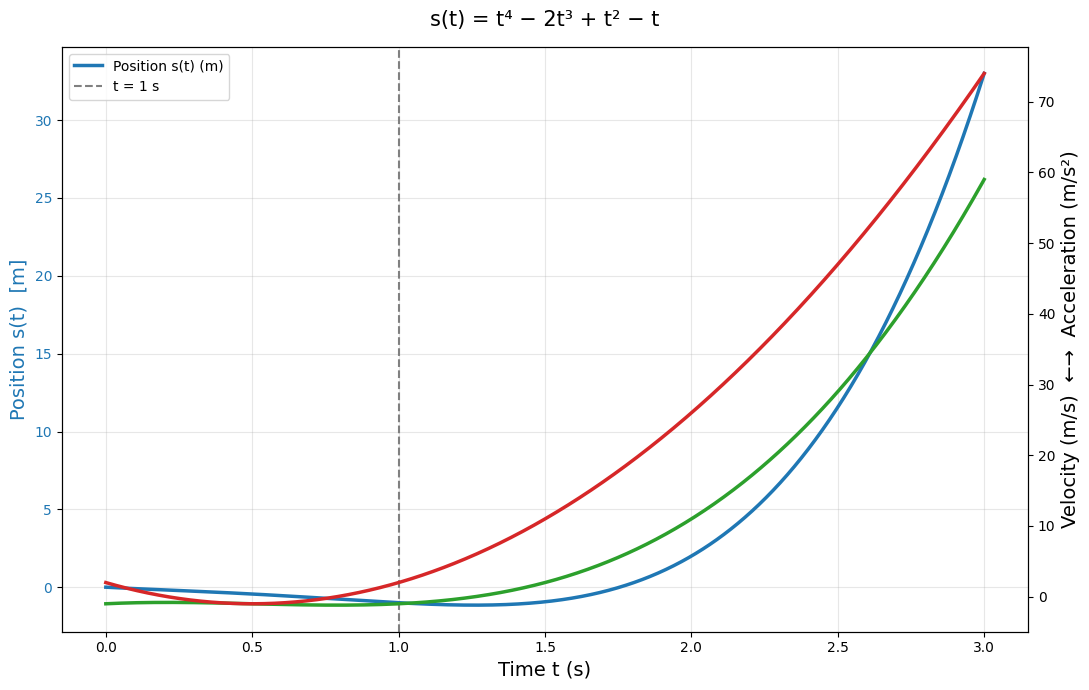
The equation of motion of a particle is given by \(s=t^4-2t^3+t^2-t\text{,}\) where \(s\) is in meters and \(t\) is in seconds.
  1. Find the velocity and acceleration of the particle in terms of \(t.\)
  2. Find the acceleration after \(1\) second.
  3. Graph the position, velocity and acceleration of the function on the same plot.
Solution.
We have
\begin{equation*} s(t)=t^4-2t^3+t^2-t \end{equation*}
  1. \begin{equation*} v(t) = \frac{\,ds}{\,dt}= 4t^3-6t^2+2t-1 \end{equation*}
    \begin{equation*} a(t) = \frac{\,dv}{\,dt}= \frac{\,d}{\,dt}\left(\frac{\,ds}{\,dt}\right)= \frac{\,d^2s}{\,dt^2}= 12t^2-12t+2 \end{equation*}
  2. \begin{equation*} a\vert_{t=1} = 12\cdot 1^2-12\cdot 1+2 = 2 m/s^2. \end{equation*}

Example 3.2.7.

Exponential differentition If \(g(x) = e^{(5x-3)}\) find \(g'(x)\text{.}\)
Solution.
\begin{equation*} g'(x) = e^{(5x-3)} Β· 5 = 5e^{(5x-3)}. \end{equation*}

Example 3.2.8.

when exponents are complicated use Logarithimic differentiation Differentiate \(y = x^x \, (x \gt 0)\)
Solution.
Take \(\ln\) of both sides:
\begin{equation*} \ln y = x \ln x \end{equation*}
Differentiate implicitly:
\begin{equation*} (\frac{1}{y}) y' = \ln x + xΒ·(\frac{1}{x}) \end{equation*}
\begin{equation*} y' = y (\ln x + 1) = x^x (\ln x + 1) \end{equation*}

Example 3.2.9.

Higher-order derivatives. Let \(y = x^4 - 3x^2 + 5 \)
Solution.
\begin{equation*} y' =\frac{\,dy}{\,dx} = 4x^3 - 6x \end{equation*}
\begin{equation*} y" = \frac{\,d^2y}{\,dx^2} = 12x^2 - 6 \end{equation*}
The second derivative as \(y"= \frac{\,d^2y}{\,dx^2} \) tells us concavity and \(\dot{y}= \frac{\,d^2y}{\,dt^2} \) as acceleration.
\begin{equation*} y''' = \frac{\,d^3y}{\,dx^3} = 24x \end{equation*}
\begin{equation*} y^{(4)} = \frac{\,d^4y}{\,dx^4} = 24 \end{equation*}
\begin{equation*} y^{(5)} = \frac{\,d^5y}{\,dx^5} = 0. \end{equation*}
Example 3.2.10.

Differentiate \(\sqrt{\sec x^3}\)
Solution.
Let
\begin{equation*} y = \sqrt{\sec x^3} \end{equation*}
\begin{equation*} \therefore \, \frac{\,dy}{\,dx} = \frac{\,d}{\,d\,(\sec x^3)}(\sec x^3)^{\frac{1}{2}} \cdot \frac{\,d}{\,dx^3}\sec x^3 \cdot \frac{\,d}{\,dx} x^3 \end{equation*}
\begin{equation*} = \frac{1}{2\sqrt{\sec x^3}} \cdot \sec x^3 \tan x^3 \cdot 3x^2 = \frac{3x^2 \sec x^3 \tan x^3}{2\sqrt{\sec x^3}} \end{equation*}

Example 3.2.11.

Differentiate \(y=(2x+1)^5(x^3-x+1)^4\)
Solution.
Let \(u=(2x+1)^5\)
\begin{equation*} \therefore \, u' = 5(2x+1)^4.2 = 10(2x+1)^4 \end{equation*}
\(also,\, v= (x^3-x+1)^4\)
\begin{equation*} \therefore \, v' = 4(x^3-x+1)^3.(3x^2-1) \end{equation*}
\begin{equation*} Hence, \, \frac{\,dy}{\,dx} = \frac{\,d}{\,dx}(uv) = uv'+vu' \end{equation*}
\begin{equation*} = (2x+1)^5\{4(x^3-x+1)^3.(3x^2-1)\}+(x^3-x+1)^4\{10(2x+1)^4\} \end{equation*}
\begin{equation*} =2(2x+1)^4(x^3-x+1)^3\{2(2x+1)(3x^2-1)+(x^3-x+1)5\} \end{equation*}
\begin{equation*} =2(2x+1)^4(x^3-x+1)^3\{17x^3+6x^2-9x+3\} \end{equation*}

Example 3.2.12.

If
\begin{equation*} y= \frac{\log x}{x} +e^x\sin x +\log_5 x, \end{equation*}
find \(\frac{dy}{dx}.\)
Solution.
\begin{equation*} \frac{dy}{dx} = \left(\frac{1}{x} \cdot \frac{1}{x} -\log x\cdot \frac{1}{x^2}\right) +\left(e^x\sin x +e^x\cos x \right) +\left(\frac{1}{x}\log_5 e\right) \end{equation*}
\begin{equation*} = \frac{1}{x^2}\left(1 -\log x\right) +e^x\left(\sin x +\cos x \right) +\left(\frac{1}{x}\log 5\right) \quad \,[\log_5 e= \frac{1}{\log_e 5}] \end{equation*}

Example 3.2.13.

Differentiate:
  1. \begin{equation*} y= \frac{x\tan x}{2^x} \end{equation*}
  2. \begin{equation*} y=x^2\, 2^x\, \sin x \end{equation*}
Solution.
  1. \begin{equation*} y= \frac{x\tan x}{2^x} \end{equation*}
    \begin{equation*} \frac{dy}{dx} = \frac{2^x\left(x\sec^2 x+\tan x\right)-x\tan x\left(2^x \log 2\right)}{(2^x)^2} \end{equation*}
    \begin{equation*} =\frac{\left(x\sec^2 x+\tan x\right)-x\tan x \log 2}{2^x} \end{equation*}
  2. \begin{equation*} y=x^2\, 2^x\, \sin x \end{equation*}
    \begin{equation*} \frac{dy}{dx} = 2x(2^x\, \sin x)+ x^2\cdot 2^x\log 2\sin x + x^2\cdot 2^x\cos x \end{equation*}
    \begin{equation*} = 2^x\ \left[2x \sin x + x^2\log 2\sin x + x^2\cos x\right] \end{equation*}

Example 3.2.14.

If
\begin{equation*} y=\left(x+\sqrt{x^2+a^2}\right)^n \end{equation*}
prove that \(\frac{dy}{dx} = \frac{ny}{\sqrt{x^2+a^2}}.\)
Solution.
\begin{equation*} \frac{dy}{dx} = n\left(x+\sqrt{x^2+a^2}\right)^{n-1}\left[1+\frac{1}{2\sqrt{x^2+a^2}}\times 2x\right] \end{equation*}
\begin{equation*} = n\left(x+\sqrt{x^2+a^2}\right)^{n-1}\left[\frac{\sqrt{x^2+a^2}+x} {\sqrt{x^2+a^2}}\right] \end{equation*}
\begin{equation*} = \frac{n\left(x+\sqrt{x^2+a^2}\right)^n}{\sqrt{x^2+a^2}}=\frac{ny}{\sqrt{x^2+a^2}} \end{equation*}

Example 3.2.15.

If \(y=f(\sin x) \) and \(f'(x)= \frac{1+x}{1-x}\text{,}\) find \(\frac{dy}{dx}.\)
Solution.
\begin{equation*} y=f(\sin x) \end{equation*}
Differentiate w.r.t. "x"
\begin{equation*} \frac{dy}{dx} = f'(\sin x)\cos x = \left[\frac{1+\sin x}{1-\sin x}\right]\cos x \end{equation*}
Remember \(f'(\sin x) \neq \frac{d}{dx}f(\sin x)\)

Example 3.2.16.

\begin{equation*} y =\sin (x^2+1) \end{equation*}
Solution.
\begin{equation*} \frac{dy}{dx} = \frac{d}{dx}\left[\sin (x^2+1) \right] = \frac{d[\sin (x^2+1)]}{d(x^2+1)}\times \frac{d(x^2+1)}{dx} =\cos (x^2+1)2x. \end{equation*}

Example 3.2.17.

\begin{equation*} y=\log (x+\sqrt{a^2+x^2}) \end{equation*}
\begin{equation*} \frac{dy}{dx} = \frac{d}{dx}\left[\log (x+\sqrt{a^2+x^2})\right] \end{equation*}
\begin{equation*} = \left(\frac{1}{x+\sqrt{a^2+x^2}}\right)\left(1+\frac{1}{2\sqrt{a^2+x^2}2x}\right) \end{equation*}
\begin{equation*} = \left(\frac{1}{x+\sqrt{a^2+x^2}}\right)\left(\frac{\sqrt{a^2+x^2}+x}{\sqrt{a^2+x^2}}\right) \end{equation*}
\begin{equation*} = \frac{1}{\sqrt{a^2+x^2}}. \end{equation*}

Example 3.2.18.

\begin{equation*} \frac{d}{dx}\left[\cos (\ln x)\right] = -\sin (\ln x)\cdot \frac{1}{x}. \end{equation*}
\begin{equation*} \frac{d}{dx}\left[\sin [\ln (tan x)]\right] = -\cos (\ln (\tan x))\cdot \frac{1}{\tan x}\sec^2 x. \end{equation*}
\begin{equation*} \frac{d}{dx}\left[\sqrt{\sin x^2}\right] = \frac{d}{dx}(\sin x^2)^(1/2) \end{equation*}
\begin{equation*} = \frac{1}{2} (\sin x^2)^{-\frac{1}{2}}\cos x^2\cdot 2x = \frac{x\cos x^2}{\sqrt{\sin x^2}}. \end{equation*}

Example 3.2.19.

Find the derivative of
\begin{equation*} g(t) = \left(\frac{t-2}{2t+1}\right)^9 \end{equation*}
Solution.
\begin{align*} g(t) \amp = \left(\frac{t-2}{2t+1}\right)^9 \\ g'(t) \amp = \frac{dg}{dt} = \frac{dg}{du}\times \frac{du}{dt} \end{align*}
\begin{align*} Let \, u \amp = \left(\frac{t-2}{2t+1}\right) \\ \frac{du}{dt} \amp = \frac{(2t+1)(1)-(t-2)2}{(2t+1)^2}\\ and \, g(u) \amp = u^9 \\ \frac{dg}{du} \amp = 9u^8 = 9\left(\frac{t-2}{2t+1}\right)^8 \\ \therefore \, g'(t) \amp = 9\left(\frac{t-2}{2t+1}\right)^8 \left[ \frac{(2t+1)-2(t-2)}{(2t+1)^2} \right] \\ \amp = 9\left(\frac{t-2}{2t+1}\right)^8 \left[ \frac{5}{(2t+1)^2} \right] = \frac{45(t-2)^8}{(2t+1)^10} \end{align*}

