Chapter 3 Differentiation

Differentiation is the process of finding the derivative of a function, which measures how the function’s output changes with respect to its input. It is the instantaneous rate of change or the slope of the tangent line to the curve at a point. [FigureΒ 2.1.2]
Geometrically, (\(f'(a)\)) represents the slope of the tangent line to the graph of the function at that point (\(x = a\)).
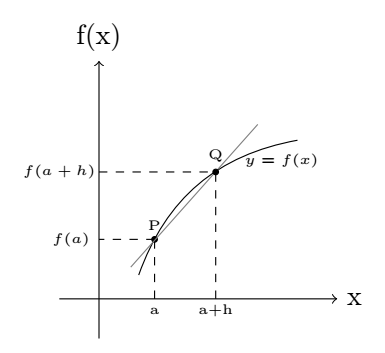
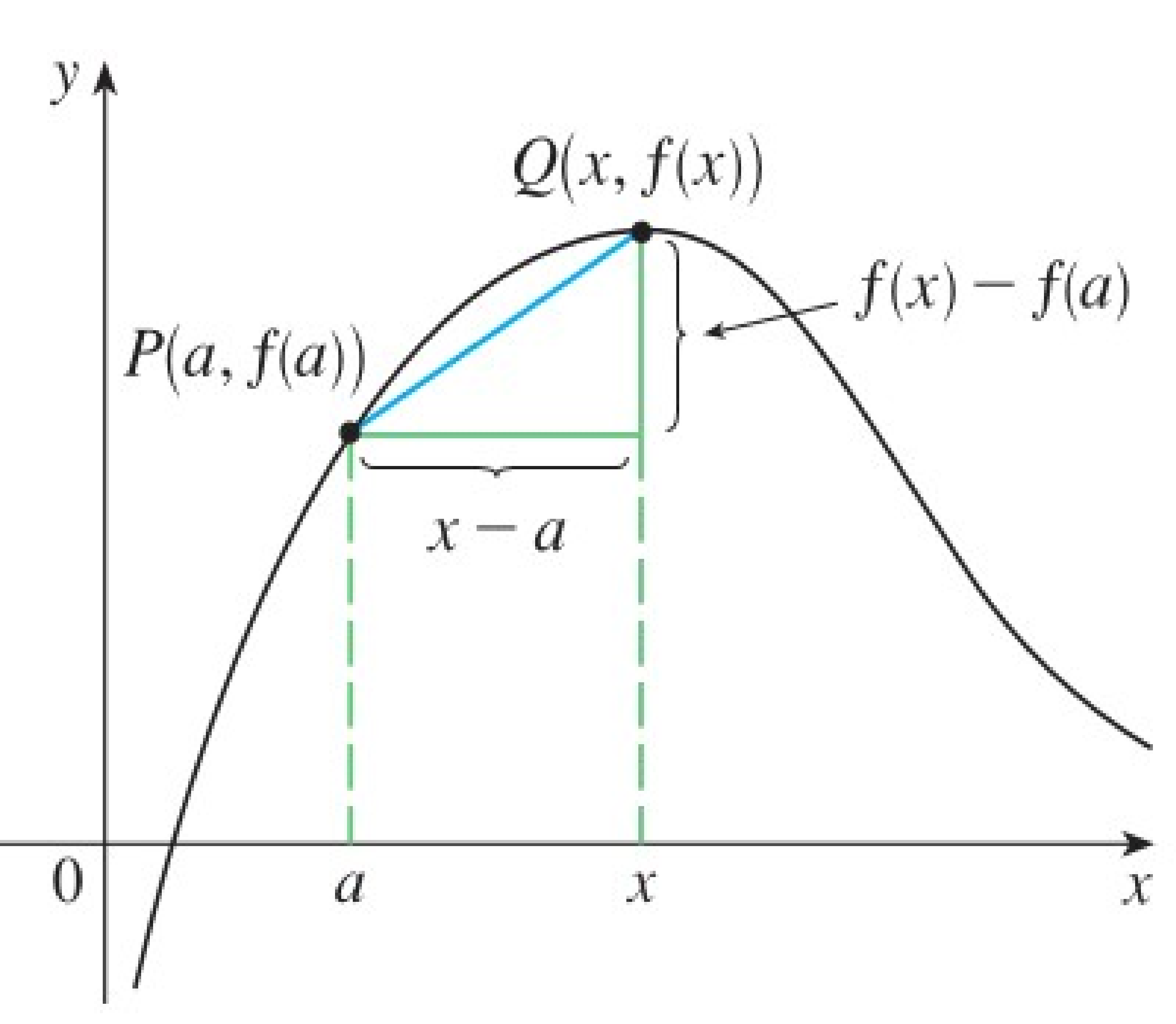
Consider a function \(f(x)\) and a point \(P (a, f(a))\) on its graph. The secant line through \(P\) and a nearby point \(Q = (a + h, f(a + h))\) has slope
\begin{equation} m_{\text{sec}} = \frac{f(x_2) - f(x_1)}{x_2-x_1} = \frac{f(a + h) - f(a)}{h} \tag{3.0.1} \end{equation}
\begin{equation*} or, \, f'(a)=\frac{f(x) - f(a)}{x-a} \end{equation*}
It is a difference quotient [SubsectionΒ 2.1.8] and gives the average rate of change of \(y\) with respect to \('x'\) over the interval \([x_1, x_2]\text{.}\) As \(Q\) approaches \(P\) (i.e., \(h \to 0\)), this secant slope approaches the tangent slope at \(P\text{.}\) Then this average rate of change becomes instantaneous rate of change of \(y\) with respect to \('x'\) at \(x=x_1\) which represents the slope of tangent line to the curve \(y=f(x)\) at \(P(x_1, f(x_1))\) as \(x_2 \to x_1.\) i.e.,
\begin{equation} f'(x_1) = \lim_{x_2 \to x_1}\frac{f(x_2)-f(x_1)}{x_2-x_1}.\tag{3.0.2} \end{equation}
or,
\begin{equation*} f'(x) = \lim_{h \to 0}\frac{f(x+h)-f(x)}{h}. \end{equation*}
The tangent line to the curve \(y=f(x)\) at the point \(P(a, f(a))\) is the line through \(P\) with slope
\begin{equation*} m = \lim_{x \to a} \frac{f(x) - f(a)}{x-a} =\lim_{h \to 0} \frac{f(a + h) - f(a)}{h}. \end{equation*}
or,
\begin{equation} f(x)-f(a)= m(x-a)\tag{3.0.3} \end{equation}
The derivative of a function \(f(x)\) is defined as \(f'(x)\) (or \(\frac{dy}{dx}\)):
\begin{equation*} f'(x) = \lim_{h \to 0} \frac{f(x+h) - f(x)}{h} \end{equation*}
provided the limit exists. At a point \(x=a\) it is
\begin{equation*} f'(a) = \lim_{h \to 0} \frac{f(a+h) - f(a)}{h}\text{.} \end{equation*}
The first principle (definition of the derivative) is:
\begin{equation} f'(x) = \lim_{h \to 0} \frac{f(x+h) - f(x)}{h}\tag{3.0.4} \end{equation}

Example 3.0.1.

Find an equation of the tangent line to the parabola \(y = x^2\) at the point \(P(1, 1)\text{.}\)
Solution.
Here, we have \(a = 1\) and \(f(x)= x^2\text{,}\) so the slope is
\begin{equation*} m = \lim_{x \to 1} \frac{f(x) - f(1)}{x-1}. \end{equation*}
\begin{equation*} or, \, m = \lim_{x \to 1} \frac{x^2 - 1}{x-1} = \lim_{x \to 1} \frac{(x-1)(x+1)}{(x-1)} = \lim_{x \to 1} (x+1) =1+1=2. \end{equation*}
Using the point-slope form of the equation of a line [(3.0.3)], we find that an equation of the tangent line at \((1, 1)\) is
\begin{equation*} y-1= 2(x-1) \end{equation*}
or,
\begin{equation*} y=2x-1. \end{equation*}

Example 3.0.2.

Find an equation of the tangent line to the hyperbola \(y =\frac{3}{x}\) at the point \((3, 1).\)
Solution.
Let \(f(x)=\frac{3}{x}\text{.}\) Then the slope of the tangent [(3.0.4)] at \((3, 1)\) is
\begin{equation*} m = f'(x) = \lim_{h \to 0} \frac{f(x+h) - f(x)}{h} \end{equation*}
\begin{align*} or, f'(a) \amp = \lim_{h \to 0} \frac{f(3+h) - f(3)}{h} \\ \amp = \lim_{h \to 0} \frac{\frac{3}{3+h} - \frac{3}{3}}{h} = \lim_{h \to 0} \frac{\frac{3}{3+h} - 1}{h}\\ \amp = \lim_{h \to 0} \frac{\frac{3-(3+h)}{3+h}}{h} =\lim_{h \to 0} \frac{-h}{h(3+h)} =\lim_{h \to 0} \frac{-1}{(3+h)} = \frac{-1}{3}. \end{align*}
Therefore an equation of the tangent at the point \((3,1)\) is
\begin{equation*} y-1= \frac{-1}{3}(x-3) \end{equation*}
or,
\begin{equation*} x+3y-6 = 0. \end{equation*}
