Section 2.3 Example A

Example 2.3.1.

Find:
\begin{equation*} \lim_{x \to -4} \frac{5x}{\lvert{x+4}\rvert} \end{equation*}
Solution.
convert modulus function in algebric function as
\begin{equation*} \lvert{x+4}\rvert = \begin{cases} x+4; & \text{for } x+4 \gt 0 \, \rightarrow x \gt -4 \\ -(x+4); & \text{for } x+4 \lt 0 \, \rightarrow x \lt -4 \\ \end{cases} \end{equation*}
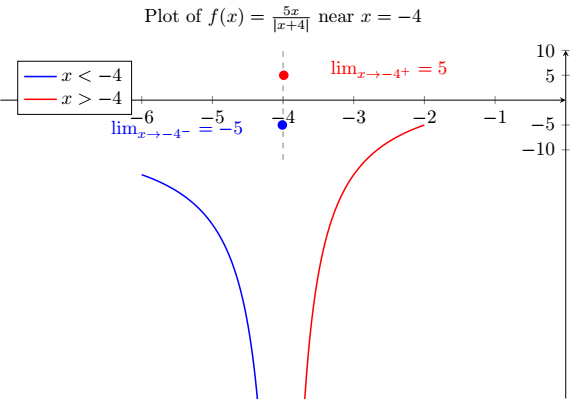
From left hand limit (LHL)
\begin{equation*} = \lim_{x \to -4^-} \frac{5x}{-(x+4)} \, [Form: \frac{\#}{0}] \end{equation*}
\begin{equation*} = \lim_{x \to -4^-} \frac{5x}{-(x+4)} = \frac{-ve \,\#}{+ ve \,\#} = -ve \,\#. \end{equation*}
Since, \(x \lt -4 \)
From right hand limit (RHL)
\begin{equation*} = \lim_{x \to -4^+} \frac{5x}{(x+4)} \, [Form: \frac{\#}{0}] \end{equation*}
\begin{equation*} = \lim_{x \to -4^+} \frac{5x}{(x+4)} = \frac{-ve \,\#}{- ve \,\#} = +ve \,\#. \end{equation*}
Since, \(x \gt -4 \text{.}\)
Hence, the limit does not exist as
\begin{equation*} \lim_{x \to -4^-} \frac{5x}{\lvert{x+4}\rvert} \neq \lim_{x \to -4^+} \frac{5x}{\lvert{x+4}\rvert}. \end{equation*}
Indeterminant Forms of Limit.

If
\begin{equation*} \lim_{x \to a^-} f(x)=\lim_{x \to a^+} f(x) = l \text{ finit} \end{equation*}
then we say the
\begin{equation*} \lim_{x \to a} f(x) \end{equation*}
exists and
\begin{equation*} \lim_{x \to a} f(x)=l. \end{equation*}
If \(f\to 0\) and \(g\to 0\text{,}\) then \(f^g\) is in indetrminant form.
\(0^2 =0^1=0,\) \(5^0=7^0=1\text{,}\) \(5\times 0 = 0\) are determinant forms.
However, \(0^0\) can not tell whether it is determinant or inderminant without looking at the context.

Example 2.3.2.

Evaluate:
\begin{equation*} \lim_{x \to 0} \frac{(1-x)^{1/5}-1}{x} \end{equation*}
Solution.
Set, \(1-x=t^5\) and as \(x\to 0,\) \(t\to 1.\)
\begin{equation*} \lim_{t \to 1} \frac{(t-1)}{1-t^5} = - \lim_{t \to 1} \frac{\cancel{(t-1)}}{\cancel{(t-1)}(t^4+t^3+t^2+t+1)} =-\frac{1}{5}. \end{equation*}
Using Binomial Expression
\begin{equation*} \lim_{x \to 0} \frac{1-\frac{1}{5}x+\cdots -1}{x} = - \lim_{x \to 0}\frac{1}{5} \frac{x}{x} = -\frac{1}{5} \end{equation*}
Using L Hosppital’s Rule
\begin{equation*} \lim_{x \to 0} \frac{\frac{1}{5}(1-x)^{-4/5}(-1)}{1} = -\frac{1}{5}. \end{equation*}

Example 2.3.3.

If
\begin{equation*} \lim_{x\to -2} \frac{3x^2+ax+a+3}{x^2+x-2} \end{equation*}
exists then find the value of \(a.\)
Solution.
At \(x\to -2,\) \(x^2+x-2 =0\) then
\begin{equation*} \lim_{x\to -2} 3x^2+ax+a+3 =0 \end{equation*}
see remark [RemarkΒ 2.2.3].
\(3\times 4 -2a +a+3 =0\) or, \(a=15.\)

Example 2.3.4.

Rationalization method:
\begin{equation*} \lim_{x\to 4} \frac{\sqrt{4x+9}-5}{x-4} \end{equation*}
Solution.
\begin{equation*} \lim_{x\to 4} \frac{\sqrt{4x+9}-5}{x-4} \times \frac{\sqrt{4x+9}+5}{\sqrt{4x+9}+5} \end{equation*}
\begin{equation*} = \lim_{x\to 4} \frac{(4x+9)-25}{(x-4)(\sqrt{4x+9}+5)} =\lim_{x\to 4} \frac{4x-16}{(x-4)(\sqrt{4x+9}+5)} \end{equation*}
\begin{equation*} =\lim_{x\to 4} \frac{4}{\sqrt{4x+9}+5} =\frac{4}{\sqrt{16+9}+5} = 2/5. \end{equation*}

Example 2.3.5.

When \(x\to \infty\) or \(-\infty\text{,}\) then just take biggest terms in nemerator and denominator common.
\begin{equation*} \lim_{x\to \infty} \frac{x^3-2x^2+1}{5x^3+x+3} \end{equation*}
Solution.
\begin{equation*} \lim_{x\to \infty} \frac{x^3(1-2/x+1/x^3)}{x^3(5+1/x^2+3/x^3)} = 1/5. \end{equation*}

Remark 2.3.6.

  • If quotient functions of top and bottom has same power of variable, then we get finite value after substitution of \(\lim_{x\to \infty}.\)
  • If bottom function has higher power then the top function, then \(\lim_{x\to \infty}\) gives zero.
  • If top function has higher power then the bottom function, then \(\lim_{x\to \infty}\) gives either \(\infty\) or, \(-\infty\text{.}\)

Example 2.3.7.

If
\begin{equation*} \lim_{x\to \infty} \frac{x^2+x+1}{x+1}-ax-b=4, \end{equation*}
then find the value of \(a\) and \(b.\)
Solution.
Solution: Set as
\begin{equation*} \lim_{x\to \infty} \frac{x^2+x+1}{x+1}-ax-b-4=0, \end{equation*}
or,
\begin{equation*} \lim_{x\to \infty} \frac{(x^2+x+1)-(ax+b+4)(x+1)}{x+1}=0, \end{equation*}
or,
\begin{equation*} \lim_{x\to \infty} \frac{x^2+x+1-ax^2-ax-bx-b-4x-4}{x+1}=0, \end{equation*}
or,
\begin{equation*} \lim_{x\to \infty} \frac{x^2(1-a) +x(1-a-b-4) -3}{x+1}=0, \end{equation*}
To get expression zero, bottom power must be high but it is not the condition here so set the coefficient of \(x^2\) and \(x\) to be zero.
Hence, \(1-a=0 \, \Rightarrow \, a=1\)
and, \(1-a-b-4=0, \, \Rightarrow b=-4\)

Example 2.3.8.

Find:
\begin{equation*} \lim_{x\to y} \frac{\sin^2x-\sin^2y}{x^2-y^2} \end{equation*}
here x is a variable as x is going to y.
Solution.
\begin{equation*} \lim_{x\to y} \frac{\sin(x-y)\sin(x+y)}{(x-y)(x+y)} = \lim_{x\to y} \frac{\sin(x-y)}{(x-y)} \times \frac{\sin(x+y)}{(x+y)} \end{equation*}
\begin{equation*} = \frac{\sin(y+y)}{(y+y)} = \frac{\sin 2y}{2y}. \end{equation*}

Example 2.3.9.

Evaluate:
\begin{equation*} \lim_{x\to \frac{\pi}{2}} \frac{1+\cos 2x}{(\pi-2x)^2} \end{equation*}
Solution.
\begin{equation*} \lim_{x\to \frac{\pi}{2}} \frac{1+\cos 2x}{(\pi-2x)^2} \end{equation*}
\begin{equation*} \lim_{x\to \frac{\pi}{2}} \frac{2\cos^2 x}{(\pi-2x)^2} \end{equation*}
Now change limit as \(x-\frac{\pi}{2} =t\) so that \(t\to 0\) as \(x\to \frac{\pi}{2}\)
\begin{equation*} \therefore \, \lim_{ t \to 0} \frac{2\cos^2 (\frac{\pi}{2}+t)}{(4t)^2}=\frac{1}{2} \end{equation*}

Example 2.3.10.

Find:
\begin{equation*} \lim_{x\to 0} \frac{x\tan 2x-2x\tan x}{(1-\cos 2x)^2} \end{equation*}
Solution.
\begin{equation*} \lim_{x\to 0} \frac{x\tan 2x-2x\tan x}{(2\sin^2 x)^2} = \lim_{x\to 0} \frac{x\tan 2x-2x\tan x}{4\sin^4 x} \end{equation*}
\begin{equation*} = \lim_{x\to 0} \frac{x(\tan 2x-2\tan x)}{\frac{4\sin^4 x}{x^4}\times x^4} \end{equation*}
\begin{equation*} = \lim_{x\to 0} \left[ \frac{\frac{2\tan x}{(1-\tan^2x)}-2\tan x}{4x^3\left(\frac{\sin^4x}{x^4}\right)}\right] \end{equation*}
\begin{equation*} = \lim_{x\to 0} \left[ \frac{2\tan x (1-1+\tan^2 x)}{(1-\tan^2 x)4x^3\left(\frac{\sin^4x}{x^4}\right)}\right] \end{equation*}
\begin{equation*} = \lim_{x\to 0} \frac{\tan^3 x}{2x^3\left(\frac{\sin^4x}{x^4}\right)} =1/2. \end{equation*}
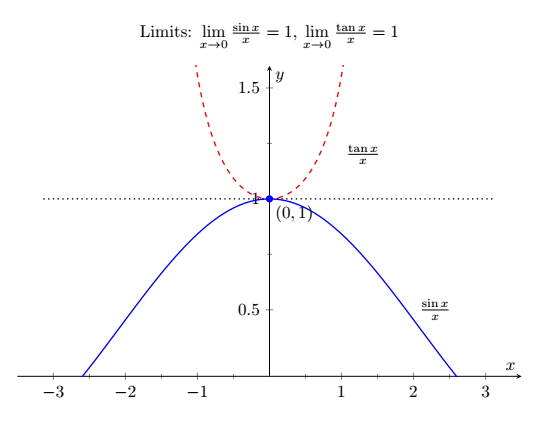
As \(x\to 0, \) \(\frac{\sin x}{x} \to 1\) but slightly less than 1.
and as \(x\to 0, \) \(\frac{\tan x}{x} \to 1\) but slightly greater than 1.

Example 2.3.11.

\begin{equation*} \lim_{h\to 0} \frac{\ln(1+2h)-2\ln(1+h)}{h^2} \end{equation*}
Solution.
\begin{equation*} \lim_{h\to 0} \frac{\ln(1+2h)-2\ln(1+h)}{h^2} \end{equation*}
\begin{equation*} \qquad = \lim_{h\to 0} \frac{(2h -4h^2/2+.....)-2(h-h^2/2+---)}{h^2} =-1 \end{equation*}

Example 2.3.12.

If
\begin{equation*} \lim_{x\to 1} \frac{x^2-ax+b}{x-1} =5 \end{equation*}
then find the value of \(a+b.\)
Solution.
At \(x\to 1,\) \(x-1 =0\text{,}\) then
\begin{equation*} \lim_{x\to 1} (x^2-ax+b) =0 \end{equation*}
or,
\begin{equation*} 1-a+b=0 \end{equation*}
from L Hospital rule:
\begin{equation*} \lim_{x\to 1} \frac{(2x-a)}{1} =5 \end{equation*}
or,
\begin{equation*} 2-a=5\, \Rightarrow \, a =-3 \end{equation*}
From previous equation,
\begin{align*} 1-a+b \amp =0\\ or, \, 1+3+b \amp =0\\ \therefore \, b \amp = -4 \end{align*}
Hence,
\begin{equation*} a+b=-3-4=-7. \end{equation*}

Example 2.3.13.

\begin{equation*} \lim_{x\to 0^+} x\ln x \end{equation*}
Solution.
Rewrite as
\begin{equation*} \lim_{x\to 0^+} \frac{\ln x}{\frac{1}{x}} \end{equation*}
Use L’Hospital’s rule
\begin{equation*} \lim_{x\to 0^+} \frac{\frac{1}{x}}{-\frac{1}{x^2}}= \lim_{x\to 0^+} -x = 0. \end{equation*}

Example 2.3.14.

  1. \begin{equation*} \lim_{x\to 2} \frac{x^2-3x+2}{x^2-4} \end{equation*}
  2. \begin{equation*} \lim_{x\to 0} \frac{\sqrt{x+1}-1}{x} \end{equation*}
  3. \begin{equation*} \lim_{x\to 1} \frac{x^3-1}{\sqrt{x}-1} \end{equation*}
  4. \begin{equation*} \lim_{x\to -2} \frac{x^2+x-2}{\lvert x+2 \rvert} \end{equation*}
  5. \begin{equation*} \lim_{x\to 3} \frac{\sqrt{2x+3}-3}{x-3} \end{equation*}

Checkpoint 2.3.15.

Checkpoint 2.3.16.

Checkpoint 2.3.17.

Checkpoint 2.3.18.

Checkpoint 2.3.19.

Checkpoint 2.3.20.

Checkpoint 2.3.21.

Example 2.3.22.

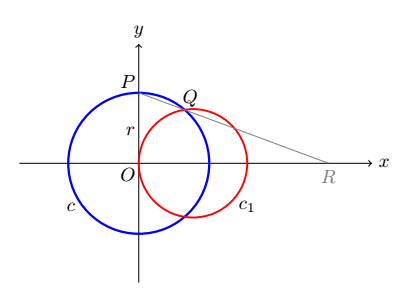
A shrinking circle \(c\) with radius \(r\) at the origin is defined by \(c(r) = \{ x^2 + y^2 = r^2\}.\) Another circle \(c_1\) is tangential to the y-axis at the origin is defined by \(c_1 = \{ (x-1)^2+y^2 = 1\}.\) The line \(PR\) intersected to the circles \(c\) and \(c_1\) at \(Q.\) What happens to \(R\) as circle \(c\) shrinks to \(r \to 0^+\text{.}\)
Solution.
Find point Q: The fixed circle is defined by
\begin{align*} (x-1)^2+y^2 \amp =1 \\ x^2-2x+1+y^2 \amp =1\\ x^2+y^2 \amp =2x \end{align*}
The shrinking circle is defined by
\begin{equation*} x^2+y^2=r^2 \end{equation*}
To find the intersection point \(Q\text{,}\) we substitute \(x^2+y^2=r^2\) into the fixed circle equation \(x^2+y^2=2x\text{,}\) giving us \(r^2=2x\text{,}\) so \(x=\frac{r^2}{2}\text{.}\) Substituting back into the shrinking circle equation, we get
\begin{equation*} y^2=r^2-\frac{r^4}{4} \end{equation*}
\begin{equation*} y= \pm\frac{r\sqrt{4-r^2}}{2} \end{equation*}
So the coordinates of point \(Q\) to the right are
\begin{equation*} \left(\frac{r^2}{2}, \frac{r\sqrt{4-r^2}}{2}\right) \end{equation*}
Find the line PQ: \(P(0,r)\) and \(Q\left(\frac{r^2}{2}, \frac{r\sqrt{4-r^2}}{2}\right)\)
The slope \(m\) of line \(PQ\) is
\begin{equation*} m = \frac{\frac{r\sqrt{4-r^2}}{2} - r}{\frac{r^2}{2} - 0} = \frac{r\sqrt{4-r^2} - 2r}{r^2} = \frac{\sqrt{4-r^2} - 2}{r} \end{equation*}
The equation of line through point \(P\) and \(Q\) is
\begin{equation*} y -r = \frac{\sqrt{4-r^2} - 2}{r}(x - 0) \end{equation*}
Find point R: Point \(R\) occurs where \(y=0.\) Therefore
\begin{equation*} 0 - r = \frac{\sqrt{4-r^2} - 2}{r}(x - 0) \quad \Rightarrow \quad x = \frac{r^2}{2-\sqrt{4-r^2}} \end{equation*}
Evaluate the limit: As \(r \to 0^+\text{,}\) we have \(\sqrt{4-r^2} \to 2\text{,}\) so the denominator \(2-\sqrt{4-r^2}\) approaches zero.
To evaluate the limit, we can use the conjugate to rationalize the denominator:
\begin{equation*} \lim_{r \to 0^+} \frac{r^2}{2-\sqrt{4-r^2}} \cdot \frac{2+\sqrt{4-r^2}}{2+\sqrt{4-r^2}} = \lim_{r \to 0^+} \frac{r^2(2+\sqrt{4-r^2})}{4-(4-r^2)} \end{equation*}
\begin{equation*} = \lim_{r \to 0^+} \frac{r^2(2+\sqrt{4-r^2})}{r^2} = \lim_{r \to 0^+} (2+\sqrt{4-r^2}) = 4. \end{equation*}
Hence, as the circle shrinks, point \(R\) approaches the point \((4,0)\text{.}\)