Section 3.7 Examples

Example 3.7.1.

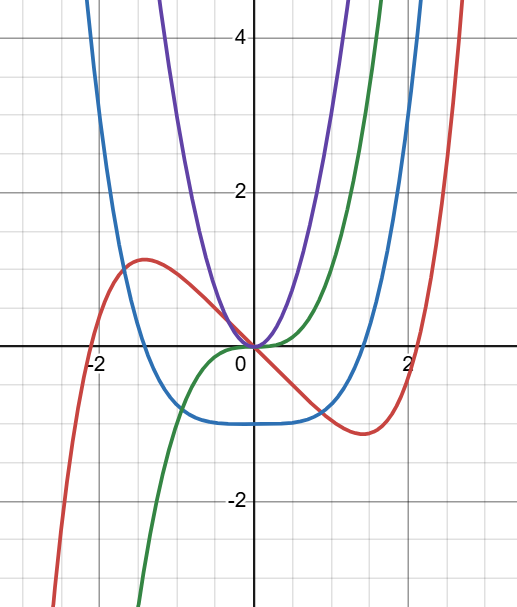
From the curve of given plots identify the functions and explain your reasoning.
Solution.
select one curve as a function of \(f(x)\) and starts ploting its higher derivative curve as \(f'(x), \, f''(x), \, etc.\text{.}\)
The main function is similar to \(f(x) = x^5-x\) which is the last red curve (d), \(f\prime (x)= x^4-1\) is blue curve (c), \(f\prime\prime(x)=x^3\) is green curve (b), and the first purple curve (a) is similar to \(f'''(x)=x^2.\)
Checkpoint 3.7.9.

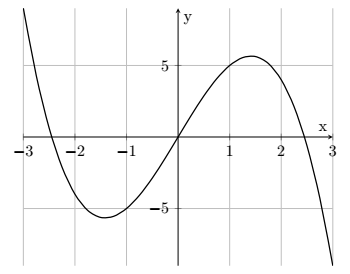
If \(f(x) = x^3-x\) is a position function then plot its velocity function \(f'(x)\text{,}\) its acceleration function \(f''(x)\text{,}\) and finally its jerk function \(f^{iv} (x).\)

Example 3.7.10.

Find the derivative of the function given below using first principles (or by the definition of derivative).
  1. \(\displaystyle f(x) = 2x + 5\)
  2. \(\displaystyle g(x)=3\)
  3. \(\displaystyle y=x^3\)
  4. \(\displaystyle f(x) = 4x^2 - 2x\)
  5. \(\displaystyle f(x)=\frac{1}{x}\)
  6. \(\displaystyle f(x)=\sqrt{x}\)
  7. \(\displaystyle y = x^4 \)
Solution.
  1. \(f(x) = 2x + 5\)
    \begin{align*} f'(x) \amp = \lim_{h \to 0} \frac{f(x+h)-f(x)}{h}\\ \amp = \lim_{h \to 0} \frac{[2(x+h)+5]-(2x+5)}{h}\\ \amp = \lim_{h \to 0} \frac{2x+2h+5-2x-5}{h} \\ \therefore \, f'(x) \amp = \lim_{h \to 0} \frac{2h}{h} = 2 \end{align*}

Example 3.7.11.

Find an equation of the tangent line to the curve at the given point.
\begin{equation*} y=1-2x-3x^2, \, (-2,7) \end{equation*}
Solution.
Using first principle
\begin{equation*} m =f'(a) = \lim_{h \to 0} \frac{f(a + h) - f(a)}{h} = \lim_{h \to 0} \frac{f(-2 + h) - f(-2)}{h} \end{equation*}
\begin{equation*} = \lim_{h \to 0} \frac{[1-2(-2 + h)-3(-2+h)^2] - [1-2(-2)-3(-2)^2}{h} \end{equation*}
\begin{equation*} = \lim_{h \to 0} \frac{[-7+10h-3h^2] - [-7]}{h} \end{equation*}
\begin{equation*} = \lim_{h \to 0} \frac{h(10-3h)}{h} = \lim_{h \to 0} (10-3h) =10. \end{equation*}
Now, equation of tangent line is [(3.0.3)]
\begin{equation*} y_2-y_1=m(x_2-x_1) \end{equation*}
\begin{equation*} \therefore \, y-7 = 10(x+2) \end{equation*}
or
\begin{equation*} y=10x+13. \end{equation*}

Example 3.7.12.

If a ball is thrown into the air with a velocity of \(40 ft/s\text{,}\) its height ( in feet) after t seconds is given by \(y = 40t - 16t^2\text{.}\) Find the velocity when \(t = 2\text{.}\)
Solution.
here
\begin{equation*} y = f(t) = 40t - 16t^2 \end{equation*}
Using first principle [(3.0.4)]
\begin{align*} v_{a} = f'(x) \amp = \lim_{h \to 0} \frac{f(x+h) - f(x)}{h} \\ \amp = \lim_{h \to 0} \frac{[40(t+h)-16(t+h)^2] - [40t - 16t^2]}{h} \\ \amp = \lim_{h \to 0} \frac{[40t+40h-16(t^2+2th+h^2)] - [40t - 16t^2]}{h} \\ \amp = \lim_{h \to 0} \frac{\cancel{40t}+40h-\cancel{16t^2}-32th-16h^2 - \cancel{40t} + \cancel{16t^2}}{h} \\ \amp = \lim_{h \to 0} \frac{\cancel{h}(40-32t-16h)}{\cancel{h}} \\ \amp = \lim_{h \to 0} (40-32t-16h) = 40-32t \\ \therefore \,v_{t=2} \amp = 40-32\times 2 = -24 \end{align*}
Answer.
\(\therefore \, v_{t=2} = -24 \, ft/s.\)

Example 3.7.13.

The displacement of a particle moving in a straight line is given by \(s=t^2-8t+18,\) where \(t\) is time in seconds and \(s\) is displacement in meters.
  1. Find the average velocity of the particle over the time interval \([2,3]\text{.}\)
  2. Find the instantaneous velocity at \(t=3.\)
Solution.
here, \(s=t^2-8t+18\)
  1. From [(3.0.1)]
    \begin{equation*} f'(x) = \frac{f(x_2) - f(x_1)}{x_2-x_1} \end{equation*}
    \begin{equation*} v_{avg} = \frac{s(t_3) - s(t_2)}{t_3-t_2} = \frac{(3^2-8\times 3+18) - (2^2-8\times 2+18)}{3-2} \end{equation*}
    \begin{equation*} \, = \frac{(9-24+18) - (4-16+18)}{1} = \frac{(3) - (6)}{1} = -3 \end{equation*}
    \(\therefore \, v_{avg} =-3 \, m/s \)
  2. From [(3.0.4)]
    \begin{equation*} f'(x) = \lim_{h \to 0} \frac{f(x+h) - f(x)}{h} \end{equation*}
    \begin{align*} v(a) \amp = \lim_{h \to 0} \frac{s(t+h) - s(t)}{h} \\ \amp = \lim_{h \to 0} \frac{[(t+h)^2-8(t+h)+18] - [t^2-8t+18]}{h} \\ \amp = \lim_{h \to 0} \frac{\cancel{t^2}+2th+h^2-\cancel{8t}-8h+\cancel{18} - \cancel{t^2}+\cancel{8t}-\cancel{18}}{h} \\ \amp = \lim_{h \to 0} \frac{h(2t+h-8)}{h} \\ \amp = \lim_{h \to 0} 2t+h-8 = 2t-8\\ \therefore \, v(a)=v(3) \amp =2\times 3-8 = -2 \, m/s \end{align*}

Example 3.7.14.

Find an equation of the tangent line if the graph of \(y=g(x)\) at \(x=5\text{,}\) \(g(5)=-3\) and \(g'(5)=4.\)
Solution.
From eqn. (3.0.2)
\begin{equation*} f'(x_1) = \lim_{x_2 \to x_1}\frac{f(x_2)-f(x_1)}{x_2-x_1}. \end{equation*}
\begin{equation*} g'(5) = \lim_{x \to 5}\frac{g(x)-g(5)}{x-5}. \end{equation*}
\begin{equation*} 4 = \frac{y+3}{x-5}. \end{equation*}
\begin{equation*} y+3 = 4x-20 \, \Rightarrow \, y=4x-23. \end{equation*}

Example 3.7.15.

If the tangent line to \(y=f(x)\) at \((4,3)\) passes through the point \((0,2),\) find \(f(4)\) and \(f'(4).\)
Solution.
The function passes through the point \((4, 3)\text{,}\) so \(f(4) = 3.\) The tangent line at \((4, 3)\) has slope \(f'(4)\) and passes through \((0,2)\text{.}\) Hence from equation of secant (3.0.1)
\begin{equation*} f'(a) = \frac{f(x) - f(a)}{x-a}. \end{equation*}
\begin{equation*} f'(4) = \frac{f(4) - f(0)}{4-0} = \frac{3 - 2}{4} = \frac{1}{4}. \end{equation*}

Example 3.7.16.

Find an equation of a tangent line to the curve \(y=3x^2-x^3 \) at the point (1,2).
Solution.
The tangent line at \((1,2)\) has slope \(f'(1)\) and at \(a=1, f(1)=2\text{.}\) Hence from the equation of tangent line
\begin{equation*} f'(a) = \lim_{x\to a}\frac{f(x) - f(a)}{x-a}. \end{equation*}
at point (1,2)
\begin{align*} f'(x) \amp = \lim_{h\to 0}\frac{f(x+h) - f(x)}{h} \\ \amp = \lim_{h\to 0}\frac{[3(x+h)^2-(x+h)^3] - 3x^2+x^3}{h} \\ \amp = \lim_{h\to 0}\frac{[3(x^2+h^2+2xh)-(x^3+h^3 + 3x^2h+3xh^2)] - 3x^2+x^3}{h} \\ \amp = \lim_{h\to 0}\frac{3x^2+3h^2+6xh-x^3-h^3 - 3x^2h-3xh^2 - 3x^2+x^3}{h} \\ \amp = \lim_{h\to 0}\frac{\cancel{3x^2}+3h^2+6xh-\cancel{x^3}-h^3 - 3x^2h-3xh^2 - \cancel{3x^2}+\cancel{x^3}}{h} \\ \amp = \lim_{h\to 0}\frac{(6x-3x^2)h}{h}+ \lim_{h\to 0}\frac{(3h-h^2-3xh)h}{h}\\ \amp = 6x-3x^2\\ \therefore \, f'(1) \amp = 6\times 1-3\times 1^2 = 3. \end{align*}
or solve \(f'(a) = \lim_{h\to 0}\frac{f(a+h) - f(a)}{h}.\)
Now the equation of tangent line is [(3.0.3)]
\begin{equation*} y-2 = 3(x-1) \, \Rightarrow \, y = 3x - 1. \end{equation*}

Example 3.7.17.

Determine whether \(f'(0)\) exists for
\begin{equation*} f(x)= \begin{cases} x\sin{\frac{1}{x}} & \text{ if } x \neq 0 \\ 0 & \text{ if } x=0 \end{cases} \end{equation*}
Solution.
\begin{equation*} f'(a) = \lim_{h\to 0}\frac{f(a+h) - f(a)}{h}. \end{equation*}
\begin{align*} f'(0) \amp = \lim_{h\to 0}\frac{f(0+h) - f(0)}{h} \\ \amp = \lim_{h\to 0}\frac{f(h)-0}{h} \\ \amp = \lim_{h\to 0}\frac{h\sin{\frac{1}{h}}}{h} \\ \amp = \lim_{h\to 0} \sin{\frac{1}{h}} \end{align*}
Hence, the limit \(\lim_{h \to 0} \sin \frac{1}{h}\) does not exist because \(\sin \frac{1}{h}\) oscillates between \(-1\) and \(1.\)

Example 3.7.18.

Find the points on the curve \(y=x^4-6x^2+4\) where the tangent line is horizontal.
Solution.
If tangent line is horizontal then its slope is zero. i.e.,
\begin{equation*} m = f'(x)= 0 =\frac{dy}{dx}=f'(a) \end{equation*}
or,
\begin{align*} f'(x) \amp = \lim_{h \to 0} \frac{f(x+h)-f(x)}{h}\\ \amp = \lim_{h \to 0} \frac{[(x+h)^4-6(x+h)^2+4]-(x^4-6x^2+4)}{h}\\ \amp = \lim_{h \to 0} \frac{[(x^4+4x^3h+6x^2h^2+4xh^3+h^4)-6(x^2+2xh+h^2)+4]-x^4+6x^2-4}{h}\\ \amp = \lim_{h \to 0} \frac{x^4+4x^3h+6x^2h^2+4xh^3+h^4-6x^2-12xh-h^2+4-x^4+6x^2-4}{h}\\ \amp = \lim_{h \to 0} \frac{4x^3h+6x^2h^2+4xh^3+h^4-12xh-h^2}{h}\\ \amp = \lim_{h \to 0} \frac{h(4x^3+6x^2h+4xh^2+h^3-12x-h)}{h}\\ or, \, 0 \amp = 4x^3-12x\\ \therefore \, x = a \amp =\pm \sqrt{3} \end{align*}
evaluating at points \((0)\) \(f(0) = 0^4-6\times 0^2+4 =4\) at points \((\sqrt{3})\) \(f(\sqrt{3}) = \sqrt{3}^4-6\times \sqrt{3}^2+4 = 9-18+4=-5\) at points \((-\sqrt{3})\) \(f(-\sqrt{3}) = -\sqrt{3}^4-6\times -\sqrt{3}^2+4 = 9-18+4=-5\)
Hence, The points are \((0, 4)\text{,}\) \((\sqrt{3}, -5)\text{,}\) and \((-\sqrt{3}, -5)\text{.}\)

Example 3.7.19.

Find equation of the tangent line and normal line to the curve at the given point.
  1. \begin{equation*} y=x+\sqrt{x} \, \text{ at } (1,2) \end{equation*}
  2. \begin{equation*} y=(1+2x)^2 \, \text{ at } (1,9) \end{equation*}
Solution.
Hint.
if slope of the tangent line
\begin{equation*} y_2-y_1=m(x_2-x_1) \end{equation*}
then normal line to the tangent is given by
\begin{equation*} y_2-y_1=-\frac{1}{m}(x_2-x_1). \end{equation*}

Example 3.7.20.

At what points on the hyperbola \(xy=12\) is the tangent line parallel to the line \(3x+y=0\text{?}\)
Solution.
\begin{equation*} xy=12 \, \Rightarrow \, y=\frac{12}{x} \end{equation*}
\begin{equation*} \therefore \, \frac{\,dy}{\,dx}=-\frac{12}{x^2} \end{equation*}
Now from the given line \(3x+y=0\)
\begin{equation*} y=-3x \end{equation*}
slope, \(m=-3.\)
Since tangent line is parallel to the given line their slopes must be equal. i.e.,
\begin{equation*} -\frac{12}{x^2} =-3 \, \Rightarrow \, x^2=4 \end{equation*}
\begin{equation*} \therefore \, x = \pm 2. \end{equation*}
Hence the rquired points are \((2,6), (-2,-6) \) as \(xy=12.\)

Example 3.7.21.

If differential \(f(x) =\frac{\sec x}{1+\tan x}\text{.}\) For what values of \(x\) does the graph of \(f(x)\) have a horizontal tangent?
Solution.
\begin{equation*} Let, \, f(x)=y =\frac{\sec x}{1+\tan x} \end{equation*}
\begin{align*} then \, f'(x) \amp = \frac{\,dy}{\,dx}= \frac{(1+\tan x)(\sec x\tan x)-\sec x(\sec^2 x)}{(1+\tan x)^2}\\ \amp = \frac{\sec x \{(\tan x+\tan^2 x) - \sec^2 x \}}{(1+\tan x)^2} \\ \amp = \frac{\sec x[\tan x-1] }{(1+\tan x)^2} \, \quad [\because \sec^2 x= 1+\tan^2 x] \end{align*}
Since \(\sec x \neq 0\text{,}\) and to be \(f'(x)=0\) to get hrizontal slope, we must need to set
\begin{equation*} \tan x-1 =0 \end{equation*}
\begin{equation*} or, \, \tan x= 1=\tan(n\pi+\frac{\pi}{4}) \end{equation*}
i.e., \(x=n\pi+\frac{\pi}{4}.\)

Example 3.7.22.

  1. \begin{equation*} y= \sec^2 x+\tan^2 x \end{equation*}
  2. \begin{equation*} y= \sin \sqrt{1+x^2} \end{equation*}
  3. \begin{equation*} y= \sin (\tan 2x) \end{equation*}
  4. \begin{equation*} y=\sin (\sin (\sin x)) \end{equation*}
  5. If
    \begin{equation*} |x| = \sqrt{x^2}, \, \text{ proof } \, \frac{d}{dx}|x| = \frac{x}{|x|} \end{equation*}
  6. If
    \begin{equation*} f(x) = |\sin x|, \, \text{ find } \, f'(x). \end{equation*}
Solution.
  1. \begin{equation*} \frac{d}{dx}|x| = \frac{d}{dx}\sqrt{x^2} = \frac{d}{dx^2}(x^2)^{\frac{1}{2}}\times \frac{d}{dx}(x^2) \end{equation*}
    \begin{equation*} = \frac{1}{2}(x^2)^{\frac{1}{2}-1}\times 2x = \frac{x}{\sqrt{x^2}} = \frac{x}{|x|} \end{equation*}
  2. \begin{equation*} f(x) = \begin{cases} \sin x & \, \text{ if } \sin x \gt 0 \\ -\sin x & \, \text{ if } \sin x \lt 0 \end {cases} \end{equation*}
    \begin{equation*} \therefore \, f'(x) = \begin{cases} \cos x & \, \text{ if } \sin x \gt 0 \\ -\cos x & \, \text{ if } \sin x \lt 0 \end {cases} \end{equation*}

Example 3.7.23.

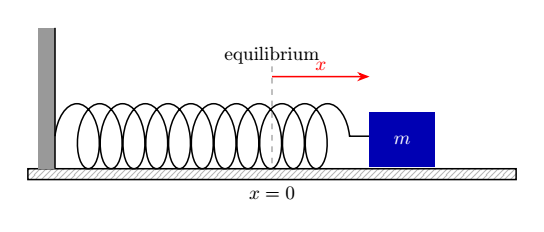
If the equation of motion of an oscillation object with a horizontal spring is \(x(t) = 8\sin t,\) find
  1. the horizontal velocity and acceleration at time \(t.\)
  2. the position, velocity, and acceleration of the mass at time \(t= \frac{2\pi}{3}. \) In what direction is it moving at that time?
Solution.
  1. \begin{equation*} x(t) = 8\sin t \end{equation*}
    \begin{equation*} x'(t) = 8\cos t \end{equation*}
    \begin{equation*} x''(t) = -8\sin t \end{equation*}
  2. \begin{equation*} x(\frac{2\pi}{3}) = 8\sin (\frac{2\pi}{3}) = 4\sqrt{3} \end{equation*}
  3. \begin{equation*} x'(\frac{2\pi}{3}) = 8\cos (\frac{2\pi}{3}) = -4 \end{equation*}
  4. \begin{equation*} x''(\frac{2\pi}{3}) = -8\sin (\frac{2\pi}{3}) = -4\sqrt{3} \end{equation*}
    It is moving to the left at \(7=\frac{2\pi}{3}\) as velocity is negative. [Negative velocty and negative acceleration means the object is speeding up]

Example 3.7.24.

Find \(a\) so that \(f(x)=\sin x-2(a-1)x\) possess critical point.
Solution.
\begin{equation*} f(x)=\sin x-2(a-1)x \end{equation*}
\begin{equation*} f'(x)=\cos x-2(a-1) \end{equation*}
Now if
\begin{equation*} \cos x-2(a-1)=0 \end{equation*}
as \(f'(x)=0\) at critical point. we have -
\begin{equation*} \cos x=2(a-1) \end{equation*}
But
\begin{equation*} -1\leq \cos x\leq 1 \end{equation*}
\begin{equation*} \therefore \, -1\leq 2(a-1) \leq 1 \end{equation*}
\begin{equation*} or, \, -\frac{1}{2}\leq (a-1) \leq \frac{1}{2} \end{equation*}
\begin{equation*} or, \, \frac{1}{2}\leq a \leq \frac{3}{2} \end{equation*}
Hence, the interval is \([\frac{1}{2}, \frac{1}{2}]\) Point at which \(f'(x) =0\) is called a stationary point.

Example 3.7.25.

Find the stationary point of \(f(x) = e^x+e^{-x}\text{.}\)
Solution.
\begin{equation*} f(x) = e^x+e^{-x} \end{equation*}
\begin{equation*} f'(x) = e^x-e^{-x} =0 \end{equation*}
\begin{equation*} e^x=e^{-x} = \frac{1}{e^x} \end{equation*}
\begin{equation*} e^{2x}=1 = e^0 \end{equation*}
or, alternately,
\begin{equation*} \log {e^{2x}}=2x= \log {1} = 0 \end{equation*}
\begin{equation*} \Rightarrow \, x=0 \end{equation*}
Hence the stationary point is \(0,2\) as \(f(x) = 1+1 =2\) at \(x=2.\)

Example 3.7.26.

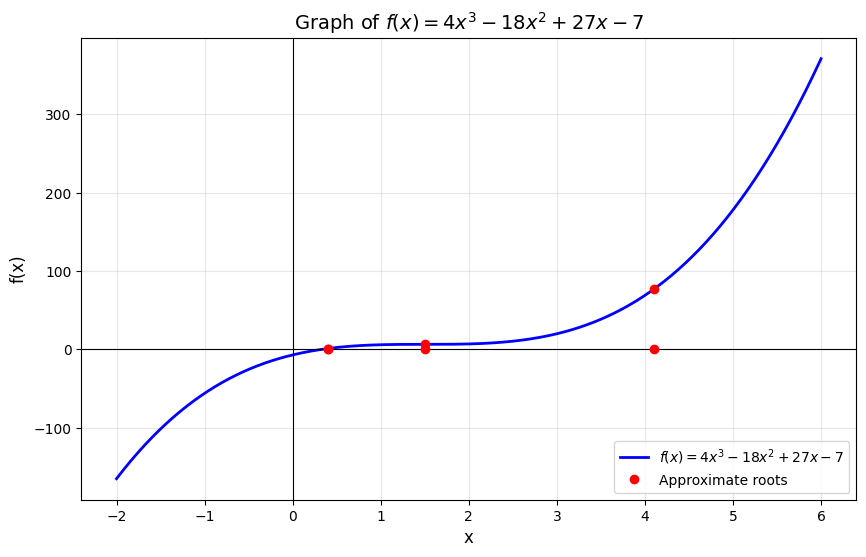
Prove that \(y = 4x^3-18x^2+27 x-7\) has no extremum.
Solution.
\begin{equation*} f(x) = 4x^3-18x^2+27 x-7 \end{equation*}
\begin{equation*} f'(x) = 12x^2+-36x+27= 3(2x-3)(2x-3) =0 \end{equation*}
\begin{equation*} \therefore \, x = \frac{3}{2} \end{equation*}
At \(x = \frac{3}{2},\) \(f'(x) \) gives zero value but its graph is increasing continuously. Hence, \(x = \frac{3}{2}\) does not give any extremum point.
Here \(f'(x)\) is not changing sign, so there is no maxima and minima.