
Section 2.2 Limit Laws

Remark 2.2.3.

  1. If \(\lim_{x \to a} \frac{f(x)}{g(x)}\) exists and \(g(x) \to 0\) as \(x \to a,\) then \(f(x) \to 0\) as \(x \to a.\) Meaning, if limit exists between \(f(x)\) and \(g(x)\text{,}\) then as \(g(x) \to 0\text{,}\) \(f(x)\) also goes to zero at \(x\to a.\)
  2. If \(\lim_{x \to a} f(x) \neq 0 \) and \(\lim_{x \to a} g(x) = 0 \) then \(\lim_{x \to a}\frac{f(x)}{g(x)} \) could be \(-\infty, \) \(\infty, \) or, limit does not exist.
  3. If \(\lim_{x \to a} f(x) = 0 \) and \(\lim_{x \to a} g(x) = 0 \text{,}\) then \(\lim_{x \to a}\frac{f(x)}{g(x)} \) could exist or could not exist.

Example 2.2.4.

Find:
\begin{equation*} \lim_{x \to 2} \frac{x^2+3x+6}{x+9} \end{equation*}
Solution.
\begin{equation*} \lim_{x \to 2} \frac{x^2+3x+6}{x+9} = \frac{\lim_{x \to 2}(x^2+3x+6)}{\lim_{x \to 2} (x+9)} = \frac{(2^2+3\times 2 +6)}{(2+9)} =16/11. \end{equation*}

Example 2.2.5.

If
\begin{equation*} \lim_{x \to -1} \frac{2x^2+ax+2a+5}{x^2-x-2} \end{equation*}
exist then find \(a.\)
Solution.
At \(x\to -1, \) then \(g(x) = x^2-x-2 \to 0\text{,}\)
\begin{equation*} \therefore, f(x) = 2x^2+ax+2a+5=0 \end{equation*}
or,
\begin{equation*} 7+a=0 \rightarrow \, a = -7. \end{equation*}

Example 2.2.6.

Evaluate:
  1. \begin{equation*} \lim_{x \to 3} \frac{\sqrt{3x+7}-4}{x-3} \end{equation*}
  2. \begin{equation*} \lim_{x \to 1} \frac{x^{1/3}-1}{x^2-1} \end{equation*}
Solution.
Remember: if numerator or denominator or both contains square roots then we need to rationalize the function.
  1. \begin{equation*} \lim_{x \to 3} \frac{\sqrt{3x+7}-4}{x-3} = \lim_{x \to 3} \frac{[\sqrt{3x+7}-4]}{(x-3)} \times \frac{[\sqrt{3x+7}+4]}{[\sqrt{3x+7}+4]} \end{equation*}
    \begin{equation*} = \lim_{x \to 3} \frac{[(3x+7)-16]}{(x-3)[\sqrt{3x+7}+4]} = \lim_{x \to 3} \frac{[3x-9]}{(x-3)[\sqrt{3x+7}+4]} \end{equation*}
    \begin{equation*} = \lim_{x \to 3} \frac{3\cancel{(x-3)}}{\cancel{(x-3)}[\sqrt{3x+7}+4]} = \lim_{x \to 3} \frac{3}{[\sqrt{3x+7}+4]} = \frac{3}{[\sqrt{9+7}+4]} =3/8. \end{equation*}
  2. \begin{equation*} \lim_{x \to 1} \frac{x^{1/3}-1}{x^2-1} \end{equation*}
    Let \(x^{1/3}= t\text{,}\) then at \(x \to 1, \) \(t\to 1.\)
    \begin{equation*} \therefore \, \lim_{t \to 1} \frac{t-1}{t^6-1} = \lim_{t \to 1} \frac{\cancel{(t-1)}}{\cancel{(t-1)}(t^5+t^4+t^3+t^2+t+1)} =1/6. \end{equation*}

Example 2.2.7.

Evaluate:
\begin{equation*} \lim_{x \to -\infty} \frac{2x^3+x+1}{1-x-x^3} \end{equation*}
Solution.
Let \(x=-t\text{,}\) so as \(x \to -\infty\text{,}\) we have \(t \to \infty\text{.}\)
\begin{equation*} \lim_{t \to \infty} \frac{-2t^3-t+1}{1+t +t^3} = \lim_{t \to \infty} \frac{\cancel{(t^3)}(-2-1/t^2+1/t^3)}{\cancel{(t^3)}(1/t^3+1/t^2 +1)} =-2. \end{equation*}

Example 2.2.8.

\(\infty-\infty\) form:
\begin{equation*} \lim_{x \to \infty} \left(\sqrt{x^2+x}-\sqrt{x^2+1}\right) \end{equation*}
Solution.
Rationalize:
\begin{equation*} \lim_{x \to \infty} \left(\sqrt{x^2+x}-\sqrt{x^2+1}\right) \times \frac{\left(\sqrt{x^2+x}+\sqrt{x^2+1}\right)}{\left(\sqrt{x^2+x}+\sqrt{x^2+1}\right)} \end{equation*}
\begin{equation*} = \lim_{x \to \infty}\frac{\left((x^2+x)-(x^2+1)\right)}{\left(\sqrt{x^2+x}+\sqrt{x^2+1}\right)} = \lim_{x \to \infty}\frac{\left(x-1\right)}{\left(\sqrt{x^2+x}+\sqrt{x^2+1}\right)} \end{equation*}
\begin{equation*} or, \, \lim_{x \to \infty}\frac{\cancel{x}\left(1-1/x\right)}{\cancel{x}\left(\sqrt{1+1/x}+\sqrt{1+1/x^2}\right)} =1/2. \end{equation*}
Alternate:

Note 2.2.9.

\begin{equation*} (1+x)^n = 1+nx+n(n-1)\frac{x^2}{2!}+ n(n-1)(n-2)\frac{x^3}{3!}+ \cdots; \text{ when } |x|\lt 1. \end{equation*}
Therefore,
\begin{equation*} \lim_{x \to \infty} \left(\sqrt{x^2+x}-\sqrt{x^2+1}\right) = \lim_{x \to \infty}\left[x \left(1+\frac{1}{x}\right)^{1/2} - x \left(1+\frac{1}{x^2}\right)^{1/2}\right] \end{equation*}
\begin{equation*} = \lim_{x \to \infty} x\left[1+\frac{1}{2} \cdot \frac{1}{x}+\frac{1}{2}\cdot(\frac{1}{2}-1)\cdot\left(\frac{1}{x}\right)^2\frac{1}{2!}+ \cdots \right] \end{equation*}
\begin{equation*} \quad \, - x\left[1+\frac{1}{2} \cdot \frac{1}{x^2}+\frac{1}{2}\cdot(\frac{1}{2}-1)\cdot\left(\frac{1}{x^2}\right)^2\frac{1}{2!}+ \cdots \right] \end{equation*}
\begin{equation*} = \lim_{x \to \infty} x\left[1+\frac{1}{2x}+\cdots -1- \frac{1}{2x^2}-\cdots\right] = \lim_{x \to \infty}(\frac{1}{2}+\cdots -\frac{1}{2x}-\cdots) =\frac{1}{2}. \end{equation*}

Subsection 2.2.1 Squeeze Theorem

The Squeeze Theorem (also known as the Sandwich Theorem or Pinching Theorem) is a tool for evaluating limits, especially when direct substitution leads to indeterminate forms like \(0/0\) or \(\infty/\infty\text{.}\)
Let \(f(x), g(x),\) and \(h(x)\) be functions defined on some open interval containing \((a)\text{,}\) and suppose: \(g(x) \leq f(x) \leq h(x)\) for all \(x\) in that interval (except possibly at \(x = a\)). If \(\lim_{x \to a} g(x) = L\) and \(\lim_{x \to a} h(x) = L,\) then \(\lim_{x \to a} f(x) = L.\)
In words: If \(f(x)\) is squeezed between two functions \(g(x)\) and \(h(x)\) that both approach the same limit \(L\text{,}\) then \(f(x)\) must also approach \(L\text{.}\)

Example 2.2.10.

Evaluate:
\begin{equation*} \lim_{x \to 0} \frac{\sin x}{x} \end{equation*}
Solution.
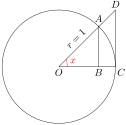
Let’s consider a unit circle: From right angled \(\triangle OAB,\)
\begin{equation} \sin x =\frac{AB}{OB} \rightarrow \, AB = OA\sin x = 1.\sin x\tag{2.2.1} \end{equation}
\begin{equation} and, \, \cos x = \frac{OB}{OA} \rightarrow \, OB = OA\cos x = \cos x\tag{2.2.2} \end{equation}
From right angled triangle, \(COD,\) we have
\begin{equation} and, \, \tan x = \frac{DC}{OC} \rightarrow \, DC = OC\tan x = 1.\tan x\tag{2.2.3} \end{equation}
Now from figure,
Area of \(\triangle OAB\) \(\leq\) Area of \(\triangle AOC\) \(\leq\) Area of \(\triangle DOC\)
\begin{equation*} or, \, \frac{1}{2}(AB)(OB) \leq \text { area of sector AOC } \leq \frac{1}{2}(DC)(OC) \end{equation*}
\begin{equation} or, \, \frac{1}{2}\sin x \cos x \leq \text { area of sector AOC } \leq \frac{1}{2}\tan x .1\tag{2.2.4} \end{equation}
Area of sector \(AOC\) = \(\frac{1}{2} r^2 x \)
\(\because \) For angle \(2\pi\) area subtends by radius \(=\pi r^2\text{.}\) Hence, area subtends by radius for an angle \(x = \frac{\pi r^2}{2\pi}x\)
Now from eqn 3,
\begin{equation} \, \frac{1}{2}\sin x \cos x \leq \frac{1}{2} x \leq \frac{1}{2}\tan x \, [\because r=1.]\tag{2.2.5} \end{equation}
\begin{equation*} or, \, \frac{\sin x \cos x}{x} \leq 1 \leq \frac{\tan x}{x} \end{equation*}
\begin{equation*} \therefore, \, \frac{\sin x \cos x}{x} \leq 1 \end{equation*}
\begin{equation} or, \, \frac{\sin x }{x} \leq \frac{1}{\cos x} \tag{2.2.6} \end{equation}
\begin{equation*} also, \, 1 \leq \frac{\tan x}{x} \end{equation*}
\begin{equation*} or, \, 1 \leq \frac{1}{x} \cdot \frac{\sin x}{\cos x} \end{equation*}
\begin{equation} or, \, \cos x \leq \frac{\sin x}{x} \tag{2.2.7} \end{equation}
Hence, from eqns. 8 and 9.
\begin{equation*} \cos x \leq \frac{\sin x}{x} \leq \frac{1}{\cos x} \end{equation*}
\begin{equation*} \therefore, \, \lim_{x\to 0} \frac{\sin x}{x} =1. \end{equation*}
Alternate: use L’Hospital rule
Example 2.2.11.

Find:
\begin{equation*} \lim_{x\to 0} x^2 \sin\frac{1}{x} \end{equation*}
Solution.
from squeeze theorem,
\begin{equation*} -1 \leq \sin\frac{1}{x} \leq 1 \end{equation*}
\begin{equation*} or, \, -x^2 \leq x^2 \sin {\frac{1}{x}} \leq x^2 \end{equation*}
\begin{equation*} but, \, \lim_{x\to 0} x^2 =0 = \lim_{x\to 0} (-x^2) \end{equation*}
\begin{equation*} \therefore \, x^2 \sin {\frac{1}{x}} =0. \end{equation*}

Subsection 2.2.2 Some Standard Limits

  1. Algebric Function
    \begin{equation*} \lim_{x\to a} \frac{x^n-a^n}{x-a} =na^{n-1} \end{equation*}
  2. Trigonometric Functions
    1. \begin{equation*} \lim_{x\to 0} \frac{\sin x}{x} =1 \end{equation*}
    2. \begin{equation*} \lim_{x\to 0} \frac{\tan x}{x} =1 \end{equation*}
    3. \begin{equation*} \lim_{x\to 0} \frac{\sin^{-1} x}{x} =1 \end{equation*}
    4. \begin{equation*} \lim_{x\to 0} \frac{\tan^{-1} x}{x} =1 \end{equation*}
  3. Logarithimic and Exponential
    1. \begin{equation*} \lim_{x\to 0} \frac{\ln(1+x)}{x} =1 \end{equation*}
    2. \begin{equation*} \lim_{x\to 0} \frac{e^x-1}{x} =1 \end{equation*}
    3. \begin{equation*} \lim_{x\to 0} \frac{a^x-1}{x} =\ln a \end{equation*}
    4. \begin{equation*} \lim_{x\to 0} \frac{\log_a(1+x)}{x} =\frac{1}{\ln a} \end{equation*}

Example 2.2.12.

\begin{equation*} \lim_{x\to 1} \frac{x+x^2+x^3+ \cdots +x^n-n}{x-1} \end{equation*}
Solution.
Solution:
\begin{equation*} \lim_{x\to 1} \frac{(x-1) + (x^2-1^2) +(x^3-1^3) + \cdots + (x^n-1^n)}{x-1} \end{equation*}
\begin{equation*} = 1\cdot 1^0+ 2\cdot 1^1+ 3\cdot 1^2+\cdots \end{equation*}
\begin{equation*} = 1+ 2+ 3+\cdots + n =\frac{n(n+1)}{2}. \end{equation*}

Example 2.2.13.

Find:
\begin{equation*} \lim_{x\to 0} \frac{1-\cos 4x}{x^2} \end{equation*}
Solution.
\begin{align*} \lim_{x\to 0} \frac{1-\cos 4x}{x^2} \amp = \lim_{x\to 0} \frac{2\sin^2{2x}}{x^2} \\ \amp = \lim_{x\to 0} 2\frac{\sin{2x}}{2x}\times \frac{\sin{2x}}{2x}\times 4 \\ \amp = 8\times 1\times 1 =8. \end{align*}

Example 2.2.14.

\begin{equation*} \lim_{x\to \infty} 3^{-x} \sin 3^x \end{equation*}
Solution.
Step 1: Analyze the behavior as \(x \to \infty\)
\(3^x \to +\infty\) (since base \(\gt\) 1)
\(\sin(3^x)\) oscillates between -1 and +1 for all real \(x\text{,}\) because the argument \(3^x\) grows exponentially, and sine is periodic. So the fraction is:
\begin{equation*} \lim_{x\to \infty} \frac{\sin 3^x}{3^x} \leq \frac{1}{3^x}\to 0. \end{equation*}
Step 2: Apply the Squeeze Theorem
We know: \(-1 \leq \sin 3^x \leq 1\)
Divide by \(3^x \gt 0\) (for \(x\) large):
\begin{equation*} -\frac{1}{3^x} \leq \frac{\sin 3^x}{3^x} \leq \frac{1}{3^x} \end{equation*}
Now take the limit,
\begin{equation*} \lim_{x\to \infty} \left(-\frac{1}{3^x} \right) =0 \end{equation*}
and
\begin{equation*} \lim_{x\to \infty} \left(\frac{1}{3^x} \right) =0 \end{equation*}
Hence, from squeeze theorem
\begin{equation*} \frac{\sin 3^x}{3^x} =0. \end{equation*}

Example 2.2.16.

Find:
\begin{equation*} \lim_{\theta \to 0} \frac{\tan(\pi\cos^2\theta)}{\sin(2\pi\sin^2\theta)} \end{equation*}
Solution.
At \(\theta \to 0, \frac{\tan \pi}{\sin 0}=\frac{0}{0}.\)
\begin{align*} \lim_{\theta \to 0} \frac{\tan(\pi\cos^2\theta)}{\sin(2\pi\sin^2\theta)}\times \frac{2\pi\sin^2\theta}{2\pi\sin^2\theta} \amp = \lim_{\theta \to 0} \frac{\frac{\tan(\pi\cos^2\theta)}{(2\pi\sin^2\theta)}}{\frac{\sin(2\pi\sin^2\theta)}{2\pi\sin^2\theta}}\\ \amp = \lim_{\theta \to 0} \frac{\frac{\tan(\pi-\pi\sin^2\theta)}{(2\pi\sin^2\theta)}}{\frac{\sin(2\pi\sin^2\theta)}{2\pi\sin^2\theta}} \\ \amp = \lim_{\theta \to 0} \frac{-\frac{\tan(\pi\sin^2\theta)}{(2\pi\sin^2\theta)}}{\frac{\sin(2\pi\sin^2\theta)}{2\pi\sin^2\theta}} =-1/2. \end{align*}

Example 2.2.17.

Find:
\begin{equation*} \lim_{x\to 0} \frac{\ln (1+x^2)}{1-\cos x} \end{equation*}
Solution.
\begin{equation*} \lim_{x\to 0} \frac{\ln (1+x^2)}{1-\cos x} = \lim_{x\to 0} \frac{\ln (1+x^2)}{2\sin^2{x/2}} \times \frac{(x/2)^2}{(x/2)^2} \end{equation*}
\begin{equation*} \lim_{x\to 0} \frac{\ln (1+x^2)}{x^2} \times \frac{4(x/2)^2}{2(\sin{x/2})^2} =1\times 1/2\times 4 =2. \end{equation*}

Example 2.2.18.

Find:
\begin{equation*} \lim_{x\to \frac{\pi}{4}} \frac{\ln (\tan x)}{1-\tan x} \end{equation*}
Solution.
\begin{equation*} \lim_{x\to \frac{\pi}{4}} \frac{\ln (\tan x)}{1-\tan x} = \lim_{h\to 0} \frac{\ln [\tan (\frac{\pi}{4}+h)]}{1-\tan (\frac{\pi}{4}+h)} \end{equation*}
\begin{equation*} = \lim_{h\to 0} \frac{\ln [1+(\tan (\frac{\pi}{4}+h)-1)]}{1-\tan (\frac{\pi}{4}+h)} \end{equation*}
\begin{equation*} = - \lim_{h\to 0} \frac{\ln [1+(\tan (\frac{\pi}{4}+h)-1)]}{\tan (\frac{\pi}{4}+h)-1} =-1. \end{equation*}

Example 2.2.19.

Find:
\begin{equation*} \lim_{x\to 0} \frac{(ab)^x-a^x-b^x+1}{x^2} \end{equation*}
Solution.
\begin{equation*} \lim_{x\to 0} \frac{a^x(b^x-1)-1(b^x-1)}{x^2} = \lim_{x\to 0} \frac{(a^x-1)(b^x-1)}{x\cdot x} =\ln a \ln b. \end{equation*}

Remark 2.2.20.

\begin{equation*} \lim_{x\to a} \left(1+f(x)\right)^{g(x)} = e^{\lim_{x\to a}f(x)g(x)} \end{equation*}
where \(f(x)\to 0\) and \(g(x)\to \infty \) as \(x\to a.\)

Example 2.2.21.

\(1^\infty\) Form Evaluate:
\begin{equation*} \lim_{x\to \infty} \left(1+\frac{1}{x^2}\right)^{2x^2} \, [(1+0)^\infty] \end{equation*}
Solution.
\begin{equation*} \lim_{x\to \infty} \left(1+\frac{1}{x^2}\right)^{2x^2} = e^{\lim_{x\to \infty}\frac{1}{x^2}(2x^2)} = e^{\lim_{x\to \infty}2} =e^2. \end{equation*}

Example 2.2.22.

\begin{equation*} \lim_{x\to 0}\left[\frac{3x^2+2}{7x^2+2} \right]^{1/x^2} \, [(1)^\infty] \end{equation*}
Solution.
\begin{equation*} \lim_{x\to 0}\left[1+\frac{3x^2+2}{7x^2+2} -1 \right]^{1/x^2} = \lim_{x\to 0}\left[1+\frac{3x^2+2-7x^2-2}{7x^2+2} \right]^{1/x^2} \end{equation*}
\begin{equation*} = \lim_{x\to 0}\left[1+\frac{-4x^2}{7x^2+2} \right]^{1/x^2} = e^{\lim_{x\to a}\left(\frac{-4x^2}{7x^2+2}\right)^{1/x^2}} =e^{-2}. \end{equation*}

Subsection 2.2.3 \(0\times\infty, \infty^0, \) and \(0^0\) Forms

If forms of limit are \(0\times\infty \) then convert it into either \(\frac{0}{0}\) formate or \(\frac{\infty}{\infty}\) format before solving the limit.

Example 2.2.23.

\begin{equation*} \lim_{x\to 0^+} \tan x \times \ln(\sin x) \, [0\times\infty] \end{equation*}
Solution.
\begin{equation*} \lim_{x\to 0^+} \frac{\ln(\sin x)}{\cot x} \, [\frac{\infty}{\infty}] \end{equation*}
use L Hospital’s rule:
\begin{equation*} \lim_{x\to 0^+} \frac{\frac{1}{\sin x} \times \cos x }{-\csc^x} = \lim_{x\to 0^+} -\cos x\times \sin x=0 \end{equation*}

Example 2.2.24.

\begin{equation*} \lim_{x\to 0^+} x\ln x \,[0\times\infty] \end{equation*}
Solution.
\begin{equation*} \lim_{x\to 0^+} \frac{\ln x}{1/x} = \lim_{x\to 0^+} \frac{1/x}{-1/x^2} = \lim_{x\to 0^+}(-x) =0. \end{equation*}

Remark 2.2.25.

\begin{equation*} \lim_{x\to a} \left(f(x)\right)^{f(x)} = 1 \end{equation*}
where \(f(x)\to 0^+\) as \(x\to a.\)

Example 2.2.26.

\begin{equation*} \lim_{x\to 0^+} x^x \, [0^0 \, form] \end{equation*}
Solution.
\begin{equation*} \lim_{x\to 0^+} x^x = \lim_{x\to 0^+} e^{\ln x^x} \end{equation*}
for \(0^0 \) form convert into \(0\times \infty\) form.
\begin{equation*} = \lim_{x\to 0^+} e^{x\ln x} \, [0\times \infty] \end{equation*}
\begin{equation*} = \lim_{x\to 0^+} e^{0} =1. \end{equation*}

Example 2.2.27.

\begin{equation*} \lim_{x\to 0^+} (\sin x)^x \, [0^0 \, form] \end{equation*}
Solution.
\begin{equation*} \lim_{x\to 0^+} (\sin x)^x = \lim_{x\to 0^+} e^{x\ln (\sin x)} \, [0\times \infty] \end{equation*}
\begin{equation*} = \lim_{x\to 0^+} e^{\frac{\ln \sin x}{1/x}} \end{equation*}
use L hospital rule,
\begin{equation*} = \lim_{x\to 0^+} e^{\frac{1}{\sin x} \times \frac{\cos x}{-1/x^2}} \end{equation*}
\begin{equation*} = \lim_{x\to 0^+} e^{-\frac{x}{\frac{\sin x}{x}}\cos x} = \lim_{x\to 0^+} e^{0} =1. \end{equation*}

Note 2.2.29.

Whenever function under consideration has one of the following traits, always check RHL, LHL for the existance of limit.

Example 2.2.30.

The value of
\begin{equation*} \lim_{x \to 1} \frac{(x^2-1)\sin^2 (\pi x)}{x^4-2x^3+2x-1} \end{equation*}
Solution.
After factorization, we get
\begin{equation*} \lim_{x \to 1} \frac{(x^2-1)\sin^2 (\pi x)}{(x^2-1)(x^2-2x+1)} \end{equation*}
\begin{equation*} = \lim_{x \to 1} \frac{\sin^2 (\pi x)}{(x-1)^2} \end{equation*}
This is \(\frac{0}{0}\) form.
\begin{equation*} = \lim_{h \to 0} \frac{\sin^2 \pi (1+h)}{(1+h-1)^2} \end{equation*}
\begin{equation*} = \lim_{h \to 0} \frac{\sin^2 \pi (1+h)}{h^2[\pi (1+h)]^2}\times [\pi (1+h)]^2 \end{equation*}
\begin{equation*} = \lim_{h \to 0} \frac{\pi^2 (1+h)^2}{h^2} = \pi^2. \end{equation*}

Example 2.2.31.

Evaluate:
\begin{equation*} \lim_{x \to 0} \left[ \left(\frac{1-\cos^2 (3x)}{\cos^3 (4x)}\right) \left(\frac{\sin^3 (4x)}{(\ln (2x+1))^5}\right) \right] \end{equation*}
This is \(\frac{0}{0}\) form.
Solution.
\begin{equation*} = \lim_{x \to 0} \left[ \left(\frac{\sin^2 (3x)}{\cos^3 (4x)}\right) \left(\frac{\sin^3 (4x)}{(\ln (2x+1))^5}\right) \right] \end{equation*}
\begin{equation*} = \lim_{x \to 0} \left[ \left(\frac{\sin^2 (3x)}{(3x)^2}\times (3x)^2 \right) \left(\frac{\sin^3 (4x)}{(4x)^3}\times (4x)^3 \right) \left(\frac{1}{\cos^3(4x)}\right) \left(\frac{(2x)^5}{(\ln (2x+1))^5 (2x)^5}\right) \right] \end{equation*}
\begin{equation*} = \lim_{x \to 0} \left[\left(\frac{(3x)^2 \times (4x)^3}{\cos^3(4x)}\right) \times \frac{1}{(2x)^5} \right] = \frac{9\times 64}{32} =18. \end{equation*}

Example 2.2.32.

Evaluate:
\begin{equation*} \lim_{x\to \frac{\pi}{4}} \frac{8\sqrt{2}-(\cos x +\sin x)^7}{\sqrt{2}-\sqrt{2}\sin(2x)} \end{equation*}
Solution.
Use L’Hospital’s rule:
\begin{equation*} =\lim_{x\to \frac{\pi}{4}} \frac{0-7(\cos x +\sin x)^6(-\sin x +\cos x)}{0-\sqrt{2}\cdot 2\cos(2x)} \end{equation*}
\begin{equation*} = \lim_{x\to \frac{\pi}{4}} \frac{7(\cos x +\sin x)^6(\cos x-\sin x)}{2\sqrt{2}\cos(2x)} \end{equation*}
\begin{equation*} = \lim_{x\to \frac{\pi}{4}} \frac{7(\cos x +\sin x)^6(\cos x-\sin x)}{2\sqrt{2}(\cos^2 x -\sin^2 x)} \end{equation*}
\begin{equation*} = \lim_{x\to \frac{\pi}{4}} \frac{7\cancelto{5}{(\cos x +\sin x)^6} \cancel{(\cos x-\sin x)}}{2\sqrt{2}\cancel{(\cos x -\sin x)}\cancel{(\cos x +\sin x)}} \end{equation*}
\begin{equation*} = \lim_{x\to \frac{\pi}{4}} \frac{7(\cos x +\sin x)^5}{2\sqrt{2}} = \frac{7(1/\sqrt{2} +1/\sqrt{2})^5}{2\sqrt{2}} = 14. \end{equation*}

Subsection 2.2.4 \(\infty-\infty \) Forms

We need to convert this form into \(0/0\) form first.

Example 2.2.33.

Evaluate:
\begin{equation*} \lim_{x \to \infty} \left(\sqrt{25 x^2-3x}-5x\right) \end{equation*}
Solution.
Always set \(x=\frac{1}{t}\) in this form, so as \(x \to \infty, t \to 0.\) This substitution converts [\(\infty-\infty \) form into [\(0/0\) form].
Now,
\begin{equation*} \lim_{t \to 0} \left(\sqrt{\frac{25}{t^2} -\frac{3}{t}}-\frac{5}{t}\right) \end{equation*}
\begin{equation*} or, \, \quad \lim_{t \to 0} \frac{\sqrt{\frac{25-3t}{t^2}} -5}{t} \, \quad [0/0 \, form] \end{equation*}
\begin{equation*} or, \, \quad \lim_{t \to 0} \frac{\sqrt{\frac{25-3t}{t^2}} -5}{t} \times \frac{\sqrt{\frac{25-3t}{t^2}} +5}{\sqrt{\frac{25-3t}{t^2}} +5} \end{equation*}
\begin{equation*} = \lim_{t \to 0} \frac{(25-3t)-25}{t(\sqrt{25-3t} +5)} = \lim_{t \to 0} \frac{-3}{\sqrt{25-3t} +5} = -\frac{3}{10}. \end{equation*}

Example 2.2.34.

If
\begin{equation*} \lim_{x \to \infty} \left(\sqrt{x^2-x+1}-ax\right)= b, \text{ then ordered pair (a,b) is }? \end{equation*}
Solution.
Set \(x=\frac{1}{t}\) in this form, so as \(x \to \infty, t \to 0.\) This substitution converts [\(\infty-\infty \) form into [\(0/0\) form].
\begin{equation*} \lim_{x \to \infty} \left(\sqrt{x^2-x+1}-ax\right) = \lim_{t \to 0} \left(\sqrt{\frac{1}{t^2}-\frac{1}{t}+1}-\frac{a}{t}\right) \end{equation*}
\begin{equation*} = \lim_{t \to 0} \frac{\sqrt{1 -t +t^2}-a}{t} \, [0/0 \, form] \end{equation*}
If the above form is in 0/0 form, we must set \(a=1.\)
\begin{equation*} = \lim_{t \to 0} \frac{\sqrt{1 -t +t^2}-1}{t} \times \frac{\sqrt{1 -t +t^2}+1}{\sqrt{1 -t +t^2}+1} \end{equation*}
\begin{equation*} = \lim_{t \to 0} \frac{1 -t +t^2-1}{t[\sqrt{1 -t +t^2}+1]} = \lim_{t \to 0} \frac{-t +t^2}{t[\sqrt{1 -t +t^2}+1]} \end{equation*}
\begin{equation*} = \lim_{t \to 0} \frac{-1 +t}{\sqrt{1 -t +t^2}+1} = -\frac{1}{2}. \end{equation*}
\begin{equation*} \therefore \, b= -\frac{1}{2} \, and \, (a,b) = (1,-\frac{1}{2}). \end{equation*}

