Skip to main content
Contents Index Dark Mode Prev Up Next \(\newcommand{\N}{\mathbb N} \newcommand{\Z}{\mathbb Z} \newcommand{\Q}{\mathbb Q} \newcommand{\R}{\mathbb R}
\newcommand{\lt}{<}
\newcommand{\gt}{>}
\newcommand{\amp}{&}
\definecolor{fillinmathshade}{gray}{0.9}
\newcommand{\fillinmath}[1]{\mathchoice{\colorbox{fillinmathshade}{$\displaystyle \phantom{\,#1\,}$}}{\colorbox{fillinmathshade}{$\textstyle \phantom{\,#1\,}$}}{\colorbox{fillinmathshade}{$\scriptstyle \phantom{\,#1\,}$}}{\colorbox{fillinmathshade}{$\scriptscriptstyle\phantom{\,#1\,}$}}}
\)
Section 1.7 Asymptote
An asymptote is a line that a curve (function) approaches but never touches as it extends toward infinity. Asymptotes describe the behavior of functions, especially rational functions, as their input (or output) grows very large or very small. There are three main types: horizontal, vertical, and oblique (slant).
Vertical Asymptote: A vertical asymptote is a vertical line \(x = a\) where the function approaches infinity (or negative infinity) as \(x\) approaches \(a\text{.}\) It occurs where the function is undefined, typically at values that make the denominator zero. i.e.,
\begin{equation*}
\lim_{x \to a} f(x) = \pm \infty
\end{equation*}
For example: If
\begin{equation*}
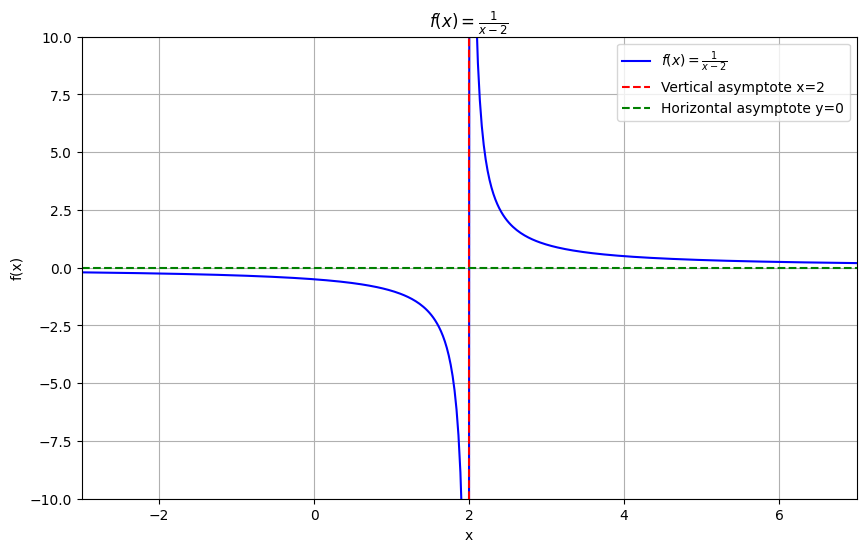
f(x)= \frac{1}{x-2}
\end{equation*}
then, Vertical asymptote (VA) lies at \(x = 2\) by setting denominator to \(x - 2 = 0\text{,}\) so \(x = 2\text{.}\)
As
\(x \to 2^+\text{,}\) \(f(x) \to \infty\text{;}\) as
\(x \to 2^-\text{,}\) \(f(x) \to -\infty\text{.}\) The graph shoots upward on one side and downward on the other.
If
\begin{equation*}
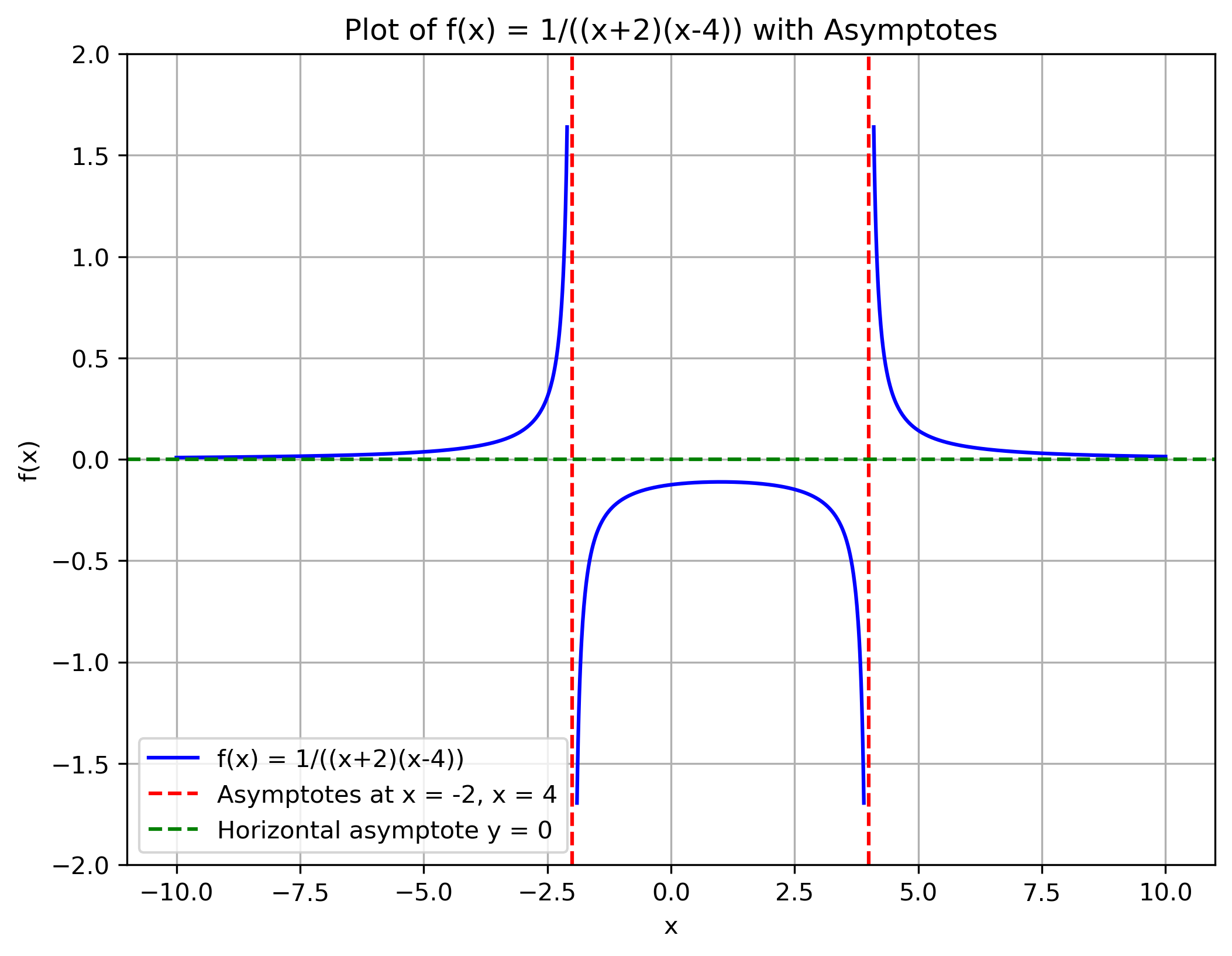
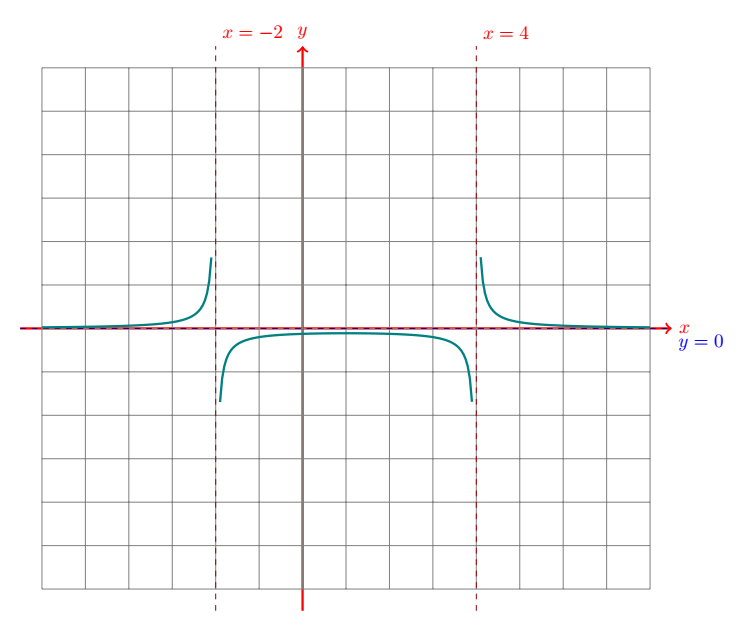
f(x) = \frac{1}{(x+2)(x-4)}
\end{equation*}
VA: at \(x=-2\) and \(x=4.\)
Horizontal Asymptote: A horizontal asymptote is a horizontal line \(y = c\) for a function as \(x \to \infty\) or \(x \to -\infty\text{.}\) It describes the function’s behavior at the extremes of the x-axis. For a rational function
\begin{equation*}
f(x) = \frac{p(x)}{q(x)}
\end{equation*}
compare the degrees of the numerator \(p(x) \) and denominator \(q(x)\text{:}\)
If the degree of
\(p(x) \lt \, \text{ degree of }\, q(x)\text{,}\) the horizontal asymptote (HA) is
\(y = 0\text{.}\)
If the degrees are equal, the horizontal asymptote is
\(y = \frac{a}{b}\text{,}\) where
\(a\) and
\(b\) are the leading coefficients of
\(p(x)\) and
\(q(x)\text{.}\)
If the degree of
\(p(x) \gt \) degree of
\(q(x)\text{,}\) there is no horizontal asymptote.
For
\begin{equation*}
f(x)=\frac{2x+1}{x^2+1}
\end{equation*}
Degree of numerator: 1 (from (
\(2x\) )).
Degree of denominator: 2 (from
\(x^2\) ).
Since 1
\(\lt\) 2, the horizontal asymptote is
\(y = 0\text{.}\)
As
\(x \to \pm \infty\text{,}\) the denominator grows faster, so
\(f(x) \approx \frac{2x}{x^2} = \frac{2}{x} \to 0\text{.}\) The graph flattens toward the x-axis.
For
\begin{equation*}
f(x)=\frac{3x^2+2}{2x^2-1}
\end{equation*}
Degrees are equal: both
\(2\text{.}\)
Leading coefficients: 3 (numerator) and 2 (denominator).
Horizontal asymptote:
\(y = \frac{3}{2}\text{.}\)
As
\(x \to \pm \infty\text{,}\) \(f(x) \approx \frac{3x^2}{2x^2} = \frac{3}{2} \text{,}\) so the graph approaches
\(y = 1.5\text{.}\)
Horizontal asymptote may or may not touch by the curve as
\(x\to \infty.\)
Oblique Asymptote An oblique asymptote is a slanted line
\(y = mx + b\) that the graph approaches when the degree of the numerator is exactly one more than the degree of the denominator.
There may be an oblique asymptote if degree of
\(p(x)\) is
\(1\) more than the degree of
\(q(x)\text{,}\) i.e., the difference in degrees is
\(1.\)
For
\begin{equation*}
f(x) = \frac{x^2+4x+10}{x-2}
\end{equation*}
After long division,
\begin{equation*}
f(x)= (x+6)+\frac{22}{x-2}
\end{equation*}
Hence, at \(x=2:\) HA, we have \(y=f(x) = x+6\) gives a slanted asymptote.
Plot function below by adjusting your p2.
Subsection 1.7.1 Graph of Asymptotic Functions
Draw graph of the following functions:
Example 1.7.2 .
\begin{equation*}
f(x) = \frac{4}{x-2}
\end{equation*}
\begin{equation*}
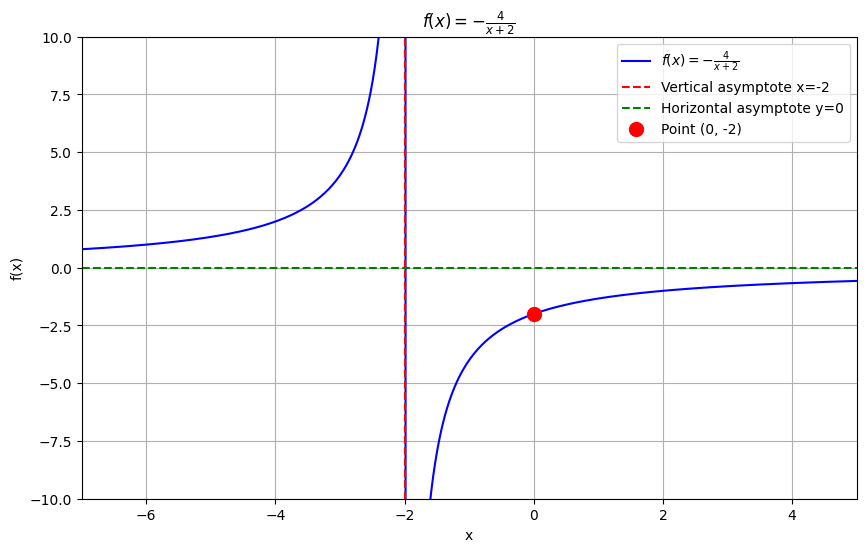
f(x) = -\frac{4}{x+2}
\end{equation*}
\begin{equation*}
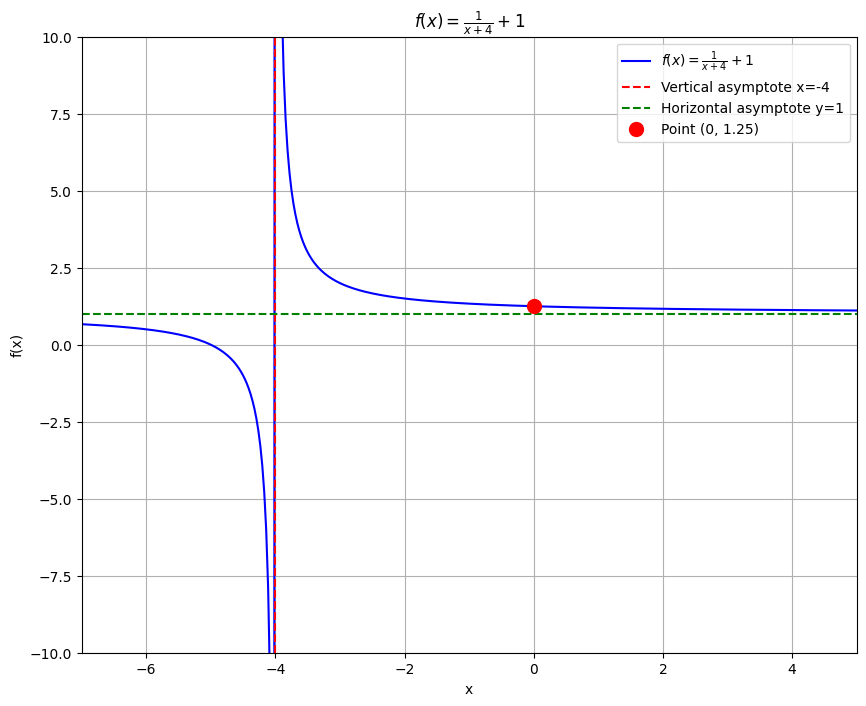
f(x) = \frac{1}{x+4}+1
\end{equation*}
\begin{equation*}
f(x) = \frac{2}{x-2}-3
\end{equation*}
\begin{equation*}
f(x) = \frac{x-2}{3x}
\end{equation*}
Solution .
\begin{equation*}
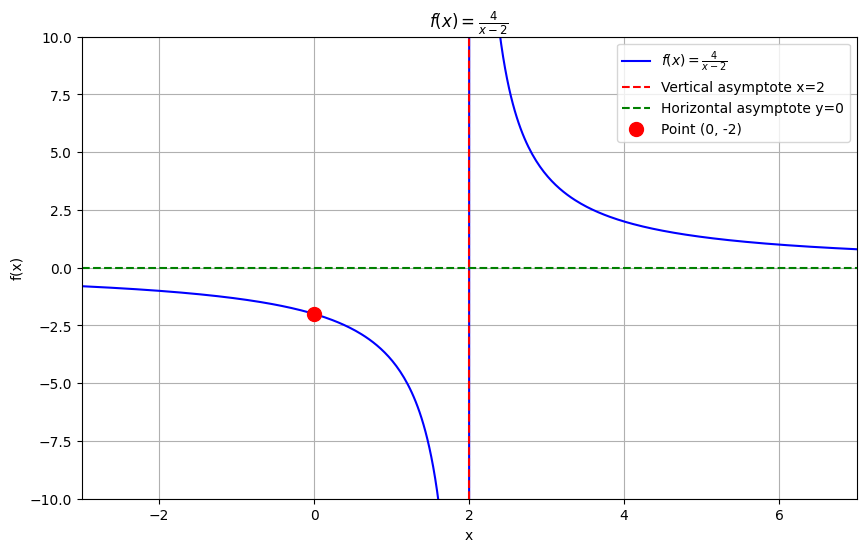
f(x) = \frac{4}{x-2}
\end{equation*}
VA:
\(x=2\) as
\(x\to 2, \, f(x)\to \infty.\)
HA:
\(0\) as
\(\frac{x^0}{x^1}\) i.e., degree of numerator is less than degree of denominator.
draw one point at your convenient location
\(P(x,y) \) at
\(x=0,\) \(y=f(x) = \frac{4}{0-2}= -2.\) Now from the standard graph [
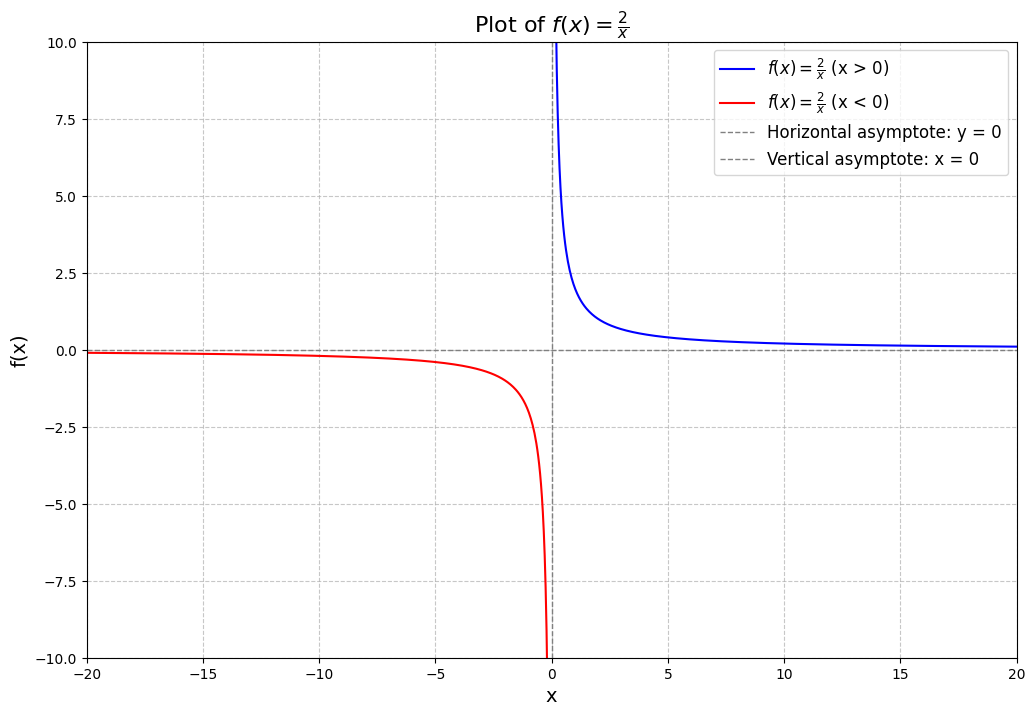
Some Standard Graphs ]
\begin{equation*}
f(x) = -\frac{4}{x+2}
\end{equation*}
VA:
\(x=-2\text{,}\) HA:
\(0\text{,}\) Point(x,y) =
\((0,-2).\)
\begin{equation*}
f(x) = \frac{1}{x+4}+1
\end{equation*}
vertical shift = 1 unit upward, VA: \(x=-4\text{,}\) HA =\(0+1=1\text{,}\) point (x,y)= \((0,1.25).\)
Example 1.7.3 .
Find horizontal asymptote:
\begin{equation*}
f(x)= \frac{5x+4}{3x^2+5x-7}
\end{equation*}
Look at higher power terms in numerator and denomirator.
\begin{equation*}
\frac{5x}{3x^2} = \frac{5}{3x}
\end{equation*}
At \(x\to \infty, \, \) \(\frac{5}{3x} \to 0.\) Therefore HA at \(y=0\text{.}\)
Example 1.7.4 .
Find horizontal asymptote:
\begin{equation*}
g(x)= \frac{2x^3+4}{3x^3-7x}
\end{equation*}
Look at higher power terms in numerator and denomirator.
\begin{equation*}
\frac{2x^3}{3x^3} = \frac{2}{3}
\end{equation*}
At \(x\to \infty, \, \) HA at \(y=2/3\text{.}\)
Example 1.7.5 .
Find horizontal asymptote:
\begin{equation*}
h(x)= \frac{x^2+4x-5}{2x-1}
\end{equation*}
Look at higher power terms in numerator and denomirator.
\begin{equation*}
\frac{x^2}{2x} = \frac{x}{2} \to \infty
\end{equation*}
no HA. As \(x\to +\infty \, \) and \(x\to -\infty\)
Example 1.7.6 .
Draw hole in a graph of
\begin{equation*}
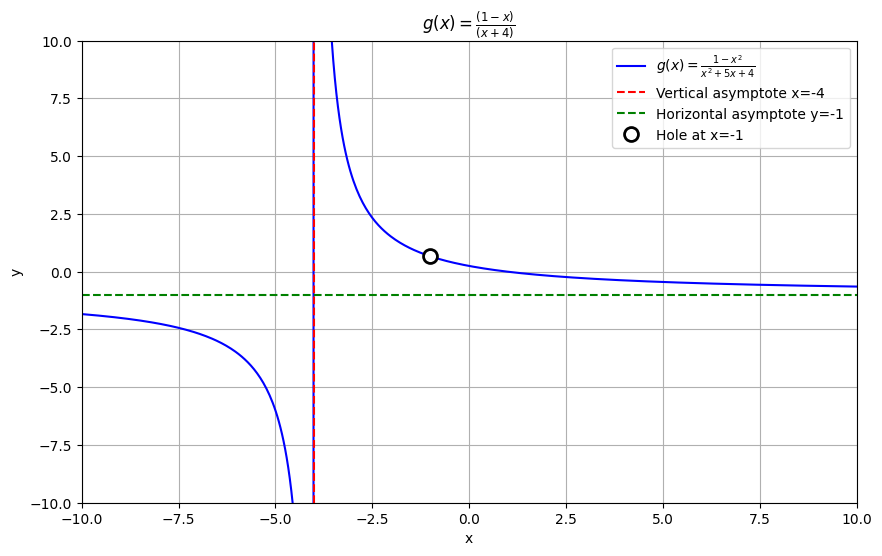
f(x) = -\frac{x^2+1}{x^2+5x+4}
\end{equation*}
Draw hole in a graph of
\begin{equation*}
f(x) = \frac{x^2-3x-4}{x+1}
\end{equation*}
Solution .
\begin{equation*}
f(x) = -\frac{x^2+1}{x^2+5x+4} = \frac{(1-x)(1+x)}{(x+4)(x+1)} = \frac{1-x}{x+4}
\end{equation*}
VA:
\(x=-4\text{,}\) HA:
\(-1, \,[\because \, \frac{-x}{x}]\text{,}\) point(x,y) =
\((0, 0.25)\text{,}\) hole:
\(x=-1 \) because in original function,
\(f(x) = \frac{(1-x)\cancel{(1+x)}}{(x+4)\cancel{(x+1)}} \)
Example 1.7.7 .
Find VA and draw graph.
\begin{equation*}
f(x) = \frac{1}{x^2-2x-8}
\end{equation*}
Solution .
\begin{equation*}
f(x) = \frac{1}{(x-4)(x+2)}; \, x\neq 4,-2
\end{equation*}
Hence, VA @ \(x = 4,-2.\)
Example 1.7.8 .
Find HA and draw graph.
\begin{equation*}
f(x) = \frac{x-3}{x^2-5x+4}
\end{equation*}
Solution .
\begin{equation*}
f(x) = x^2\frac{\frac{1}{x}-\frac{3}{x^2}}{(1-\frac{5}{x}+\frac{4}{x^2})}
\end{equation*}
Now as \(x\to \infty\) then
\begin{equation*}
f(x) \to \frac{0}{1}=0.
\end{equation*}
Hence, HA @ \(y=0.\)
In this function degree of denominator
\(\gt \) degree of numerator.
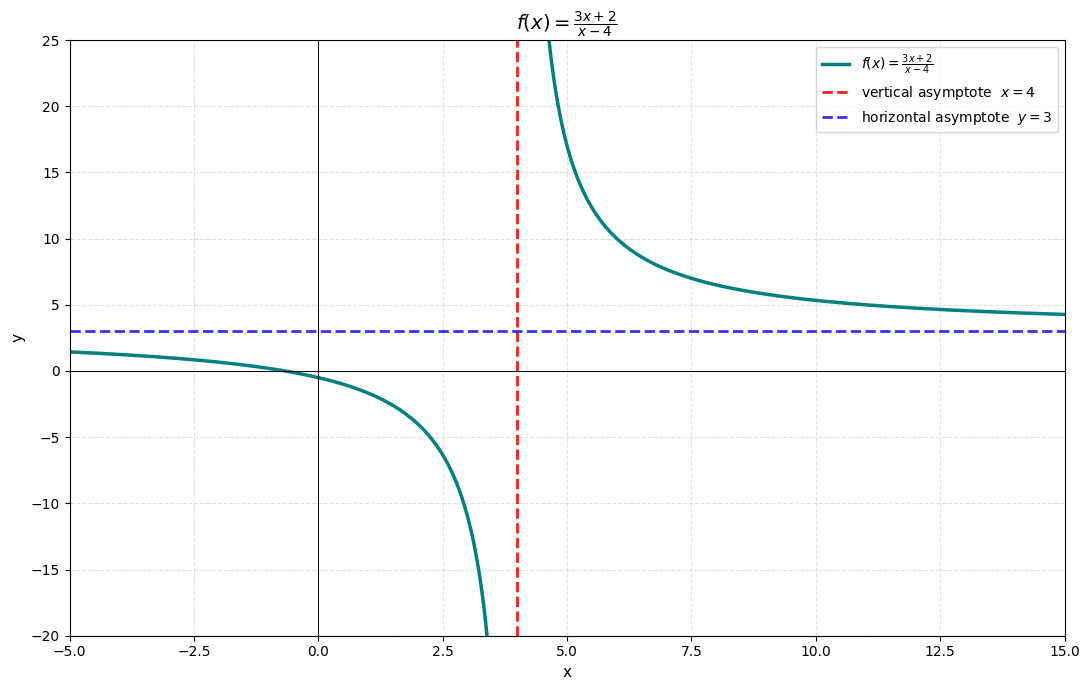
Example 1.7.9 .
Find HA and draw graph.
\begin{equation*}
f(x) = \frac{3x+2}{x-4}
\end{equation*}
Solution .
\begin{equation*}
\lim_{x\to \infty} f(x) = \lim_{x\to \infty} \frac{3+2/x}{1-4/x} = \frac{3}{1} =3
\end{equation*}
Hence, HA @ \(y=3.\)
In this function degree of numerator
\(=\) degree of denominator.