Skip to main content
Contents Index Dark Mode Prev Up Next \(\newcommand{\N}{\mathbb N} \newcommand{\Z}{\mathbb Z} \newcommand{\Q}{\mathbb Q} \newcommand{\R}{\mathbb R}
\newcommand{\lt}{<}
\newcommand{\gt}{>}
\newcommand{\amp}{&}
\definecolor{fillinmathshade}{gray}{0.9}
\newcommand{\fillinmath}[1]{\mathchoice{\colorbox{fillinmathshade}{$\displaystyle \phantom{\,#1\,}$}}{\colorbox{fillinmathshade}{$\textstyle \phantom{\,#1\,}$}}{\colorbox{fillinmathshade}{$\scriptstyle \phantom{\,#1\,}$}}{\colorbox{fillinmathshade}{$\scriptscriptstyle\phantom{\,#1\,}$}}}
\)
Section 1.8 Logarithm
A function that gives the exponent to which a fixed number (base) must be raised to produce a given number (argument) is called a logarithmic function.
\begin{equation*}
\log_{b}{(x)}
\end{equation*}
In the above expression \(x\) is argument and \(b\) is called the base of logarithm. The condition in logarithm
\begin{equation*}
\text{argument}\gt 0
\end{equation*}
and
\begin{equation*}
\text{base}\gt 0, \neq 1.
\end{equation*}
In real numbers, the base must be a positive number and not equal to 1. The argument of a logarithm must also be a positive number.
We know that
\begin{equation*}
2^5=32
\end{equation*}
Hence,
\begin{equation*}
\log_2{32} = 5
\end{equation*}
Or, in general: if
\begin{equation*}
a^x=y
\end{equation*}
then,
\begin{equation*}
\log_a{y} = x.
\end{equation*}
Examples:
\(\displaystyle \log_{3}{(9)} =\log_{3}{(3)^2}= 2\)
\(\displaystyle \log_{2}{(8)} =\log_{2}{(2)^3}= 3\)
\(\displaystyle \log_{2}{(\frac{1}{8})} =\log_{2}{(\frac{1}{2^3})} =\log_{2}{(2)^{-3}} = -3\)
Common Logarithm:
\begin{equation*}
\log_{10}{(x)} =\log{x}
\end{equation*}
Natural Logarithm:
\begin{equation*}
\log_{e}{(x)} =\ln{x}
\end{equation*}
Example 1.8.1 .
Evaluate:
\(\displaystyle \log {(100)} = \log_{10} {(100)} = \log_{10} {(10)^2} =2\)
\(\displaystyle \log {(10)} = \log_{10} {(10)} = \log_{10} {(10)^1} =1\)
\(\displaystyle \log {(1)} = \log_{10} {(1)} = \log_{10} {(10)^{0} } =0\)
\(\displaystyle \log {(0.1)} = \log_{10} {(0.1)} = \log_{10} {(10)^{-1} } =-1\)
\(\displaystyle \log {(2)} = \log_{10} {(2)} = \log_{10} {(10)^{0.30103} } \approx 0.30103\)
Logarithm to Exponent Conversion:
\begin{equation*}
y=\log_{b}{(x)} \rightarrow \, x= b^y
\end{equation*}
Example 1.8.2 .
\begin{equation*}
5=\log_{2}{(32)} \rightarrow \, 32 = 2^5
\end{equation*}
\begin{equation*}
2=\log_{7}{(x)} \rightarrow \, x = 7^2
\end{equation*}
Exponent to Logarithm Conversion:
\begin{equation*}
b^m=n \rightarrow \, m= \log_{b}{(n)}
\end{equation*}
Example 1.8.3 .
\begin{equation*}
4^3= 64 \rightarrow \, 3 = \log_{4}{(64)}
\end{equation*}
\begin{equation*}
2^5= 32 \rightarrow \, 5 = \log_{2}{(32)}
\end{equation*}
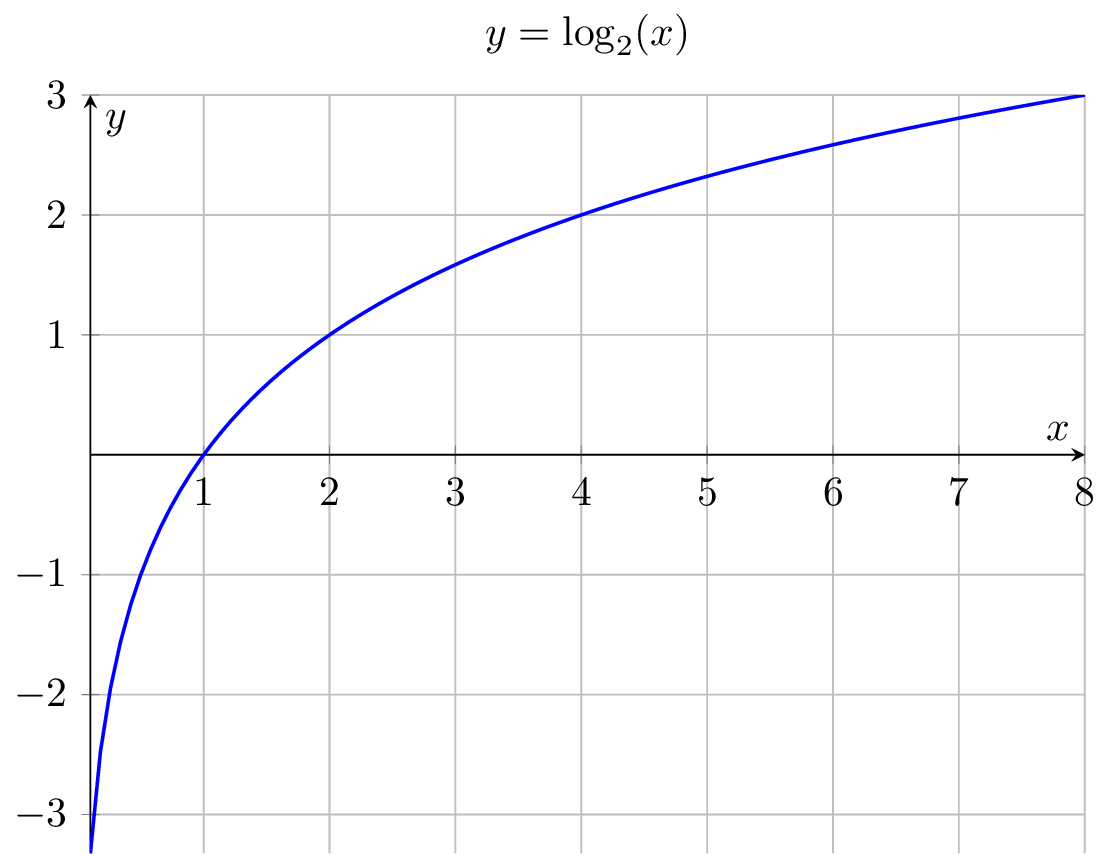
Subsection 1.8.1 Graph of Lagarithimic Function:
\(y=\log_{2}{(x)} \rightarrow \, x= 2^y\)
\begin{equation*}
\begin{array}{c|c}
x & y \\ \hline
0.25 & -2 \\
0.5 & -1 \\
1 & 0 \\
2 & 1 \\
8 & 3 \\
\end{array}
\end{equation*}
Figure 1.8.4. Domain:
\({x \in \mathbb R|x\gt 0}\)
Subsection 1.8.2 Logarithmic Rules
Power Rule:
\begin{equation*}
\log_{b}{(m)^n} = n\log_{b}{(m)} \, \text{ for } \, b \gt 0, b\neq 1, m \gt 0.
\end{equation*}
Example 1.8.5 .
\(\displaystyle \log_{3}{(9)^4} = 4\log_{3}{(9)} = 4\log_{3}{(3)^2} = 4\times 2 \log_{3}{(3)} = 8\)
\(\displaystyle \log_{2}{(\sqrt{8})} = \log_{2}{(8)^{1/2}} = \frac{1}{2}\log_{2}{(8)} = \frac{1}{2}\dot 3 = \frac{3}{2}\)
\(\displaystyle 2=\log{(3)^x} = x\log{3} \rightarrow \, x = \frac{2}{\log{3}} \approx 4.19\)
\begin{equation*}
100 =2^y \, \text{ or, } \, \log{100} = \log{(2^y)}
\end{equation*}
\begin{equation*}
2 = y\log{2}; \, \therefore \, y = \frac{2}{\log{2}} \approx 6.64
\end{equation*}
Product Rule:
\begin{equation*}
\log_{b}{(m)} + \log_{b}{(n)}= \log_{b}{(mn)} \, \text{ for } \, b \gt 0, b\neq 1, m \gt 0, n \gt 0.
\end{equation*}
Example 1.8.6 .
\(\displaystyle \log_{3}{(7)} + \log_{3}{(5)}= \log_{3}{(35)}\)
\(\displaystyle 2\log{(5)} + \frac{1}{2} \log{(16)}= \log{(25)}+\log{4} =\log_{10}{100} =2\)
Quotient Rule:
\begin{equation*}
\log_{b}{(m)} - \log_{b}{(n)}= \log_{b}{(\frac{m}{n})} \, \text{ for } \, b \gt 0, b\neq 1, m \gt 0, n \gt 0.
\end{equation*}
Example 1.8.7 .
\(\log_{4}{(30)} - \log_{4}{(60)}= \log_{4}{(\frac{30}{60})} =\log_{4}{5} \approx 1.16\)
Other Rules or Tricks:
\begin{equation*}
\log_{b}{(m)} = \frac{\log_{a}{m}}{\log_{a}{b}} \, \text{ for } \, b \gt 0, b\neq 1, \text{ argument } \gt 0.
\end{equation*}
\(\displaystyle b^{\log_{b}{(m)}} = m \)
If
\(\log_{b}{m} = \log_{b}{n} \, \) then,
\(\, m=n.\)
\(\displaystyle \log_{a}{(a)}=1\)
\(\displaystyle \log_{b}{(1)} =0\)
\(\displaystyle \log_a{x} = \frac{1}{\log_x{a}}\)
Example 1.8.8 .
\(\displaystyle \log_{4}{(20)} = \frac{\log{20}}{\log{4}} \)
\(\displaystyle 3^{\log_{3}{(9)}} = 9 \)
\(\displaystyle 5= 2^{\log_{2}{(5)}} \)
Subsection 1.8.3 Solving Exponential Equations.
\begin{equation*}
2^x =20
\end{equation*}
\begin{equation*}
x = \log_{2}{20} = \frac{\log{(20)}}{\log{(2)}} = 4.32.
\end{equation*}
\begin{equation*}
2^x = 8^{(2x-5)}
\end{equation*}
\begin{align*}
or, \, 2^x \amp = 2^{3(2x-5)} = 2^{(6x-15)} \\
or, \, x \amp = 6x-15\\
\therefore, \, x \amp =3.
\end{align*}
\begin{equation*}
2^x = 7^{(2x-5)}
\end{equation*}
\begin{align*}
or, \, \log{(2^x)} \amp = \log{(7^{2x-5})} \\
or, \, x \log{(2)} \amp = (2x-5) \log{(7)} = 2x \log{(7)} -5 \log{(7)}\\
5 \log{(7)} \amp = 2x \log{(7)} - x \log{(2)} = x\left[\log{(49)}-\log{(2)}\right] \\
\log{(7)^5} \amp = x\left[\log{(\frac{49}{2})}\right]\\
\therefore, \, x \amp = \frac{\log{(7)^5} }{\log{(24.5)} } = \log_{24.5}{16807} \approx 3.04.
\end{align*}
Subsection 1.8.4 Solving Logarithmic Equations.
\begin{equation*}
\log{(x+5)} = 2 \log{(x-1)}
\end{equation*}
\begin{align*}
\log{(x+5)} \amp = \log{(x-1)^2}\\
or, \, x+5 \amp = (x-1)^2 = x^2-2x+1\\
or, \, x^2-3x-4 \amp = 0 \\
\therefore \, x \amp = 4, -1
\end{align*}
but in logarithm argument is always positive, hence \(x= -1 \) need to be excluded for \(\log{(x-1)}\text{.}\)
\begin{equation*}
\log_{5}{(2x-3)} = 2
\end{equation*}
\begin{align*}
or, \, 5^2 \amp = 2x-3\\
or, \, 25 \amp = 2x-3\\
\therefore \, x \amp =14.
\end{align*}
\begin{equation*}
\log{(x+6)} = 1- \log{(x+3)}
\end{equation*}
\begin{align*}
or, \, \log{(x+6)}+\log{(x+3)}\amp = 1\\
or, \, \log{(x+6)(x+3)} \amp =\log{(x^2+9x+18)}=1 \\
or, 10^1 \amp = x^2+9x+18 \, \text{ on removing log }\\
\therefore \, x \amp = -8, -1
\end{align*}
Since, \(x=-8\) makes negative argument, hence this value must be excluded for the solution.
Prove that:
\begin{equation*}
\log_{ab}{x} = \frac{\log_{a}{x}\times \log_{b}{x}}{\log_{a}{x} + \log_{b}{x}}
\end{equation*}
\begin{equation*}
\frac{\log_{a}{(x)}\times \log_{b}{x}}{\log_{a}{x} + \log_{b}{x}} = \frac{\frac{1}{\log_{x}{a}}\times \frac{1}{\log_{x}{b}}}{\frac{1}{\log_{x}{a}}+ \frac{1}{\log_{x}{b}}}
\end{equation*}
\begin{equation*}
\qquad \, = \frac{1}{\log_{x}{a}+\log_{x}{b}} = \frac{1}{\log_x{ab}} = \log_{ab}{(x)}
\end{equation*}
Subsection 1.8.5 Applications of Logarithmic Expression
Logarithms can be used to analyze either very small or very large numbers. It has wide applications in science such as represent earthquake magnitude (Richter scale), sound intensity (decibels), and chemical acidity (pH scale).