Example 1.11.1.
Find inverse, domian and range of the given functions:
-
\begin{equation*} f(x) = 3x-5 \end{equation*}
-
\begin{equation*} f(x) = \frac{2x+5}{3x-1} \end{equation*}
-
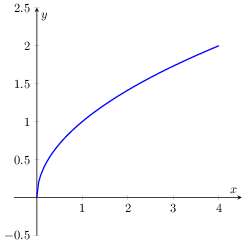
\begin{equation*} f(x) = \sqrt{2x-6} \end{equation*}
-
\begin{equation*} f(x) = \sqrt[3]{2x-5} \end{equation*}
-
\begin{equation*} f(x) = \sqrt[3]{x-4}+1 \end{equation*}
-
\begin{equation*} f(x) = e^{3x+1}-5 \end{equation*}
Solution.
-
Let\begin{equation*} y=f(x) = 3x-5 \end{equation*}Now, interchange \(y\) to \(x\)\begin{align*} x \amp =3y-5 \\ \therefore \, f^{-1}(x) \amp = y =\frac{x+5}{3} \end{align*}
-
Let\begin{equation*} y=\frac{2x+5}{3x-1} \end{equation*}interchange \(y\) to \(x\)\begin{align*} x \amp =\frac{2y+5}{3y-1} \\ or, \, 3xy-x \amp = 2y+5 \\ or, \, y(3x-2) \amp =5+x \\ \therefore \, f^{-1}(x) \amp = y =\frac{5+x}{3x-2} \end{align*}
-
Let\begin{equation*} y=\sqrt{2x-6} \end{equation*}interchange \(y\) to \(x\)\begin{align*} x \amp =\sqrt{2y-6} \\ or, \, x^2 \amp = 2y-6 \\ \therefore \, f^{-1}(x) \amp = y =\frac{x^2+6}{2} \end{align*}Domain:\begin{equation*} 2x-6 \geq 0 \, \Rightarrow \, x\geq 3 \end{equation*}so the domain is \([3,\infty)\)Range:\begin{equation*} y =\sqrt{2x-6} \end{equation*}Find \(x\) in terms of \(y.\)\begin{equation*} or, \, y^2 = 2x-6 \end{equation*}\begin{equation*} or, \, x = \frac{y^2+6}{2} \end{equation*}This is polynomial function. Now to obey the original square root function, \(y\) should not be negative rather \(y \geq 0. \) Hence range is \([0,\infty)\)
-
do yourself
-
\begin{equation*} f(x) = \sqrt[3]{x-4}+1 \end{equation*}\begin{equation*} x = \sqrt[3]{y-4}+1 \end{equation*}\begin{equation*} x -1 = \sqrt[3]{y-4} \end{equation*}\begin{equation*} (x -1)^3 = y-4 \end{equation*}\begin{equation*} \therefore \, y =(x -1)^3 +4 =f^{-1}(x). \end{equation*}Domain: \(x\in \mathbb R\)Range: \(y\in \mathbb R\)
-
\begin{equation*} y = e^{3x+1}-5 \end{equation*}\begin{equation*} x = e^{3y+1}-5 \end{equation*}\begin{equation*} x+5 = e^{3y+1} \end{equation*}\begin{equation*} \ln{x+5} = \ln_e^{3y+1} \end{equation*}\begin{equation*} 3y+1 = \ln{x+5} \end{equation*}\begin{equation*} y = \frac{\ln{x+5}-1}{3} =f^{-1} (x) \end{equation*}Domain: \((-\infty, \infty)\)Range: \((-\infty, \infty)\)