Exercises 1.12 Exercise
Sage Plot.
2.
Determine whether each of the following function is even, odd or neither even nor odd.
-
\(\displaystyle f(x) =x\)
-
\(\displaystyle f(x) = x^3+x\)
-
\(\displaystyle f(x) =\cos x\)
-
\(\displaystyle g(x) =1-x^2\)
-
\(\displaystyle f(x) =\sin x\)
-
\(\displaystyle h(x) = 2x+3\)
-
\(\displaystyle f(x) = e^x\)
-
\(\displaystyle f(x)=\ln |x| +1\)
3.
Find the domain of the following functions
-
\begin{equation*} f(x) =\frac{x-2}{3-x} \end{equation*}
-
\begin{equation*} f(x) = \sqrt{4-x^2} \end{equation*}
-
\begin{equation*} f(x) =\frac{1}{\sqrt{1-x}} \end{equation*}
-
\begin{equation*} f(x) =\sqrt{4-x}+\frac{1}{\sqrt{x^2-1}} \end{equation*}
-
\begin{equation*} f(x) = \sqrt[3]{t-1} \end{equation*}
-
\begin{equation*} g(x) = \sqrt{5-2x} \end{equation*}
-
\begin{equation*} f(x) = \frac{x^4}{x^2+4x-5} \end{equation*}
4.
Draw graph of the given function \(f(x)=\log_2{x-1}\) and find its domain and Range.
5.
6.
Find the domain and sketch the graph of the following functions:
-
\begin{equation*} f(x) = \sqrt{2x-3} \end{equation*}
-
\begin{equation*} f(x) = \frac{1}{x+1} \end{equation*}
-
\begin{equation*} f(x) = \sqrt{-\frac{1}{x}} \end{equation*}
-
\begin{equation*} f(x) = \frac{1}{(x^2-1)} \end{equation*}
-
\begin{equation*} f(x) = \sqrt[3]{x} \end{equation*}
-
\begin{equation*} f(x) = \sqrt[4]{x} \end{equation*}
-
\begin{equation*} y=\frac{x^2-1}{x^2+1} \end{equation*}
Hint.
7.
Find the domain and sketch the graph of the following functions:
-
\begin{equation*} f(x) = \sqrt{-x} \end{equation*}
-
\begin{equation*} h(x) = |2x-1| \end{equation*}
-
\begin{equation*} f(x) = \frac{x}{|x|} \end{equation*}
-
\begin{equation*} f(x) = \frac{x^2+x-6}{x+2} \end{equation*}
-
\begin{equation*} f(x) = \begin{cases} 1-x^2; & \text{ if } x\leq 2 \\ 3x-5 & \text{ if } x\gt 2 \end{cases} \end{equation*}
8.
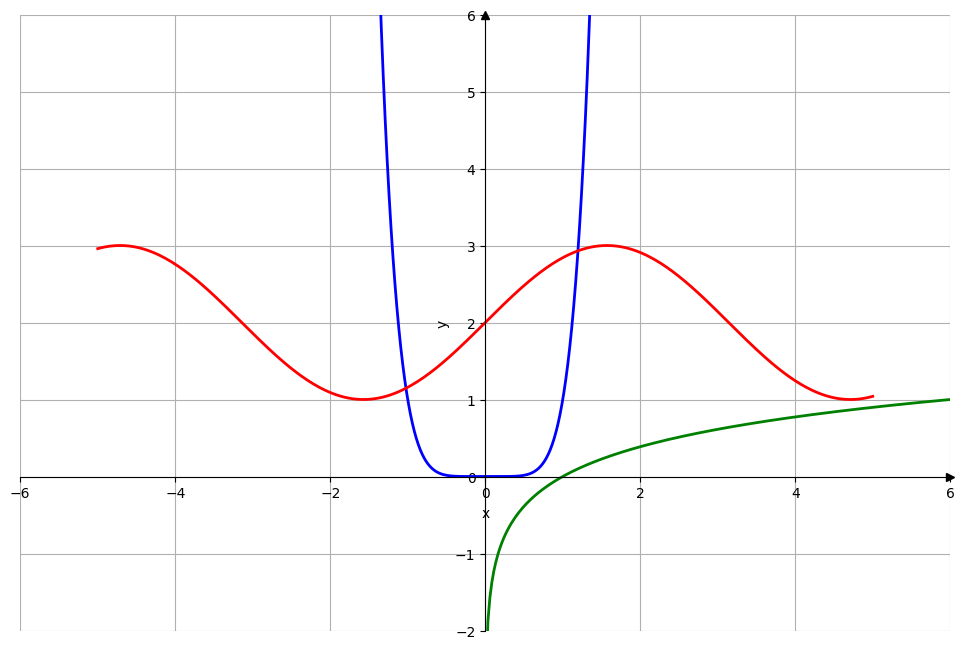
Match each equation with its graph:
-
\(\displaystyle y=x^6\)
-
\(\displaystyle y=\log_6 x\)
-
\(\displaystyle y=2+\sin x\)
9.
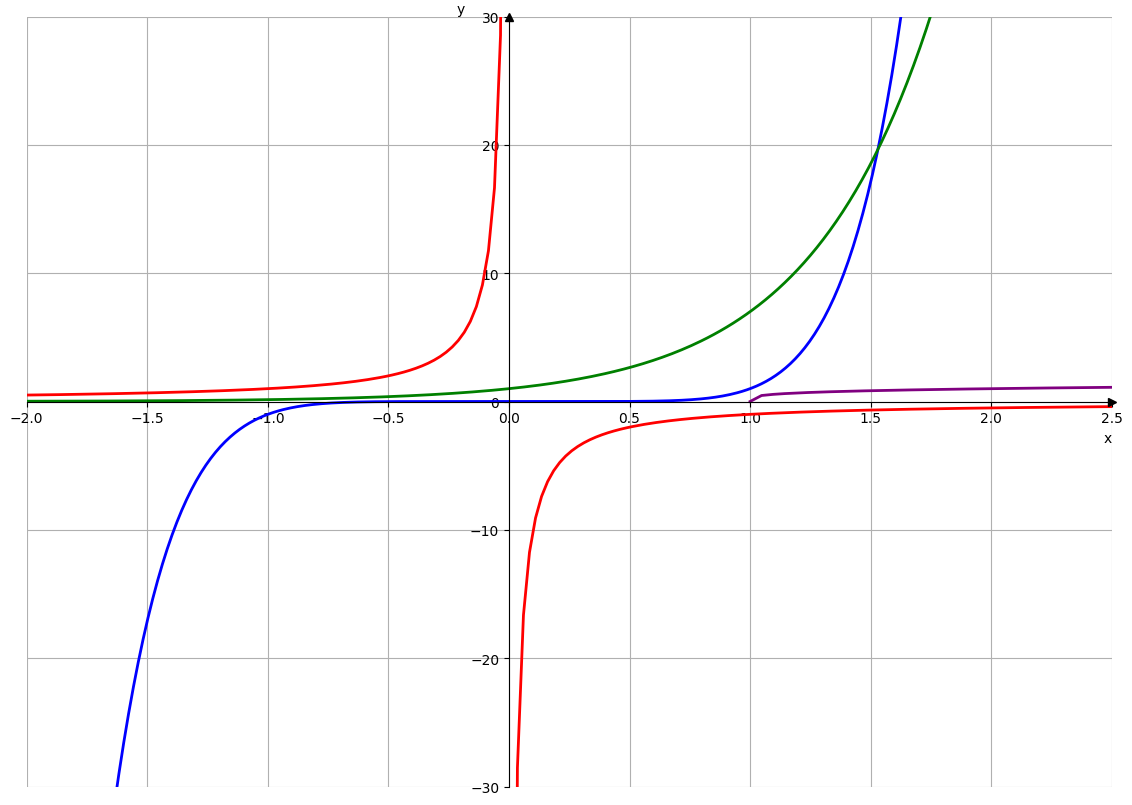
Match each equation with its graph:
-
\(\displaystyle y=x^7\)
-
\(\displaystyle y=7^x\)
-
\(\displaystyle y=-\frac{1}{x}\)
-
\(\displaystyle y=\sqrt[4]{x-1}\)
10.
Graph each function:
-
\(\displaystyle y=-\frac{1}{x}\)
-
\(\displaystyle y=\tan 2x\)
-
\(\displaystyle y=\cos \frac{x}{2}\)
-
\(\displaystyle y=\sqrt[3]{x+2}\)
-
\(\displaystyle y=2-\cos x\)
-
\(\displaystyle y=-2\sin \pi x\)
-
\(\displaystyle y=\frac{2}{x-3}\)
-
\(\displaystyle y=2+\frac{1}{x+1}\)
-
\(\displaystyle y=|\sin x|\)
-
\(\displaystyle y=(x-1)^3+1\)
-
\(\displaystyle y=2-\sqrt{x+2}\)
11.
-
Part A: Multiple Choice (2 points each)
-
What is the domain of \(f(x) = \sqrt{4 - x}\text{?}\)
-
\(\displaystyle x \geq -4\)
-
\(\displaystyle x \leq 4\)
-
\(\displaystyle x \geq 4\)
-
All real numbers
-
-
The range of \(g(x) = 3x^2 - 12\) is:
-
Find the domain of \(h(x) = \frac{5}{x+7}.\)
-
For \(f(x) = \sqrt[3]{x-5}\text{,}\) the domain and range are:
-
The function \(k(x) = \frac{1}{(x-2)(x+4)}\) has domain:
-
What is the range of \(y = -2(x+3)^2 + 5\text{?}\)
-
The domain of \(f(x) = \ln(7 - 4x)\) is:
-
For the piecewise function \(f(x) =\begin{cases} x+1 & x \lt -\frac{2}{4} & -2 \leq x \lt \frac{3}{x^2} - 5 & x \geq 3 \end{cases}\) the range is:
-
-
Part B: Free Response (show work, 5 points each)
-
Find the domain and range of \(f(x) = \sqrt{9 - x^2}\text{.}\) Write in interval notation.
-
Find the domain of \(g(x) = \frac{\sqrt{x+5}}{x^2 - 16}\text{.}\) Write in interval notation.
-
Find the domain and range of \(h(x) = 2^{x-3} + 1\)
-
For the function \(y = -3\sqrt{4-x} + 2\text{,}\) state the domain and range in interval notation.
-
12.
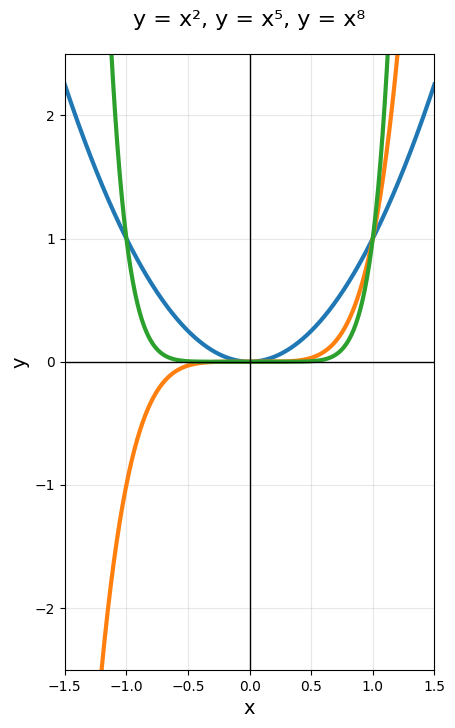
Match each equation with its graph.
-
\(\displaystyle y=x^2\)
-
\(\displaystyle y=x^5\)
-
\(\displaystyle y=x^8\)
13.
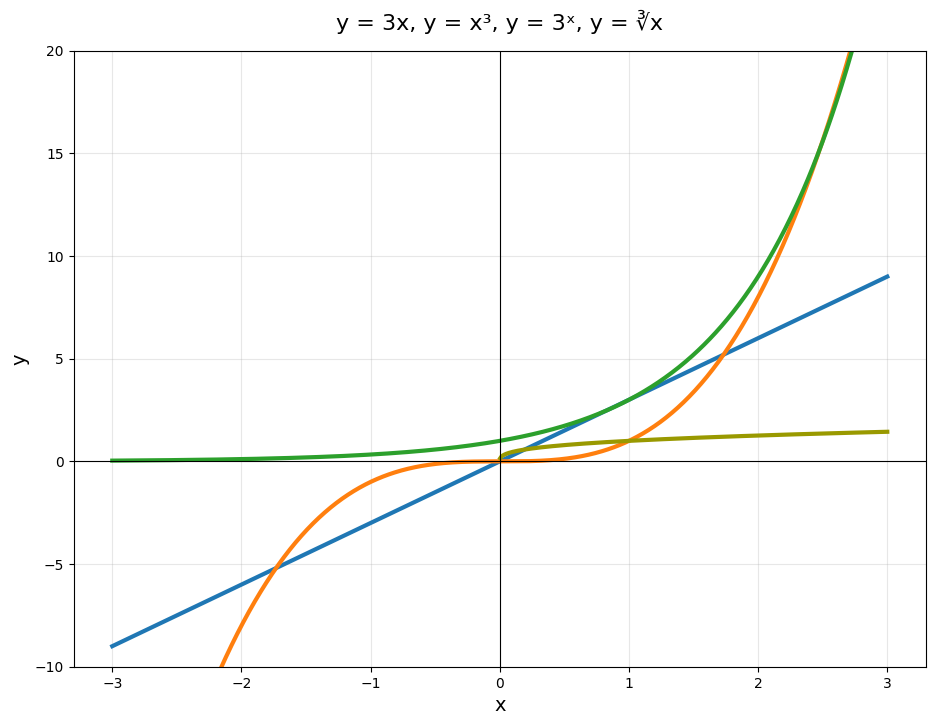
Match each equation with its graph.
-
\(\displaystyle y=3x\)
-
\(\displaystyle y=x^3\)
-
\(\displaystyle y=3^x\)
-
\(\displaystyle y=\sqrt[3]{x}\)
14.
Find the range of:
-
\begin{equation*} y = \frac{x^2+x+1}{x^2-x+1} \end{equation*}
-
\begin{equation*} y = \frac{x^2+x+2}{x^2+x+1} \end{equation*}
-
\begin{equation*} y = \frac{x^2-5x+6}{x^2-3x+2} \end{equation*}
15.
Discuss whether \(y^2=x^3\) is a function or not?
16.
Find the range of the following functions:
-
\begin{equation*} f(x) = \frac{1}{x^2-2x-8} \end{equation*}
-
\begin{equation*} f(x) = \frac{3}{x^3-16x} \end{equation*}
-
\begin{equation*} f(x) = \sqrt{2x^2-5x-7} \end{equation*}
-
\begin{equation*} f(x) = \sqrt{8+2x-3x^2} \end{equation*}
17.
Find the functions \(f\circ g, \, g\circ f, \, f\circ f, \, g\circ g\) and their domains.
\begin{equation*}
f(x) = x^2, \, g(x) = 1-\sqrt{x}
\end{equation*}
18.
Find the \(f\circ g\circ h\) and their domains.
\begin{equation*}
f(x) = x-2, \, g(x) = \sqrt{x}, \, h(x) = x-1
\end{equation*}
19.
20.
Draw graph and state the domain and range of
-
\begin{equation*} y=\sqrt{9-x^2} \end{equation*}
-
\begin{equation*} y=\sqrt{x-1} \end{equation*}
-
\begin{equation*} y=|2x| \end{equation*}
-
\begin{equation*} y=\frac{1}{x-4} \end{equation*}
-
\begin{equation*} y=|2x|-1 \end{equation*}
Answer.
-
\begin{equation*} x\in [-3,3]; \, y \in [0,3] \end{equation*}
-
\begin{equation*} x\in [1,\infty); \, y \in [0,\infty) \end{equation*}
-
\begin{equation*} x\in (-\infty,\infty); \, y \in [0,\infty) \end{equation*}
-
\begin{equation*} x\in \mathbb R \setminus \{4\}; \, y \in \mathbb R \setminus \{0\} \end{equation*}
-
\begin{equation*} x\in \mathbb R; \, y \in [-1, \infty) \end{equation*}
21.
Draw graph of \(y=\sin x, \, |\sin x|, \, \sin |x|, \, \text { and } \, |y| =\sin x. \)

