
Section 1.6 Range

The set of all possible output of \(f(x)\) as \(x\) runs over the domain is called a range of the function. The same \(x\) always leads to the same \(f(x).\) In other words, the set of all possible output values \(y\) for which the \(f(x)\) is defined.
Range of \(f={f(x):x \in \text{ domain of } \, f} \)
Steps to Find the Range:
  1. Identify the domain: Determine the set of all valid inputs.
  2. Analyze the function: Determine what output values are possible by applying the function to all inputs in the domain.
  3. Express the range: Describe the set of all possible outputs, often using interval notation or set notation.

Example 1.6.1.

Example 1: Linear Function
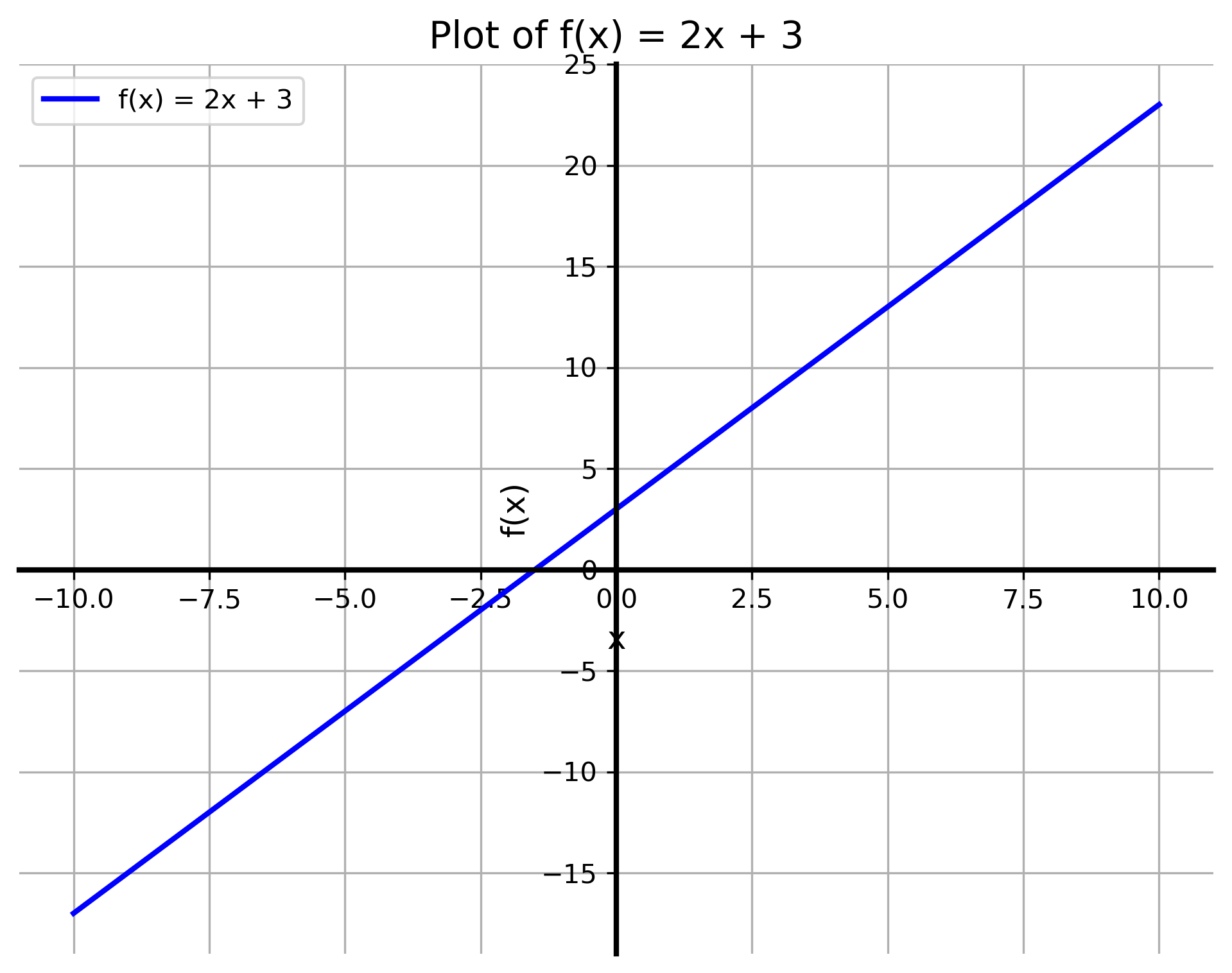
\begin{equation*} f(x) = 2x + 3 \end{equation*}
Solution.
Domain: All real numbers, \(x \in \mathbb{R}\) for any polynomials.
Finding the Range: let
\begin{equation*} f(x) = y= 2x+3 \end{equation*}
Now, obtain \(x\) interms of \(y\) as
\begin{equation*} y-3 =2x \, \Rightarrow \, x= \frac{y-3}{2} \end{equation*}
Since, this is also a polynomials, \(x \) ranges over all real numbers.
Range: All real numbers, \((-\infty, \infty).\)

Example 1.6.2.

Quadratic Function:
\begin{equation*} f(x) = x^2 \end{equation*}
Solution.
Domain: All real numbers, \(x \in \mathbb{R}\text{.}\)
Finding the Range:
\begin{equation*} y=x^2 \, \Rightarrow \, x = \sqrt{y} \end{equation*}
Since
\begin{equation*} y\geq 0 \end{equation*}
Range: All non-negative real numbers, \([0, \infty)\text{.}\)

Example 1.6.3.

Square Root Function:
\begin{equation*} f(x) = \sqrt{x} \end{equation*}
Solution.
Domain: \(x \geq 0\) (since the square root is undefined for negative numbers in the real numbers), \([0, \infty)\text{.}\)
Finding the Range:
\begin{equation*} y=\sqrt{x} \, \Rightarrow \, x = y^2 \end{equation*}
For \(x = 0\text{,}\) \(f(0) = \sqrt{0} = 0\text{.}\)
For \(x = 1\text{,}\) \(f(1) = \sqrt{1} = 1\text{.}\)
For \(x = 4\text{,}\) \(f(4) = \sqrt{4} = 2\text{.}\)
As \(x\) increases, \(\sqrt{x}\) produces larger non-negative numbers. The output is always non-negative since the square root of a non-negative number is non-negative.
Range: All non-negative real numbers, \([0, \infty)\text{.}\)

Example 1.6.4.

Constant Function:
\begin{equation*} f(x) = 5 \end{equation*}
Solution.
Domain: All real numbers, \(x \in \mathbb{R}\text{.}\)
Finding the Range: The function always outputs 5, regardless of the input ( \(x\) ).
Range: \(\{5\}\) (a single value, as the output is constant).

Example 1.6.5.

Rational Function:
\begin{equation*} f(x) = \frac{1}{x} \end{equation*}
Solution.
Domain: All real numbers except \(x = 0\text{,}\) i.e., \(x \in \mathbb{R} \setminus \{0\}\text{.}\)
Finding the Range: We need to determine what values \(y = \frac{1}{x}\) can take. Solve for ( \(x\) ) in terms of ( \(y \)): \(y = \frac{1}{x} \implies x = \frac{1}{y}\text{.}\) For ( \(x\) ) to be defined, \(y \neq 0\) (since \(x = \frac{1}{y}\) is undefined when \(y = 0\)). For any \(y \neq 0\text{,}\) there exists an \(x = \frac{1}{y}\) (which is not zero) such that \(f(x) = y\text{.}\) Thus, the range includes all real numbers except \(0\text{.}\)
Range: \(\mathbb{R} \setminus \{0\}\) or \((-\infty, 0) \cup (0, \infty)\text{.}\)

Example 1.6.6.

Sine Function:
\begin{equation*} f(x) = \sin(x) \end{equation*}
Solution.
Domain: All real numbers, \(x \in \mathbb{R}\text{.}\)
Finding the Range: The sine function oscillates between \(-1\) and \(1\) for all ( \(x\) ). For example, \(\sin(0) = 0\text{,}\) \(\sin(\frac{\pi}{2}) = 1\text{,}\) \(\sin(\frac{3\pi}{2}) = -1\text{.}\)
Range: \([-1, 1]\text{.}\)

Example 1.6.7.

Find the domain and range of the following functions.
  1. \begin{equation*} y=x^2+2 \end{equation*}
  2. \begin{equation*} y=\sqrt{x-3} \end{equation*}
  3. \begin{equation*} y=\frac{1}{x^2+1} \end{equation*}
  4. \begin{equation*} y=2^x-3 \end{equation*}
  5. \begin{equation*} y=\sin x+1 \end{equation*}
  6. \begin{equation*} y=|x-4|+1 \end{equation*}
  7. \begin{equation*} y=\ln (x+5) \end{equation*}
  8. \begin{equation*} y=\begin{cases} x+2, & \, x\lt 0 \\ 4, & \, 0\leq x\lt 3 \\ x^2, & \, x\gt 3 \end{cases} \end{equation*}
Answer.
  1. \begin{equation*} x\in (-\infty, \infty) \end{equation*}
    \begin{equation*} y\in [2, \infty) \end{equation*}
  2. \begin{equation*} x\in [3, \infty) \end{equation*}
    \begin{equation*} y\in [0, \infty) \end{equation*}
  3. \begin{equation*} x\in (-\infty, \infty) \end{equation*}
    \begin{equation*} y\in (0, 1] \end{equation*}
  4. \begin{equation*} x\in (-\infty, \infty) \end{equation*}
    \begin{equation*} y\in [-3,\infty) \end{equation*}
  5. \begin{equation*} x\in (-\infty, \infty) \end{equation*}
    \begin{equation*} y\in [0,2] \end{equation*}
  6. \begin{equation*} x\in (-\infty, \infty) \end{equation*}
    \begin{equation*} y\in [1,\infty) \end{equation*}
  7. \begin{equation*} x\in (-5, \infty) \end{equation*}
    \begin{equation*} y\in (-\infty,\infty) \end{equation*}
  8. \begin{equation*} x\in (-\infty, \infty) \end{equation*}
    \begin{equation*} y\in (-\infty,2)\cup {4} \cup (9,\infty) \end{equation*}

Example 1.6.8.

Range of
\begin{equation*} y=\frac{x-1}{x+1} \end{equation*}
Solution.
Convert this equation to get \(x\) in terms of \(y\)
\begin{equation*} xy+y = x-1 \end{equation*}
\begin{equation*} x = \frac{y+1}{1-y} \, \Rightarrow \, y \neq 1 \end{equation*}
Since \(x\in\mathbb{R}\text{.}\) Hence \(y\in \mathbb{R}\setminus \{1\}\)

Example 1.6.9.

Range of
\begin{equation*} y=\frac{1}{x-1} \end{equation*}
Solution.
Convert this equation to get \(x\) in terms of \(y\)
\begin{equation*} xy-y = 1 \end{equation*}
\begin{equation*} x = \frac{1+y}{y} \, \Rightarrow \, y \neq 0 \end{equation*}
Since \(x\in\mathbb{R}\text{.}\) Hence \(y\in \mathbb{R}\setminus \{0\}\)

Example 1.6.10.

Find the range of
  1. \begin{equation*} y = 2\sin x +1 \end{equation*}
  2. \begin{equation*} y = \frac{2}{3-2\sin x} \end{equation*}
  3. \begin{equation*} y = \frac{2}{3-2\{x\}} \, \text{ where } \, \{\cdot \} \, \text {is fractional part function } \end{equation*}
Solution.
  1. \begin{align*} -1 \amp \leq \sin x \leq 1 \\ -2 \amp \leq 2\sin x \leq 2 \\ -1 \amp \leq 2\sin x +1 \leq 3 \end{align*}
    Hence, the Range: \([-1,3]\)
  2. \begin{align*} -1 \amp \leq \sin x \leq 1 \\ 2 \amp \geq -2\sin x \geq -2 \\ 5 \amp \geq 3-2\sin x \geq 1 \\ \frac{1}{5} \amp \leq \frac{1}{3-2\sin x } \leq 1 \\ \frac{2}{5} \amp \leq \frac{2}{3-2\sin x } \leq 2 \end{align*}
    Hence, the Range: \([\frac{2}{5},2]\)
  3. \begin{align*} 0 \amp \leq \{x\} \lt 1 \\ 0 \amp \geq -2 \{x\} \gt -2 \\ 3 \amp \geq 3-2 \{x\} \gt 1 \\ \frac{1}{3} \amp \leq \frac{1}{3-2 \{x\}} \lt 1 \\ \frac{2}{3} \amp \leq \frac{2}{3-2 \{x\} } \lt 2 \end{align*}
    Hence, the Range: \([\frac{2}{3},2]\)

Example 1.6.11.

Find the range of following:
  1. \begin{equation*} y=\sqrt{x^2+4} \end{equation*}
  2. \begin{equation*} y=\sqrt{4-x^2} \end{equation*}
  3. \begin{equation*} y=\sqrt{x} \end{equation*}
Solution.
  1. \begin{equation*} y=\sqrt{x^2+4} \end{equation*}
    \begin{align*} x^2+4 \amp \geq 4 \, \text{ so domain: } \, (-\infty,\infty)\\ or, \, 2 \amp \leq \sqrt{x^2 +4} \lt \infty \end{align*}
    Hence the range: \([2, \infty)\)
  2. \begin{equation*} y=\sqrt{4-x^2} \end{equation*}
    \begin{align*} -2 \amp \leq \sqrt{4-x^2} \leq 2 \, \text{ so domain: } \, (-2, 2] \end{align*}
    Hence the range: \([0, 2]\)
  3. \begin{equation*} y=\sqrt{x} \end{equation*}

Example 1.6.12.

Find the range of following quadratic equations:
  1. \begin{equation*} y= x^2+x+1 \end{equation*}
  2. \begin{equation*} y= -x^2-2x+3 \end{equation*}
  3. \begin{equation*} y= x^2+2x+4; \, 1\leq x\leq 3 \end{equation*}
  4. \begin{equation*} y= x^2+2x+4; \, -3\leq x\leq -2 \end{equation*}
  5. \begin{equation*} y= 2x^2+x+1; \, -1\leq x\leq 1 \end{equation*}
Solution.
For a quadratic equation
\begin{equation*} y=ax^2+bx+c; \, \quad \text{Range:}\, \left[ \left. -\frac{D}{4a}, \infty\right)\right. \, \text{ for } \, a \gt 0. \end{equation*}
here \(D=b^2-4ac; \, \) is a discriminant.
  1. \begin{align*} y \amp = x^2+x+1 \\ D \amp = 1^2-4\times 1\times 1 = -3 \end{align*}
    Hence, the range: \(\left[ \left. \frac{3}{4}, \infty\right)\right.\)
  2. For a quadratic equation
    \begin{equation*} y=-ax^2-bx+c; \, \quad \text{Range:}\, \left. \left( -\infty, -\frac{D}{4a} \right. \right]\, \text{ for } \, a \lt 0. \end{equation*}
    here \(D=b^2-4ac; \, \) is a discriminant.
    \begin{align*} y \amp = -x^2-2x+3 \\ D \amp = 4+4\times 1\times 3 = 16 \end{align*}
    Hence, the range: \(\left. \left( -\infty, 4 \right. \right]\)
  3. Find the
    \begin{equation*} Vertex = \left(-\frac{b}{2a}, -\frac{D}{4a}\right) \end{equation*}
    Now find the value of function corresponding to the vertex and at \(x=0.\) These value give the range of these functions.

Example 1.6.13.

Find the range of \(2^x+2^{-x}\) and \(2^x+2^{-x}+3^x+3^{-x}\text{.}\)
Solution.
Arithmatic Mean (AM) \(\geq \) Geometric Mean (GM). Therefore
\begin{equation*} \frac{2^x+2^{-x}}{2}\geq (2^x\times 2^{-x})^{1/2} \end{equation*}
\begin{equation*} \Rightarrow \, (2^x+2^{-x}) \geq 2 \times (1)^{1/2} \end{equation*}
\begin{equation*} \therefore \, (2^x+2^{-x}) \geq 2 \end{equation*}
so the range is \([2,\infty)\)
find another by yourself.
 1 
sum of the number and its reciprocal is always \(\geq 2\text{.}\)

Example 1.6.14.

Find the range of
  1. \begin{equation*} y=2^{\sin x} \end{equation*}
  2. \begin{equation*} y=5^{(x^2+1)} \end{equation*}
  3. \begin{equation*} y=\left(\frac{1}{2}\right)^{(2\sin x+2)} \end{equation*}
  4. \begin{equation*} y=\log_{10}{(2\sin x+10)} \end{equation*}
  5. \begin{equation*} y=\log_{10}{(x^2+1)} \end{equation*}
  6. \begin{equation*} y=\log_{10}{(x^2-5x+6)} \end{equation*}
Solution.
  1. For
    \begin{equation*} y=2^{\sin x} \end{equation*}
    let, \(\sin x =t\) and we know that
    \begin{align*} -1 \amp \leq \sin x\leq 1 \\ -1 \amp \leq t \leq 1 \\ 2^{-1} \amp \leq 2^{t} \leq 2^{1} \\ \frac{1}{2} \amp \leq 2^{t} \leq 2 \end{align*}
    Range: \([\frac{1}{2},2]\)
  2. For
    \begin{equation*} y=5^{(x^2+1)} \end{equation*}
    let, \(x^2+1 =t\) and we know that
    \begin{align*} 1 \amp \leq t \lt \infty \\ 5^{1} \amp \leq 5^{t} \lt \infty \\ 5 \amp \leq 5^{t} \lt \infty \end{align*}
    Range: \([5,\infty)\)
  3. For
    \begin{equation*} y=\left(\frac{1}{2}\right)^{(2\sin x+2)} \end{equation*}
    let, \(2\sin x+2 =t\) and we know that
    \begin{align*} -1 \amp \leq \sin x\leq 1 \\ -2 \amp \leq 2\sin x \leq 2 \\ 0 \amp \leq 2\sin x+2 \leq 4 \\ 0 \amp \leq t \leq 4 \\ \left(\frac{1}{2}\right)^{0} \amp \geq \left(\frac{1}{2}\right)^{t} \geq \left(\frac{1}{2}\right)^{4} \\ 1 \amp \geq \left(\frac{1}{2}\right)^{t} \geq \frac{1}{16} \end{align*}
    Range: \([\frac{1}{16},1]\)
