Section 1.5 Domain

The set of all possible number (input values), typically \(x\) for which the function is defined and produces a real number output is called a domain. Determining the domain is a fundamental step in analyzing functions, as it identifies the values where the function is valid.
Steps to Determine the Domain: Identify the function type (polynomial, rational, radical, logarithmic, etc.). Find restrictions: Denominators cannot be zero. Expressions under even roots must be non-negative. Arguments of logarithms must be positive. Express the domain in interval notation or set notation.
  1. Polynomials: The domain is all real numbers \((\mathbb{R})\) because polynomials are defined for every \(x\text{.}\) Example: For
    \begin{equation*} f(x)=x^2+3x+5 \end{equation*}
    the domain is \((-\infty, \infty)\text{.}\)
  2. Rational Functions: Exclude values where the denominator is zero. Example: For
    \begin{equation*} f(x) = \frac{1}{x-2} \end{equation*}
    solve \(x-2\neq 0\text{,}\) so \(x \neq 2\text{.}\) The domain is \((-\infty, 2) \cup (2, \infty)\text{.}\)
  3. Square Roots (or Even Roots): The expression inside the root must be non-negative \((\geq 0)\text{.}\) Example: For
    \begin{equation*} f(x) = \sqrt{x+3} \end{equation*}
    solve \(x+3 \geq 0\text{,}\) so \(x \geq -3\text{.}\) The domain is \([-3, \infty)\text{.}\)
  4. Logarithms: The argument of a logarithm must be positive \((\gt 0)\text{.}\) Example: For
    \begin{equation*} f(x) = \ln(x-1) \end{equation*}
    solve \(x-1 \gt 0\text{,}\) so \(x \gt 1\text{.}\) The domain is \((1, \infty)\text{.}\)
  5. Trigonometric Functions: Most trigonometric functions (e.g., \(\sin(x), \cos(x)\)) have a domain of all real numbers, but others like \(\tan(x)\) or \(\csc(x)\) exclude points where the function is undefined. Example: For
    \begin{equation*} f(x) = \tan(x) \end{equation*}
    the function is undefined at \(x = \frac{\pi}{2} + k\pi\text{,}\) where \(k \) is an integer. The domain is \(\mathbb{R} \setminus \{ \frac{\pi}{2} + k\pi \mid k \in \mathbb{Z} \}\text{.}\)
  6. Piecewise Functions: Consider the domain of each piece and combine them, ensuring no overlap unless specified. Example: For
    \begin{equation*} f(x)= \begin{cases} x^2 & \text{if } x \geq 0 \\ \frac{1}{x} & \text{if } x \lt 0 \end{cases} \end{equation*}
    the domain of \(x^2\) is \(x \geq 0\text{,}\) and the domain of \(\frac{1}{x}\) is \(x \neq 0\text{.}\) Since \(x \lt 0\) for the second piece, the domain is \((-\infty, 0) \cup [0, \infty) = \mathbb{R}\text{.}\)
  7. Composite Functions: The domain of \(f(g(x))\) requires \(x\) to be in the domain of \(g\text{,}\) and \(g(x)\) to be in the domain of \(f\text{.}\) Example: For
    \begin{equation*} f(x) = \sqrt{x} \end{equation*}
    and
    \begin{equation*} g(x) = x-1\text{,} \end{equation*}
    find the domain of \(f(g(x)) = \sqrt{x-1}\text{.}\) Solve \(x-1 \geq 0\text{,}\) so \(x \geq 1\text{.}\) The domain is \([1, \infty)\text{.}\)

Subsection 1.5.1 Determining Domain:

Example 1.5.1.

  1. \begin{equation*} If \, \quad f(x)=\frac{6}{x} \end{equation*}
  2. \begin{equation*} If \,\quad f(x) = \sqrt{x} \end{equation*}
Solution.
  1. we can set \(x=2\) in \(f(x)=\frac{6}{2}=3 \text{.}\) Hence, \(x=2\) is a domain which defines \(f(x) =3 \) in a real number. Again, set \(x=0\) in \(f(x)=\frac{6}{0} = \) undefined or \(\infty\text{.}\) Hence, \(x=0\) is a not a domain of the given \(f(x)=\infty\) in a real number.
  2. we can set \(x=4\) in \(f(x)=\sqrt{4} = 2 \text{.}\) Hence, \(x=4\) is a domain which defines \(f(x)=2\) in a real number. Again, set \(x=-1\) in \(f(x)=\sqrt{-1} = \) imaginary. Hence, \(x=-1\) is a not a domain of the given \(f(x)\) in a real number.
Domain is any input values that defines a function in real number.


Example 1.5.2.

Type I: Only Polynomials.
\begin{equation*} f(x) = 4x+1 \end{equation*}
Solution.
Let \(x=2\text{,}\) then \(f(x) = 4\times 2+1 = 9\) (defined), hence \(x=2\) is a domain of a \(f(x).\)
let \(x=-1\text{,}\) then \(f(x) = 4\times -1+1 = -3\) (defined), hence \(x=-1\) is a domain of a \(f(x).\)
i.e., we can put any value of a domain from real numbers to define the given function \(f(x).\)
Domain: \((-\infty, +\infty)\) or all real numbers.

Example 1.5.3.

Type II: Only Fractions.
\begin{equation*} f(x) = \frac{3x+6}{x^2+3x+2} \end{equation*}
Solution.
Here, denominator \(\neq 0\text{,}\) otherwise the function gets undefined.
\begin{equation*} \therefore \, x^2+3x+2 \neq 0 \end{equation*}
\begin{equation*} or, \, (x+2)(x+1)\neq 0 \end{equation*}
\begin{equation*} or, \, x \neq -2, -1 \end{equation*}
Domain: \((-\infty, -2)\cup (-2, -1)\cup (-1, \infty)\) or all real numbers except \(x=-1,-2.\) Because these numbers make denominator \(=0.\)

Example 1.5.4.

Type III: Square Root on Bottom.
\begin{equation*} f(x) = \frac{x^2+6x+9}{\sqrt{x+3}} \end{equation*}
Solution.
Here, denominator \(\gt 0\text{,}\) otherwise the function gets undefined.
\begin{equation*} or, \text{ radicand } \, x+3 \gt 0 \end{equation*}
\begin{equation*} or, \, x \gt -3 \end{equation*}
\(x+3 =0 \) makes \(f\) undefined, and \(x+3 \lt 0\) makes \(f\) imaginary.
Domain: \((-3,\infty)\) or \(\forall_x \gt -3.\)

Example 1.5.5.

Type IV: Square Root on Top.
\begin{equation*} f(x) = \frac{\sqrt{x-1}}{x^2-4} \end{equation*}
Solution.
Here, denominator \(\neq 0\) and radicand \(\geq 0\)
\begin{equation*} or, \, x^2-4 \neq 0 \end{equation*}
\begin{equation*} or, \, (x+2)(x-2) \neq 0 \, \Rightarrow \, x \neq -2,+2 \end{equation*}
\begin{equation*} and \, \quad x-1 \geq 0 \, \Rightarrow \, x \geq 1 \end{equation*}
Domain: \([1,2) \cup (2, \infty) \) or all real numbers of \(x \geq 1\) excluding \(x= 2.\)

Example 1.5.6.

Type V: Only Square Root.
\begin{equation*} f(x) = \sqrt{x^2-x-12} \end{equation*}
Solution.
Here, radicand \(\geq 0\)
\begin{equation*} or, \, x^2-x-12 \geq 0 \end{equation*}
\begin{equation*} or, \, (x-4)(x+3) \geq 0 \end{equation*}
set \(x=5\text{,}\) \(x=2,\) and \(x=-4,\) in regions \(A, B,\) and \(C\) respectively, as shown in graph.
Check:
  • A region: at any value \(x \gt 4\) e.g., \(x=5\)
    \begin{equation*} (x-4)(x+3) = (5-4)(5+3) = 8 =+ve \end{equation*}
  • B region: at any value \(x \gt -3\) e.g., \(x=2\)
    \begin{equation*} (x-4)(x+3) = (2-4)(2+3) =-10 =-ve \end{equation*}
  • C region: at any value \(x \lt -3\) e.g., \(x=-4\)
    \begin{equation*} (x-4)(x+3) = (-4-4)(-4+3) =8 =+ve \end{equation*}
Since, \(-ve \) value of radicand is not allowed as we cannot have \(\sqrt{-ve}\) number. our domain looks like: Domain: \((-\infty,-3] \cup [4, \infty) \text{.}\)

Example 1.5.7.

Find the domain of the following functions:
  1. \begin{equation*} f(x) = 3x-2 \end{equation*}
  2. \begin{equation*} f(x) = x^2+5x-11 \end{equation*}
  3. \begin{equation*} f(x) = 2x^3-x^2+3x-5 \end{equation*}
  4. \begin{equation*} f(x) = 6x^7+5x^5-4x-10 \end{equation*}
Solution.
Since all these functions are polynomial functions their domain lie under real number. Hence Domain; \(\mathbb R, \, (-\infty, \infty)\text{.}\)

Rational Functions:.

Example 1.5.8.
\begin{equation*} f(x)= \frac{x+3}{x-7} \end{equation*}
Solution.
For rational funciton, \(\text{denominator }\, \neq 0\text{.}\) Hence, set
\begin{equation*} x-7 \neq 0 \rightarrow \, x \neq 7 \end{equation*}
\begin{equation*} \therefore \, \text{Domain }\, \mathbb R; (-\infty, 7) \cup (7, \infty) \end{equation*}
Remember \((\) and \()\) stands for number not included.
Example 1.5.9.
\begin{equation*} f(x)=\frac{2x+1}{x^2-16} \end{equation*}
Solution.
Here,
\begin{equation*} x^2-16\neq 0 \rightarrow \, (x-4)(x+4) \neq 0 \end{equation*}
\begin{equation*} \therefore \, x\neq -4, 4 \end{equation*}
Hence, Domain, \(\mathbb R; (-\infty, -4)\cup (-4,4) \cup (4,\infty).\)
Example 1.5.10.
\begin{equation*} f(x)=\frac{x^2}{x^2+9} \end{equation*}
Solution.
Here,
\begin{equation*} x^2+9 \geq 9 \rightarrow \, x^2 \geq 0 \end{equation*}
Since square of real number cannot be negative, as \(x^2\geq 0.\) Thus
Domain; \(\mathbb R, (-\infty, \infty).\)
Example 1.5.11.
\begin{equation*} f(x)=\frac{x^2-3x}{x^2-8x+15} \end{equation*}
Solution.
Set,
\begin{equation*} x^2-8x+15 \neq 0 \rightarrow \, (x-5)(x-3) \neq 0 \end{equation*}
\begin{equation*} \therefore \, x \neq 3, 5 \end{equation*}
Hence, Domain, \(\mathbb R; (-\infty, 3)\cup (3,5) \cup (5,\infty).\)

Radical Functions.

\begin{equation*} \sqrt[n]{expression} \end{equation*}
Here expression is any real number and \(n\) is odd. The domain of radical functions with an odd index is all real numbers.
For example:
\begin{equation*} \sqrt[3]{8} = \sqrt[3]{2^3} = 2 \, \text{ Real}. \end{equation*}
or,
\begin{equation*} \sqrt[3]{-8} = \sqrt[3]{(-2)^3} = -2 \, \text{ Real} \end{equation*}
If \(n\) is even, then \(expression \, \geq 0\text{.}\) The domain of radical functions with an even index and expression \(\geq 0\text{,}\) is all real numbers.
For example:
\begin{equation*} \sqrt[4]{16} = \sqrt[4]{2^4} = 2 \, \text{ Real} \end{equation*}
or,
\begin{equation*} \sqrt[3]{-16} = \sqrt[4]{(-2)^4} = 2i \, \text{ not Real} \end{equation*}
Example 1.5.12.
\begin{equation*} f(x)=\sqrt{x-9} \end{equation*}
Solution.
Here, \(n\) is even, hence, set,
\begin{equation*} x-9 \geq 0 \rightarrow \, x \geq 9 \end{equation*}
Hence, Domain, \(\mathbb R; [9, \infty).\)
Example 1.5.13.
\begin{equation*} f(x)=\sqrt[4]{6-2x} \end{equation*}
Solution.
Here, \(n\) is even, hence, set,
\begin{equation*} 6-2x \geq 0 \rightarrow \, 6 \geq 2x \end{equation*}
or,
\begin{equation*} x \leq 3 \end{equation*}
Hence, Domain, \(\mathbb R; (-\infty, 3].\)
Example 1.5.14.
\begin{equation*} f(x)=\sqrt{x^2+4x-21} \end{equation*}
Solution.
Here, \(n\) is even, hence, set,
\begin{align*} x^2+4x-21 \amp \geq 0 \\ x^2+7x-3x-21 \amp \geq 0 \\ (x-3)(x+7) \amp \geq 0 \end{align*}
Hence,
\begin{equation*} x-3 \geq 0 \rightarrow \, x \geq 3 \end{equation*}
and
\begin{equation*} x+7 \geq 0 \rightarrow \, x \geq -7 \end{equation*}
but, for \(x \geq -7\) gives function expression negative and for \(x \leq -7\) gives positive expression. Hence, we concluded \(x \leq -7\text{.}\) Hence, Domain, \(\mathbb R; (-\infty, -7] \cup [3, \infty).\) If \(x=0\text{,}\) \(f(x) \) becomes square root of negative expression and same will be seen if \(x \geq -7.\)
Example 1.5.15.
\begin{equation*} f(x)=\sqrt[3]{x-1} \end{equation*}
Solution.
Here, \(n\) is odd, hence, \(x\) is defined for every real number. The domain is a set of every real number. \(Domain: x\in \mathbb R\)

Domain of Fractional function with radicals..

Example 1.5.16.
\begin{equation*} f(x)=\frac{\sqrt{x+5}}{x^2-4} \end{equation*}
For radical in numerator, set \(\text{ radical } \geq 0\) and \(\text{ denominator } \neq 0.\)
Solution.
Set,
\begin{equation*} x+5 \geq 0 \, \rightarrow x \geq -5 \end{equation*}
and
\begin{equation*} x^2-4 \neq 0 \, \rightarrow x \neq -2, 2. \end{equation*}
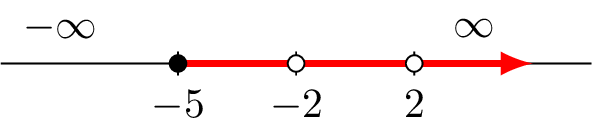
Hence, Domain, \(\mathbb R; x\geq -5, x \neq -2, 2.\) or, \([-5, -2) \cup (-2,2) \cup (2, \infty).\)
Example 1.5.17.
\begin{equation*} f(x)=\frac{3x-4}{\sqrt{x+9}} \end{equation*}
For radical in denominator, set \(\text{ radical } \gt 0\text{.}\)
Solution.
Set,
\begin{equation*} x+9 \gt 0 \, \rightarrow x \gt -9. \end{equation*}
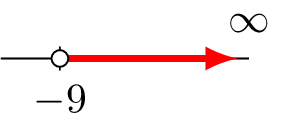
Hence, Domain, \(\mathbb R; x\gt -9.\) or, \((-9, \infty).\)
Example 1.5.18.
\begin{equation*} f(x)=\sqrt{\frac{x-3}{x+2}} \end{equation*}
If both terms are radical, then
Solution.
Set,
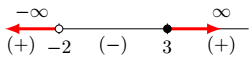
\begin{equation*} \frac{x-3}{x+2} \geq 0. \end{equation*}
Test the sign of the fraction in each interval. Domain: \(\mathbb R; x \lt -2, x \geq 3.\) or, \((-\infty, -2) \cup [3, \infty).\)