Exercises 3.8 Exercise

1.

Find the derivative of \(f(x)= \sqrt{x}\) using first principle.

6.

The side of an equilateral triange is increasing at the rate of \(2\, cm/s.\) At what rate is its area increasing when the side 0f triangle is \(20\, cm?\)

7.

A ripple in a pond is propagating at the speed of \(5 \, cm/s.\) At the instant when the ripple has radius of \(8\, cm\text{,}\) how fast is the enclosed area increasing?

8.

Find an equation of the tangent line to the curve at the given point
  1. \begin{equation*} y=\frac{2x}{x+1} \, \text{ at } (1,1). \end{equation*}
  2. \begin{equation*} y=x^4+2x^2-x \, \text{ at } (1,2). \end{equation*}

11.

Use L’Hospital’s Rule to evaluate:
  1. \begin{equation*} \lim_{x\to 0} \frac{\sin 3x}{5x^3-4x} \end{equation*}
  2. \begin{equation*} \lim_{\theta \to 0} \frac{\sin \theta}{\theta +\tan \theta} \end{equation*}
  3. \begin{equation*} \lim_{x \to 0} \frac{\sin x^2}{x} \end{equation*}

12.

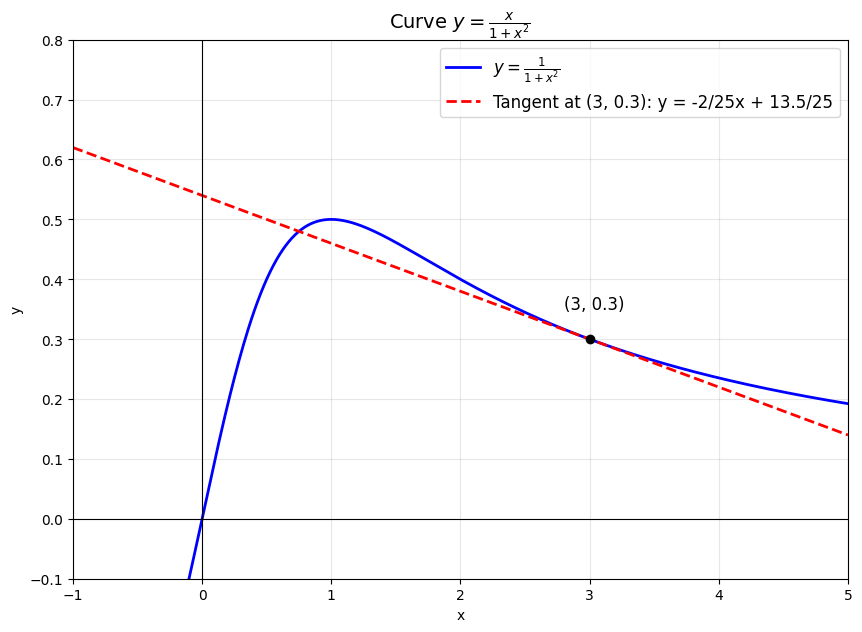
Find an equation of tangent line to the curve \(y=\frac{x}{(1+x^2)}\) at the point \((3,0.3).\)
Answer.
\begin{equation*} y=-\frac{2}{25}x+\frac{13.5}{25} \end{equation*}

13.

Find an equation of tangent line to the curve \(y=\frac{\sqrt{x}}{x+1}\) at the point \((4,0.4).\)
Answer.
\begin{equation*} y=-0.03x+0.52 \end{equation*}

14.

\(y=ax^3+bx^2+cx+5\) touches \(x-axis\) at \(P(-2,0)\) and cut \(y-axis \) where its gradient is 3. Find \(a, b, c.\)
hint take gradient as slope.
Answer.
a=-1/2, b=-3\4, c=3.

16.

If tangent at \(P(1,1)\) on \(y^2=2x-x^3,\) meets the curve again at \(Q\text{,}\) find \(Q.\)

17.

A spherical iron ball of 10 cm in radius is coated uniformly with a layer of ice that is melting at the rate of 50 cm/min. When the thickness of ice remains 5 cm, then find the rate at which the thickness of ice is decreasing.
Hint.
Differentiate the volume of ice w.r.to "\(t\text{.}\)" Consider \(x\) as a thickness of ice and \(r\) as radius of iron ball..

18.

The largest value of \(2x^3-3x^2-12x+5\) for \(-2\leq x\leq 4 \) occurs at what point.

19.

Find the altitude of cylinder of maximum volume which can be inscribed in a right circular cone of radius \(r\) and height \(h\text{.}\)
Hint.
\(y, x\) be the height and radius of cylinder, respectively and \(h,r\) be the height and radius of cone respectively. Now compare two similar tringles, we get-
\begin{equation*} \frac{h}{h-y}=\frac{r}{x} \end{equation*}
Now find points from
\begin{equation*} \frac{dV}{dx} =0 \end{equation*}
Here \(V\) is volume of cylinder.