Section 1.3 Inequality

Inequalities can be solved easily if wavy curve is drawn from the given equation. To draw wavy curve: Make sure that right hand side (RHS) is zero and coefficient of \(x\) in all the factors is positive. Then in
Step I: Put all factors equal to zero and mark corresponding values of \(x\) on the real line
Step II: Put \(+ve\) on extreme right and change the sign alternatively by moving toward left as shown in figure below.

Example 1.3.1.

Solve for the value of \(x\)
  1. \begin{equation*} (x-1)(x-4) \lt 0 \end{equation*}
  2. \begin{equation*} (x-1)(x-4) \gt 0 \end{equation*}
  3. \begin{equation*} (x-3)(x-5) \geq 0 \end{equation*}
  4. \begin{equation*} (3x-2)(x-4) \leq 0 \end{equation*}
Solution.
  1. \begin{equation*} (x-1)(x-4) \lt 0 \, \Rightarrow \, x \lt 4 \, \text{ and } \, x \gt 1 \end{equation*}

    \(\therefore \, x\in (1,4)\)
  2. \begin{equation*} (x-1)(x-4) \gt 0 \, \Rightarrow \, x \gt 4 \, \text{ and } \, x \lt 1 \end{equation*}

    \(\therefore \, x \in (-\infty,1)\cup (4,\infty)\)
  3. \begin{equation*} (x-3)(x-5) \geq 0 \, \Rightarrow \, x \leq 3 \, \text{ and } \, x \geq 5 \end{equation*}

    \(\therefore \, x \in (-\infty,3]\cup [5,\infty)\)
  4. \begin{equation*} (3x-2)(x-4) \leq 0 \, \Rightarrow \, x \leq 4 \, \text{ and } \, x \geq \frac{2}{3} \end{equation*}

    \(\therefore \, x \in [\frac{2}{3}, 4]\)

Example 1.3.2.

Solve for \(x:\)
  1. \begin{equation*} (x-3)(4x-1)(x+2) \leq 0 \end{equation*}
  2. \begin{equation*} (x-2)(3x-5)(x+3) \lt 0 \end{equation*}
  3. \begin{equation*} \frac{(x-1)(x-3)}{(x-4)} \gt 0 \end{equation*}
  4. \begin{equation*} \frac{x(x-3)}{(x-5)(x-6)} \geq 0 \end{equation*}
Solution.
  1. \begin{equation*} (x-3)(4x-1)(x+2) \leq 0 \end{equation*}
    Ans:
    \begin{equation*} x\in (-\infty,-2]\cup[\frac{1}{4},3] \end{equation*}
  2. do your self
  3. \begin{equation*} \frac{(x-1)(x-3)}{(x-4)} \gt 0 \end{equation*}
    Ans:
    \begin{equation*} x\in (1,3)\cup(4,\infty) \end{equation*}
  4. \begin{equation*} \frac{x(x-3)}{(x-5)(x-6)} \geq 0 \end{equation*}
    Ans: Mark 0 on number line for lonly \(x\)
    \begin{equation*} x\in (-\infty, 0]\cup[3,5)\cup (6,\infty) \end{equation*}

Example 1.3.3.

If
\begin{equation*} \frac{(2-x^2)(x-3)}{(x+1)(x^2-3x-4)} \geq 0 \end{equation*}
find \(x.\)
Solution.
\begin{equation*} \frac{(2-x^2)(x-3)}{(x+1)(x^2-3x-4)} \geq 0 \end{equation*}
\begin{equation*} or, \, \frac{(x^2-2)(x-3)}{(x+1)(x^2-3x-4)} \leq 0 \end{equation*}
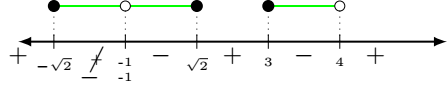
\begin{equation*} or, \, \frac{(x-\sqrt{2})(x+\sqrt{2})(x-3)}{(x+1)(x+1)(x-4)} \leq 0 \end{equation*}
ans: \(x\in[-\sqrt{2}, -1)\cup (-1, \sqrt{2}]\cup [3, 4) \)

Example 1.3.4.

  1. \begin{equation*} \frac{3x-1}{2x}\geq 1 \end{equation*}
  2. \begin{equation*} \frac{x^2-1}{x^2-7x+12} \geq 1 \end{equation*}
Solution.
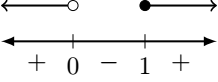
  1. \begin{align*} \frac{3x-1}{2x} \amp \geq 1\\ \frac{3x-1}{2x} -1 \amp \geq 0 \\ \frac{x-1}{2x} \amp \geq 0 \end{align*}
    Answer.
    \(x\in (-\infty, 0) \cup [1,\infty)\)
  2. \begin{align*} \frac{x^2-1}{x^2-7x+12} \amp \geq 1 \\ \frac{x^2-1}{x^2-7x+12} -1 \amp \geq 0\\ \frac{7x-13}{(x-3)(x-4)} \amp \geq 0 \end{align*}
    Ans: \(x\in [\frac{13}{7},3)\cup(4,\infty)\)

Example 1.3.5.

  1. \begin{equation*} \frac{x^2-16}{x^2+16}\lt 0 \end{equation*}
  2. \begin{equation*} (x^2+1)(x-2)(x-4) \gt 0 \end{equation*}
  3. \begin{equation*} (x-2)(x-3)\lt 0 \,\quad \& \, (x-5)(x-6) \gt 0 \end{equation*}
Solution.
  1. \begin{align*} \frac{(x-4)(x+4)}{x^2+16} \amp \lt 0; \, \quad \text{ here } \, x^2+16 \gt 0 \end{align*}
    so \(x\in (-4,4)\)
  2. \begin{align*} (x^2+1)(x-2)(x-4) \amp \gt 0\\ (x-2)(x-4) \amp \gt 0; \, \quad \because \, (x^2+1) \gt 0 \end{align*}
    so \(x\in (-\infty, 2) \cup (4, \infty)\)
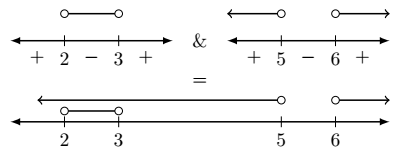
  3. \begin{equation*} (x-2)(x-3)\lt 0 \, \quad \& \, (x-5)(x-6) \gt 0 \end{equation*}
    Find the common between these two values of \(x\text{.}\) Here, \(x\in (2,3)\)

Example 1.3.6.

Solve for \(x: x^2 \lt 9\)
Solution.
Remember: we cannot write here \(x \lt \pm 3\text{,}\) because this does not make any sense due to inequality sign. So
\begin{equation*} x^2-9 \lt 0 \end{equation*}
\begin{equation*} or, \, (x-3)(x+3) \lt 0 \end{equation*}
Hence, \(x\in (-3,3)\)

Example 1.3.7.

Solve the following inequalities:
\begin{equation*} \frac{(x-4)^{24}(x-2)^{13}}{(x+3)^{27}(x+7)^{16}} \lt 0 \end{equation*}
Solution.
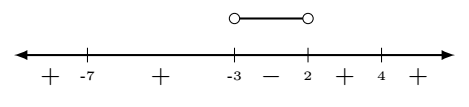
Follow the same rule as described in [Wavy Curve], starting with \(+\) sign at extreme right, but also look at the power of factors for the given points, if the power is even do not change the sign \(+\) or \(-\) if it is odd change sign of \(+\) to \(-\) and \(-\) to \(+\text{,}\) as shown in below.
The sign has not changed between points \(4\) and \(2\) starting from extereme right \(+\) sign as the power of \((x-4)^{24}\) is even. But the sign has changed between \(2\) and \(-3\) as the power of \((x-2)^{13}\) is odd. Similarly all the other sign has adjusted. Hence, \(x\in(-3,-2)\)

Example 1.3.8.

Solve the following:
\begin{equation*} \frac{(x+3)^{12}(x-2)^{5}}{(x-1)^{4}} \geq 0 \end{equation*}
Solution.
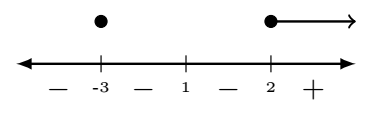
Hence, \(x\in[2,\infty) \cup \{-3\}\)

Checkpoint 1.3.9.

Solve for x.
\begin{equation*} \frac{(x-4)^{4}(x-5)^{5}}{(x-1)^{6}(x-7)^{7}} \leq 0 \end{equation*}
Answer.
Draw number line by yourself. \(x\in[5,7)\cup\{4\}\)

Checkpoint 1.3.10.

Solve the following:
\begin{equation*} \frac{(2-x)^{3}(x-7)^{6}}{(2x-3)^{2}} \geq 0 \end{equation*}
Answer.
Draw number line by yourself. \(x\in (-\infty, \frac{3}{2}) (\frac{3}{2},2] \cup\{7\}\)

Checkpoint 1.3.11.

Solve the following:
\begin{equation*} (1-x)^{4}(x-2)^{3} \gt 0 \end{equation*}
Answer.
Draw number line by yourself. \(x\in (2,\infty)\)

Checkpoint 1.3.12.

Solve the following:
\begin{equation*} \frac{(x-2)x}{(x-1)^2(x^2-5x+6)} \geq 0 \end{equation*}
Answer.
\begin{equation*} \frac{x}{(x-1)^2(x-3)} \geq 0 \, \quad \text{ here } \, x \neq 2 \, [\because \, (x-2)\, \text { in denominator }] \end{equation*}
Draw number line by yourself. \(x\in (-\infty,0] \cup (3, \infty)\)

Checkpoint 1.3.13.

Solve the following:
\begin{equation*} \frac{x}{(x-1)^2(x-3)} \leq 0 \end{equation*}
Answer.
\begin{equation*} \frac{x}{(x-1)^2(x-3)} \geq 0 \end{equation*}
Draw number line by yourself. \(x\in [0,3) \)

Checkpoint 1.3.14.

Solve the following:
\begin{equation*} \frac{(x-1)^{\frac{1}{2}}(x-2)^2}{(x-3)^5(x+1)^6} \gt 0 \end{equation*}
Answer.
here, \(x\neq 0\) otherwise \(\sqrt{(x-1)}\) becomes negative. Draw number line by yourself. \(x\in (3, \infty)\) Note: \(x\leq 1\) not in domain or \(\sqrt{x-1}\) gets undefined and does not satisfy the expression \(\gt 0\) condition.

Checkpoint 1.3.15.

Solve the following:
\begin{equation*} \frac{(x-1)^{\frac{1}{3}}(x-2)^2}{(x-3)^5(x+1)^6} \geq 0 \end{equation*}
Answer.
Draw number line by yourself. \(x\in (-\infty,-1) \cup (-1, 1] \cup (3,\infty)\cup {2} \)

Checkpoint 1.3.16.

Solve the following:
\begin{equation*} \frac{(x-1)^{\frac{2}{3}}(x-2)^2}{(x-3)^5(x+1)^6} \geq 0 \end{equation*}
Hint.
\begin{equation*} (x-1)^{\frac{2}{3}} = \left((x-1)^{\frac{1}{3}} \right)^2 \, \text{even number} \end{equation*}
answer: \(x\in (3,\infty) \cup {2} \cup {1}\)

Checkpoint 1.3.17.

Solve the following:
\begin{equation*} \frac{(x-1)^{\frac{3}{2}}(x-2)^2}{(x-3)^5(x+1)^6} \geq 0 \end{equation*}
Hint.
\begin{equation*} (x-1)^{\frac{3}{2}} = \left((x-1)^3 \right)^{\frac{1}{2}} \end{equation*}
here \((x-1)^3\) should not be negative. answer: \(x\in (3,\infty) \cup {2} \cup {1}\)

Checkpoint 1.3.18.